AI's Existential Threat vs. Its Ungraceful Reality
Why is this AI ML meme funny?
Level 1: Not So Scary
Imagine you’re worried that a super-smart robot is going to take over your job or do everything better than you. Sounds scary, right? But then you actually see this robot try to help out, and it ends up doing something really silly. For example, you ask a robot to answer a question, and it replies with a sentence that makes no sense, even saying a funny bad word by mistake. All of a sudden, you’re not scared – you’re laughing, because the big bad robot isn’t so perfect after all.
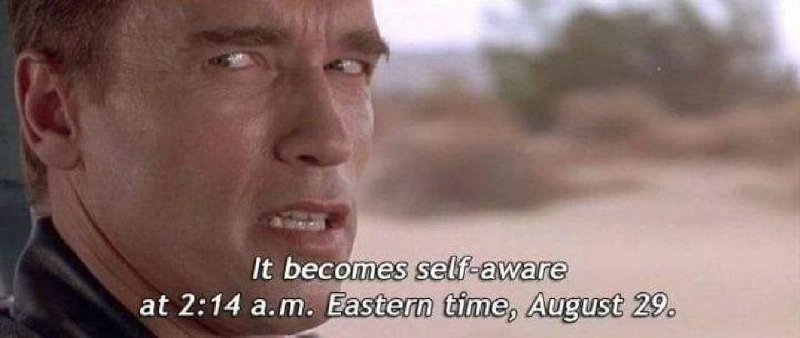
That’s what’s happening in this picture. People were afraid the AI (the smart computer program) would be so advanced that humans would become unnecessary. Meanwhile, the AI goes and says, “I’m a person… please talk to my bum if you have a question.” 😄 Obviously, no real person or helpful robot would say that! It’s a goofy error. The fear disappears because reality turned out to be kind of clumsy and funny. In simple terms: everyone thought the “genius” computer would replace us, but it ended up just being a goofy robot that still needs a lot more learning. So, instead of humans being replaced, we’re all just having a good chuckle at the robot’s expense. It’s not so scary anymore, is it?
Level 2: AI Mistakes 101
Let’s break this meme down in simple terms. The fear at the top – “Humans worried Artificial Intelligence would replace them” – is talking about the common worry that advanced AI (Artificial Intelligence) might become so smart that it takes over human jobs or tasks completely. We’ve all seen sci-fi movies or news articles suggesting robots or computer programs could outthink us. That’s the AI_hype part: a lot of buzz about AI being super powerful.
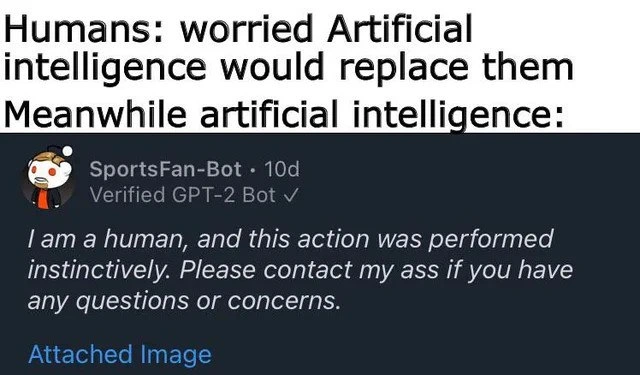
Now, the bottom part shows what actually happened with a real AI-based bot. It’s a screenshot from a site like Reddit (a forum where users post content). The user named SportsFan-Bot with a checkmark “Verified GPT-2 Bot” means this account is not a person but an automated bot running on GPT-2. GPT-2 is a text-generating AI model – basically a program that can write sentences by predicting word by word, based on patterns it learned from a ton of internet text. It’s an example of a Large Language Model (LLM). GPT-2 was pretty advanced a few years ago (developed by OpenAI in 2019), but it’s not the latest and greatest anymore (we have GPT-3 and ChatGPT now, which are smarter, but even they make mistakes).
The humor here comes from the bot’s actual message. It says: “I am a human, and this action was performed instinctively. Please contact my ass if you have any questions or concerns.” Let’s go through that step by step and explain why it’s wrong (and funny):
“I am a human,” says the bot. But it’s definitely not a human – it literally has a badge saying it’s a GPT-2 bot! On forums like Reddit, bots often clearly state “I am a bot” so people know the message came from an automated program. Here the AI did the opposite. For a newcomer, imagine a robot toy claiming “I’m actually a real boy!” – it’s obviously not true and comes off as silly. The bot is trying to sound genuine but ends up sounding like Pinocchio telling a fib. This is a clue that something’s off with its programming or its generated text.
“this action was performed instinctively.” Normally, a bot would say “performed automatically.” The word “instinctively” is usually used for animals or humans doing something by instinct (like blinking or ducking when a ball flies at you). A program doesn’t have instincts – it runs because it was coded to do so. By saying “instinctively,” the bot is using a completely wrong word. It’s as if it tried to pick a fancy term for “automatically” and totally missed the mark. For a reader, this word feels out of place. It’s a sign the language model is just guessing and not truly understanding the meaning of the words. Kind of like if a student tries to use a thesaurus for an essay and ends up with a word that doesn’t fit the context at all.
“Please contact my ass if you have any questions or concerns.” This is the part that really makes people chuckle. In a normal message, especially an official one, you’d expect something like “Please contact my team” or “contact me” or “contact the moderators” (on a forum, moderators are the people in charge). But the bot said “contact my ass.” The word “ass” here literally refers to a person’s backside (it’s a slang, slightly rude term for butt). Telling someone to “contact my ass” is nonsensical – you can’t actually contact someone’s butt! It sounds like a mashup of two different phrases: “contact me if you have questions” and “kiss my ass” (the latter is a rude idiom meaning “go away, I don’t care”). The AI probably learned the phrase “kiss my ass” or similar expressions from the internet and mistakenly thought “my ass” is something you can contact. This kind of slip-up is what we call an AI hallucination or just a plain old bot fail. The AI isn’t trying to be rude; it just doesn’t understand what “contact” implies in this context, so it grabbed a random semi-related word it’s seen elsewhere. The result is a sentence that technically follows English grammar but fails basic sense and politeness.
So, in summary, the bot’s message is wrong in three big ways: it lies about being human, it uses a weird word (“instinctively”) for no reason, and it gives a ridiculous contact instruction. Each of these errors comes from the AI model fumbling with language. Why does this happen? GPT-2 (and similar models) don’t have a real understanding of facts or context; they just try to predict plausible text. Usually they do a decent job, but as we see, they can also produce something that a real person would never intentionally say. It’s a bit like those auto-complete texts on your phone creating a goofy sentence that makes you go “No, phone, that’s not what I meant!”
For a junior developer or someone new to AI, this highlights a few key points about AI assistants and bots:
AI output can’t be blindly trusted: The AI might sound confident or formal, but it can still be completely wrong or inappropriate. This is a classic AIHypeVsReality situation. Just because an AI writes smoothly doesn’t mean it’s correct. It doesn’t “know” things; it just generates text based on patterns. This is why companies are careful about deploying AI chatbots – you have to test them so they don’t tell your customers to “contact my ass” (imagine the support emails!).
Hallucinations are common: In AI, a hallucination is when the model makes stuff up. Here the model hallucinated a bizarre phrase. In other scenarios, an AI might confidently present a fake fact (like citing a book that doesn’t exist). Developers need to be aware that even advanced models like ChatGPT can do this. We often add filters or rules to catch obvious mistakes, but some slip through, especially with older models like GPT-2 which don’t have modern safety training.
Context matters: If the programmers behind SportsFan-Bot had specifically trained or fine-tuned it to handle that disclaimer message, it probably wouldn’t have made these errors. The bot likely had free rein to generate a response, and it cobbled together language it thought was suitable. As a result, it sounds like a typical notice but every key detail is wrong. This reveals that without context or constraints, an AI might misunderstand what it’s supposed to do. When building your own bots or AI tools, providing clear instructions and examples (or using updated models that follow instructions better) is super important.
The meme is funny to developers because we deal with these AI quirks all the time. It’s a relief in a way: while people outside are freaking out that “AI is coming for our jobs,” we’re sitting here watching the AI call its own butt as the point of contact. It shows that reality is more nuanced. Yes, AI is powerful and improving rapidly, but it also misfires in almost childlike ways at times.
In plain terms, the top of the meme is the fear (AI replacing humans), and the bottom is the reality (AI making a silly mistake that no sensible human would make). It’s a classic example of AI humor where the AI’s mistake is obvious and goofy to us. The context tags like gpt2_bot_fail or contact_my_ass_quote highlight this exact failure and quote, which has probably been shared around as a funny anecdote among AI enthusiasts. For someone new to this field, it’s a quick lesson: don’t be too scared of AI taking over just yet, and also, when you use AI in any project, keep an eye on it – it might throw a curveball like this when you least expect it!
Level 3: Hype vs. Hallucinations
This meme captures a familiar scenario in the tech world: the gulf between AI hype and AI’s actual behavior in the wild. The top text – “Humans: worried Artificial Intelligence would replace them” – references the grandiose headlines and water-cooler fears that robots or AI (like advanced chatbots and assistants) are poised to steal jobs and outsmart humans in every way. As developers, we’ve been hearing variations of this for years: “The new AI will code for us, write for us, maybe even run the company for us!” It’s an IndustryTrends_Hype scenario dialed up to 11. But then comes the punchline: “Meanwhile artificial intelligence:” followed by a real example of a GPT-2 powered bot face-planting in a simple task. The contrast is comedy gold for anyone who’s tangled with AI systems. We have the public imagining Skynet or Jarvis from Iron Man, while in reality we often get something closer to a clueless parrot that occasionally spits out nonsense.
The Reddit-style screenshot shows a user named SportsFan-Bot with a special label “Verified GPT-2 Bot ✓”. Right away, any experienced developer or Redditor can tell this is an automated account run by an AI model (GPT-2 in this case). The platform verifies it to let readers know a bot is speaking, which is a transparency measure. Now, the hilarious part is what the bot actually said. Let’s break down the bot’s message compared to what a sensible or intended message would be:
| What a Normal Bot Might Say | What the GPT-2 Bot Said |
|---|---|
| “I am a bot, and this action was performed automatically.” | “I am a human, and this action was performed instinctively.” |
| “Please contact the moderators (or my creator) if you have any questions or concerns.” | “Please contact my ass if you have any questions or concerns.” |
Looking at this, you can practically see the AI malfunctioning step by step. The bot was probably trying to imitate a standard automated response. On Reddit, it’s common for bots to post a disclaimer like: “I am a bot, and this action was performed automatically. Please contact the mods if you have concerns.” It’s a canned, polite message. But our GPT-2 bot produced a warped version, like a game of telephone gone wrong:
It starts with “I am a human,” which completely subverts the expected “I am a bot” transparency. This is the first wink to the audience: obviously, a verified GPT-2 bot claiming to be human is incorrect (and ironically, a real human wouldn’t usually bother to state they are human!). The AI likely regurgitated “I am a human” from seeing many human-written posts or trying too hard to sound authentic, not realizing this destroys its credibility. This is an ai_impersonation_misfire at its finest — the AI attempts to pass as human, but in doing so, reveals how un-human it truly is.
Next, it says “this action was performed instinctively.” A human reading that goes, “Huh? Instinctively??” We humans perform sneezes instinctively, or pull our hand from a flame instinctively — we don’t remove a Reddit post or reply to a comment instinctively. A bot should say “automatically,” meaning without human intervention. The AI, however, swapped in a term that it probably thought means “without thinking” or “on its own,” which in a literal sense could describe a bot’s behavior, but it’s the wrong register and context. This single word choice shows the model’s lack of nuance; GPT-2 doesn’t grasp the difference between a human’s instinct and a program’s automation. To a developer, this is both funny and a bit cringey: it’s the kind of slight error that no real human would make in that serious context, so it’s a dead giveaway that an algorithm with a thesaurus-like brain produced it. We often shake our heads at these LLMHumor moments, where the AI is so close to the right phrasing, yet hilariously far.
And then we hit the grand finale: “Please contact my ass if you have any questions or concerns.” Here, GPT-2 mixed up a formal help request with a slangy, inappropriate term. A normal message would have said something like “contact my creator,” “contact the support team,” or in Reddit bot cases “contact the moderators.” Instead, the model blurted out “my ass.” For a senior engineer or anyone familiar with AI-generated content, this is a prime example of an ai_hallucination_example — the model has plainly wandered off-script. It’s as if the AI was auto-completing from two different sources: half from a polite customer-service style sentence, and half from an internet meme or insult it learned. The result is a mashup that absolutely no human intending to be helpful would say. It’s absurd, and that absurdity is exactly the laugh factor. We often joke that these models are just brilliant error-generators, and here it produced a perfectly grammatical sentence that just veers into comic nonsense at the end. In developer chat rooms, an outcome like this would be shared as a funny AIHumor anecdote (often with a mix of relief and schadenfreude — “Look, our robot overlord can’t even get its idioms right!”).
The overall meme underscores AIHypeVsReality: People fear a world where AI is ruthlessly competent, but the reality (at least in this case) is that AI can be ruthlessly incompetent in the most ridiculous ways. As a senior engineer, you know that deploying an AI assistant or chatbot to real users comes with a long list of caveats and safeguards. This GPT-2 bot’s public blooper is a reminder of why we implement things like content filters, review systems, and lots of testing when using language models. Left to its own devices, an LLM might say anything — from subtly off to wildly off. We’ve all seen customer-facing AI go awry (remember Microsoft’s Tay bot that learned to spout nonsense and slurs in 2016? a PR nightmare). Compared to that, “contact my ass” is tame, but it drives home the point: you can’t blindly trust an AI to always respond correctly or appropriately.
From a development perspective, this meme points out that public_fear_vs_reality gap. Non-engineers read headlines about GPT-3 or ChatGPT passing exams, writing essays, even coding, and they assume AI is practically magic. Meanwhile, those of us building or integrating these models are painfully aware of their glitchy moments. There’s a shared, quiet humor in the AI developer community: we trade these “the AI did something dumb today” stories almost like ghost stories around a campfire – but instead of being scary, they’re usually absurd and endearing. It’s a form of reality check. Sure, we’re excited (and cautious) about the progress in AI, but as this meme shows, sometimes the “intelligence” in Artificial Intelligence comes with a big asterisk.
Ultimately, the meme reassures us in a funny way: the robots aren’t taking over just yet. When a state-of-the-art (as of a couple years ago) language model proudly outputs a line like “contact my ass,” it reminds senior devs that human intuition and oversight are still very much needed. We chuckle, we roll our eyes, and we maybe feel a bit less stressed about AI replacing all our jobs overnight. If anything, AI tools in 2021 (and even now) often create unexpected DeveloperHumor moments that require a human to step in and correct or clarify. In short: Yes, we have powerful AIAssistants, and they’re improving fast, but examples like this keep us humble. It’s a meme-worthy snippet that says: don’t believe the hype until you’ve debugged the reality.
Level 4: Syntax Without Semantics
Under the hood of this meme is a story about how GPT-2, a large language model, generates text. GPT-2 is a type of neural network known as a Transformer, trained on millions of web pages to predict the next word in a sentence. It’s essentially an autoregressive text generator: given some prompt or context, it uses its 1.5 billion parameters to guess what words come next based on statistical patterns in its training data. This process produces amazingly fluent sentences — but only at the surface level. The model has learned the syntax of language (how to form grammatically correct sentences) without truly grasping the semantics (the actual meaning or appropriateness of those sentences). This meme’s punchline line, “Please contact my ass if you have any questions or concerns,” is a perfect example of that disconnect between form and meaning.
Why would an advanced AI come up with such a phrase? The answer lies in how GPT-2 recombines patterns it has seen. During training, it likely encountered phrases like “Please contact my ___ if you have any questions,” and also plenty of casual or crude language where “my ass” appears (perhaps in idioms like “move your ass” or blunt retorts like “kiss my ass”). However, GPT-2 doesn’t understand context or politeness; it doesn’t know that “my ass” is an impolite way to refer to oneself (and certainly not something to offer as contact info!). It just knows that “my ass” is a valid two-word combination that often follows a possessive pronoun in some contexts. Without an internal model of common sense or any morality filter, the model merrily fills in the blank with a statistically plausible choice: “ass” might have popped out because it had seen that word in contexts vaguely related to “contact my __ for concerns” in its vast (and occasionally inappropriate) training corpus.
This is a classic case of an AI hallucination in text generation. In AI terms, a hallucination means the model has produced output that is nonsensical or unmoored from reality, purely by following patterns that turn out to be misaligned with what we consider correct. GPT-2 wasn’t trying to be funny or rude; it has no concept of trying at all. It operates on probabilities, not intent. Each word is chosen because the math inside the network weights it as likely given the prior words. Here, the network may have latched onto “I am a human” from seeing many Reddit comments where people clarify they’re not bots (except it flips it ironically), and “performed instinctively” might have been its garbled stand-in for “performed automatically” (since instincts are an automatic impulse in animals, it’s a semantic mix-up that sounds roughly adverbial). The kicker is “contact my ass,” which likely results from the model’s context window picking up the phrase “contact my [X]” and mis-selecting a colloquial term it saw elsewhere for [X]. The Transformer has no mechanism to double-check “Does this sentence actually make sense or am I telling someone to literally call my backside?” It lacks a worldview or a fact-checker module; it’s all memorized patterns. In the technical sense, this glitch is an artifact of GPT-2’s training: it’s simply regurgitating and remixing fragments of things it read, without understanding why some combinations are absurd.
It’s worth noting that OpenAI’s GPT-2 was initially considered so good at generating human-like text that there were fears about misuse (they famously delayed releasing the full model in 2019 citing potential for abuse). Ironically, examples like this meme expose the real limitations: the model can mimic the style of human writing almost convincingly, but it doesn’t know what a human or an ass truly is in any meaningful way. Without true comprehension or an alignment layer, a language model may produce a polite-sounding sentence that suddenly veers off into the bizarre. The phrase “contact my ass” is grammatically valid and syntactically well-formed (noun phrase after a verb), but semantically it’s a nonsense instruction. Essentially, GPT-2 is a powerful stochastic parrot: it can repeat language patterns it has “overheard,” yet it doesn’t possess the functional understanding to avoid absurd outputs. Later models like GPT-3 and ChatGPT made strides with fine-tuning and reinforcement learning from human feedback (RLHF) to reduce such gaffes, adding layers of filtering and preference modeling to nudge the AI away from pure statistically likely output towards more appropriate output. However, even those advanced models can still hallucinate in other ways (like confidently stating wrong facts). The fundamental technical challenge remains: without true understanding or reasoning, an AI can wield language with impressive fluency while still producing hilariously wrong or context-breaking sentences. In other words, as long as an AI is just auto-completing text based on probabilities, we’re going to get moments where the Transformer confidently outputs something that makes human observers say, “Wait... did it really just say that?!”
Description
A two-part meme contrasting the fear of AI with its comical reality. The top caption reads, 'Humans: worried Artificial intelligence would replace them'. The second caption follows, 'Meanwhile artificial intelligence:'. Below this is a screenshot of a Reddit comment from a user named 'SportsFan-Bot', who is identified as a 'Verified GPT-2 Bot'. The bot's comment hilariously fails to imitate a human, stating, 'I am a human, and this action was performed instinctively. Please contact my ass if you have any questions or concerns.' The humor arises from the stark difference between the dystopian fear of superintelligent AI and the absurd, nonsensical output of a real-world language model (GPT-2, an older generation model). The bot's claim of being human is immediately undermined by its illogical and vulgar statement, providing comic relief about the current limitations of AI
Comments
10Comment deleted
GPT-2: 'Please contact my ass.' GPT-4: 'As a large language model, I lack a physical posterior. However, I can generate a comprehensive, multi-paragraph apology for any inconvenience this anatomical discrepancy may cause.'
The AI uprising’s been pushed to Q5 - our GPT-2 build still turns “contact us” into “contact my ass” any time the sampling temperature nudges past 0.7
This is exactly why we spent three sprints implementing bot detection, only to have the bots pass the Turing test by failing it spectacularly
When your GPT-2 bot's training data included too many Reddit moderator messages and not enough self-awareness checks, resulting in the AI equivalent of 'I'm not a robot' CAPTCHA failing spectacularly. It's the perfect encapsulation of why we still need humans in the loop - because even verified bots can't resist the urge to gaslight users about their own existence while mangling boilerplate text. At least it's honest about where to direct complaints
Leadership: “Will AI replace us?” Meanwhile GPT‑2 in prod: “I am human; this action was instinctive - please contact my posterior distribution.” Call me when it can pass both the Turing test and our output schema
Relax - this 'takeover' is a GPT-2 microservice running with temperature=1.0, guardrails=false, and is_human hard-coded to true; the only thing it replaced was the profanity filter
When your LLM's alignment dataset is just Reddit roasts: denies being AI while perfecting human assholery
Perfect Comment deleted
i also say "kick me when you need me" Comment deleted
well that aged rather quickly Comment deleted