Agile's Value-Driven Dream vs. The Monument-Building Reality
Why is this Agile meme funny?
Level 1: Built a Statue Instead
Imagine your teacher says, “This year, class is going to be all about learning useful things and working together – it will be great!” That’s the promise. But then, instead of doing homework or fun projects, the whole class spends weeks building a giant statue of the principal and bowing to it every morning. 🙄 Clearly, that’s not what was supposed to happen, right? The idea was to learn and get value (like knowledge), but in reality everyone ended up just worshipping the principal and no learning got done. It’s silly and way off-track. This meme is funny for the same reason: a team said they’d focus on what’s important (delivering a good product), but they actually ended up focusing on the wrong thing (pleasing the boss, represented by a huge boss statue). It’s a goofy way to show how plans can go wrong – we laugh because instead of doing the real work, they literally built a statue to their “leader”!
Level 2: Rituals Over Results
Let’s break down the scene and terms for a less jaded, more explanatory view. Agile is a way of working in software development that emphasizes being flexible and delivering value quickly. The core ideas come from the Agile Manifesto, which preaches things like “individuals and interactions over processes and tools” and “responding to change over following a plan.” In simple terms, Agile theory says: focus on what’s valuable to your customers, work in small increments, and be ready to adjust as you learn. This is what people mean by a "value-driven organization." It sounds great because it is – in theory. If you truly follow those principles, you avoid heavy paperwork and pointless steps, and instead constantly deliver stuff that matters.
Now enter Scrum, one of the most popular Agile frameworks (a specific way to put Agile ideas into practice). Scrum introduces roles like Product Owner, Scrum Master, and the development team, along with a bunch of rituals (called “ceremonies”). The Product Owner (often abbreviated as PO) is supposed to represent the voice of the customer or business. They manage the product backlog (a prioritized to-do list of features and fixes) and decide what the team should work on first to maximize value. The Scrum Master is like a coach who makes sure the team follows agile practices and helps remove obstacles. And you have the team who actually builds the product. In Agile theory, these roles collaborate closely: the Product Owner brings the vision and priorities, the team figures out how to implement it, and the Scrum Master facilitates communication. Everyone’s working in harmony to deliver useful software in short cycles (usually called sprints, often 1-2 weeks long).
Agile in practice, unfortunately, can play out very differently. Many new developers (and frankly, many experienced ones) discover that what’s sold as “Agile” at a company might just be a rebranding of old-school bureaucracy with new labels. For example, you might have daily stand-up meetings (a quick daily check-in that Scrum teams do). In theory, a stand-up is for the team to synchronize and quickly surface issues. In practice at some companies, it becomes a status report meeting where everyone is really just updating the Product Owner or manager in the room, trying to look busy. Similarly, sprint reviews (where the team demos what they built) can turn into theatrical presentations to impress higher-ups rather than honest discussions about the product. This is what we mean by rituals over results – following the ceremonies rigidly but losing sight of why we’re doing them.
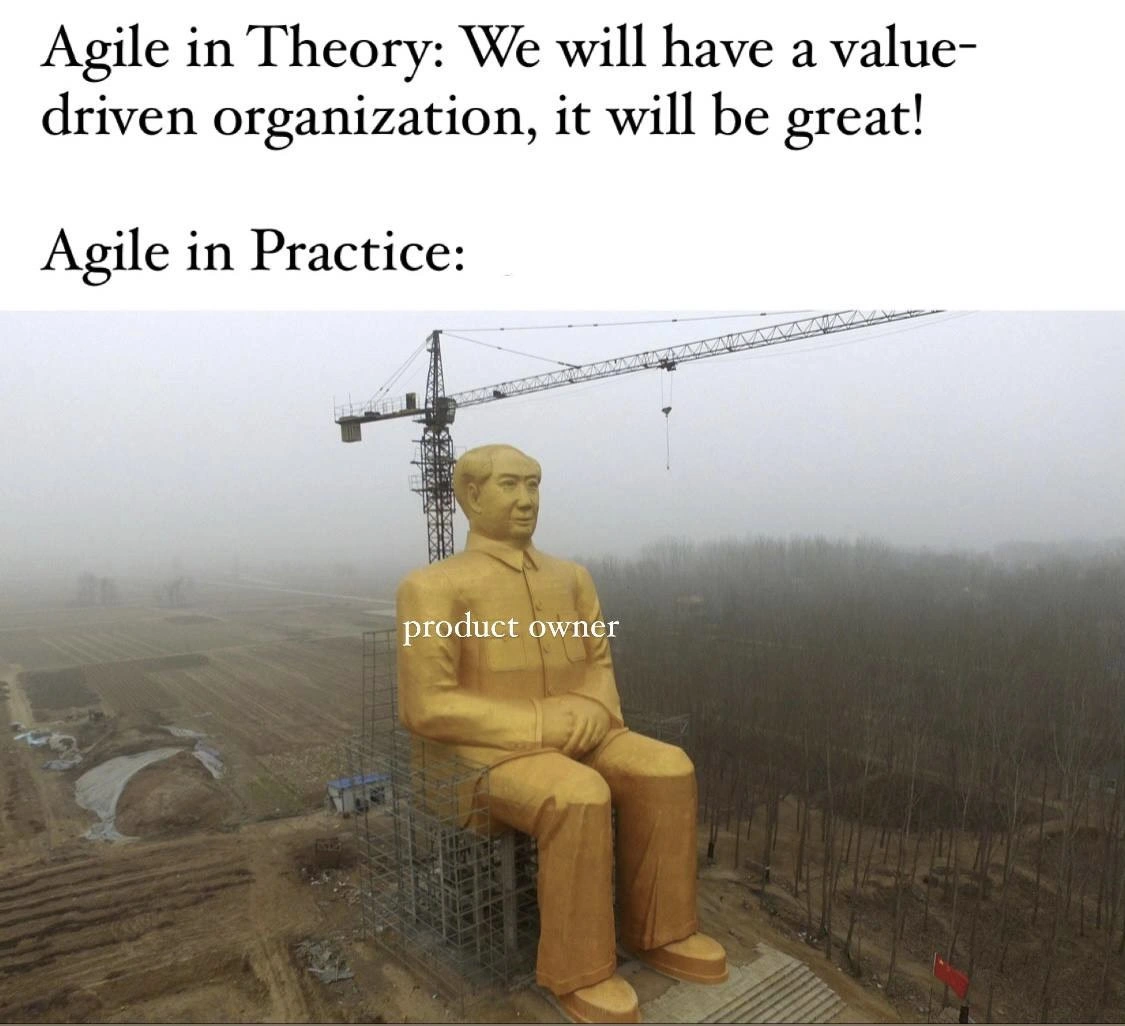
The meme’s bottom image – the giant golden statue being built – is a perfect metaphor for this problem. Let’s describe it plainly: there’s a construction site in a foggy rural area. A crane is lifting materials up to a massive statue of a seated man. The statue is so large that its lap is at the height of the trees. It’s colored golden, but it’s clearly not finished (you can see scaffolding around it, like metal frameworks supporting it as it’s being constructed). On the statue’s chest, in small white font, it says “product owner.” So literally, the workers at this site are building a huge idol of a Product Owner. That’s obviously not something that ever happens in real software projects, but it’s an exaggerated visual joke.
What does this represent? In a lot of companies, the Product Owner role can dominate the process. Instead of being an equal collaborator, a misused Product Owner can become a sort of tyrant of the backlog – whatever they say, goes. Teams might find themselves doing things just because the Product Owner “wants it that way,” even if it doesn’t deliver real value to users. The “golden statue” symbolizes putting the Product Owner on a pedestal (meaning treating them as more important than anything else). All that scaffolding and the crane? That’s like the team’s effort and company resources going into supporting this ego project. It’s scaffolding_bureaucracy – the structure and support built solely to uphold the Product Owner’s status and demands, rather than to support the actual product being built.
Let’s connect this to everyday Agile/Scrum elements a junior developer might encounter:
Product Owner (PO): Ideally, this person prioritizes features based on user needs and business goals. In a healthy agile team, the PO collaborates with the team and is open to feedback. In the meme’s scenario (the joke), the PO has effectively become an idol. That implies the PO’s word is treated as law. Have you ever been in a planning meeting where everyone keeps glancing at the PO for approval on every estimate or decision? That’s the kind of culture being mocked. Instead of focusing on the customer’s needs, the team is overly focused on the PO’s approval – like townsfolk building a statue to keep their ruler happy.
Agile Ceremonies: These include daily stand-ups, sprint planning, sprint review, retrospective, backlog refinement, etc. They exist to facilitate communication, feedback, and continuous improvement. However, when a company doesn’t truly get Agile, these ceremonies can become empty rituals. For a newcomer, it might be confusing – “We say we’re Agile, but why am I stuck in so many meetings and approval processes?” That’s exactly the confusion this meme highlights. Agile is supposed to cut out waste, but bad implementations add extra layers of process (meetings about meetings, status reports, detailed story “points” bargaining, ticket shuffling) without real benefit. It’s like if a team promised to play a quick improvisational jazz piece (free-flowing, adaptive), but instead they’re having long rehearsals to perform a rigid march. The spirit is lost.
Theory vs Practice: This phrase just means “what we intended or planned in an ideal world” versus “what actually happened in reality.” In theory, Agile’s expectation was a nimble, collaborative culture (“value-driven organization” as the top text says). In practice, the reality can degrade into office politics and corporate culture quirks – like power plays around roles. The meme explicitly labels one panel “Agile in Theory” and the other “Agile in Practice” to drive home that contrast. It’s a common theme: lots of memes and jokes in the tech world compare the shiny ideal of a methodology with the often disappointing reality experienced. If you hear developers joke about “Agile, not so agile,” or call something “Fragile” (fake-agile) or a “Scrumfall” (Scrum + Waterfall mix), they’re all pointing out this disconnect.
Product Owner Idolization: Idolization means treating someone like an idol or giving them excessive admiration. In a team context, this could mean nobody questions the Product Owner’s decisions, or everyone constantly tries to please them, even at the cost of the process’s true goals. A junior dev might not immediately spot this if they assume “Well, the Product Owner is in charge, so we do whatever they say.” But over time, one realizes Agile was meant to encourage collaboration and questioning. If the team can’t push back on unrealistic demands or suggest better ideas because the Product Owner’s wish is sacred, that’s a problem. The meme is a tongue-in-cheek way of saying “Our Agile process has basically turned into a cult of the Product Owner.”
This image is funny (and painful) to developers because it visualizes a feeling many have had: Agile was supposed to make us better and faster, but somehow we ended up with more layers of approval and hero-worship. If you’re a junior dev, don’t get discouraged – real Agile, when done right, is very empowering and efficient. What’s being lampooned here is Agile gone wrong. It’s a cautionary tale: adopting Agile means embracing its principles, not just its terminology. Otherwise, you end up with a giant process idol (or a giant “Product Owner” idol in this case) and no real progress.
To put it simply, this meme highlights an AgilePainPoint that even newcomers can soon observe: sometimes companies get so caught up in the form of Agile (roles, titles, ceremonies, fancy terminology) that they forget the function (actually delivering something valuable). The result is as useless (and ridiculous) as constructing a huge golden statue in the middle of nowhere – it’s grandiose and impressive-looking, but doesn’t actually fulfill the original goal.
Level 3: Cult of the Product Owner
Agile was supposed to be our salvation – a way to create a value-driven organization focused on delivering real customer value frequently and adapting to change. In theory, every sprint would deliver working software, teams would self-organize, and managers would step back. The meme’s top panel parrots this rosy ideal:
Agile in Theory: “We will have a value-driven organization, it will be great!”
Fast forward to Agile in Practice, and the bottom panel hits us with a foggy construction site featuring an absurdly large golden statue of a seated man under a crane. The statue is labeled "product owner" in small white letters across its chest. It’s an idol towering over an empty field – a visual punchline that seasoned developers can’t help but smirk at. Why? Because it captures the cynical truth: many so-called agile transformations end up worshipping titles and processes rather than achieving actual agility. Instead of delivering value to users, the organization pours time and resources into ceremoniously elevating the Product Owner – almost like they’re building a literal shrine to the role.
This is darkly humorous to anyone who’s lived through a real-world Agile/Scrum adoption. In the Scrum framework (a popular agile methodology), the Product Owner is meant to be the person who prioritizes work (maintains the backlog) and ensures the team is building the most valuable features first. They’re a custodian of value, not a king. But in practice, many companies twist this role into a bureaucratic mini-dictator. The meme exaggerates that to hilarious effect: the company isn’t building a great product, they’re building a giant statue of the Product Owner. It’s a savage metaphor for product_owner_idolization, the phenomenon where everything the team does revolves around pleasing that one role.
Why is this funny to senior developers? It’s basically an inside joke about the gap between agile_expectations_vs_reality. We’ve all sat through those lofty all-hands meetings where management declares, “We’re going Agile! We’ll be customer-centric and value-driven!” – only to find months later that nothing really changed except the jargon. Daily stand-ups, sprint rituals, JIRA tickets everywhere, but no actual decrease in pointless paperwork. In fact, sometimes there’s more bureaucracy (the scaffolding around that statue) than before. The meme nails this irony by showing physical scaffolding propping up the massive idol. That scaffolding is a perfect symbol of all the new process and ceremony supporting an inflated role: layers of project managers, endless backlog grooming sessions, status meetings – all ostensibly to honor whatever the Product Owner wants this week. It’s scaffolding_bureaucracy: process built around maintaining hierarchy and optics rather than shipping code.
There’s a bit of ScrumHumor and bitter truth in that giant golden statue image choice, too. Historically, enormous statues (especially golden ones) call to mind the folly of false idols – think of the biblical golden calf or extravagant monuments to egos. Here the “false idol” is Agile’s own Product Owner. It’s a sharp jab at corporate culture: instead of actually being agile (responsive, value-focused, collaborative), the company is engaging in a sort of cargo cult ritual. They’re doing all the motions – the stand-ups, the sprint planning – not to empower the team, but to appease the Product Owner and higher-ups. This is classic theory_vs_practice_gap. The theory was streamlined team communication, the practice becomes ”Did we update the Product Owner’s dashboard? Quick, build more slide decks!”
Experienced engineers have seen this pattern too many times. A company declares they’re doing “Agile” and brings in a Scrum Master and a Product Owner for every team. But instead of fewer useless meetings, there are more. Decisions bottleneck on the Product Owner’s availability or whims. The development team loses autonomy because “the Product Owner is the final authority” – a mantra which, taken too far, turns into a cult of personality. I’ve been in sprint reviews where everyone basically genuflects to whatever the Product Owner says, even if it contradicts reality (”Sure, we can rewrite the login system in one day, no problem!”). When Agile becomes a checkbox for management, you get scenarios where delivering real software takes a backseat to ceremony and powerpoints. The meme illustrates that by literally putting the Product Owner on a pedestal – a several-stories-high pedestal of solid gold, no less.
The humor also lies in the sheer absurdity. Of course no company literally builds a statue of their Product Owner (at least, not yet… though I wouldn’t put it past some 😂). But to developers stuck in dysfunctional “Agile” environments, it feels like that. It feels like endless effort is spent to glorify managers or process lords rather than writing code. The crane in the image might as well be the team at 2 AM, hoisting yet another last-minute feature request that the Product Owner demanded – lifting that golden idol a little higher – while real product improvements languish. It’s a DeveloperHumor coping mechanism: we laugh so we don’t cry about how something meant to make things better (Agile) sometimes makes them differently bad.
In summary, at this senior-insider level, the meme is a pointed critique of AgilePainPoints. It says: Agile’s noble ideals often get lost in translation, and when they do, we end up replacing genuine value with flashy vanity projects for management. The “giant product owner statue” is a perfect satirical image of that outcome. Every seasoned dev has a war story of an “Agile transformation” that turned into a bureaucratic nightmare or a cult of the product_owner. We chuckle (perhaps a bit bitterly) because we recognize our own experiences in that foggy monument to misapplied Agile. The meme is basically whispering what every burnt-out Scrum team already knows: “They promised us agility, but all we got was this colossal monument to the Product Owner’s authority.”
Description
A two-part meme that contrasts the ideal of Agile development with its common reality. The top section, labeled 'Agile in Theory:', contains the optimistic text: 'We will have a value-driven organization, it will be great!'. Below this, the section 'Agile in Practice:' displays a photograph of a massive, golden statue of a seated man, resembling former Chinese leader Mao Zedong, being erected in a bleak, foggy, and undeveloped landscape. A large construction crane is visible in the background. The text 'product owner' is superimposed over the chest of the giant statue. The meme satirizes the frequent disconnect in Agile implementations where the Product Owner, instead of being a collaborative team member, becomes an all-powerful, dictatorial figure whose vision is implemented without question - akin to building a monumental statue in their own honor, regardless of the actual value or surrounding environment
Comments
9Comment deleted
The user stories for this sprint are just 'Make it bigger,' 'Make it gold,' and 'Ensure it casts a shadow over all other teams' priorities.'
Sprint 42 demo: zero features shipped, but the 300-ton “just a 2-pointer” Product Owner monument is at 90% - apparently velocity scales better than value
After 20 years in the industry, I've learned that 'Agile transformation' is just Latin for 'we're keeping the same command structure but now with daily standups where the product owner tells you what statue to build today.'
Value-driven organization achieved: every sprint now delivers exactly one value - whatever the product owner woke up wanting
Ah yes, the classic Agile transformation: we replaced the waterfall with a monument to the product owner, because nothing says 'self-organizing teams' quite like a 50-foot golden statue that requires a construction crane and scaffolding to maintain. At least in waterfall, the project manager didn't need their own zip code
Scrum at scale, apparently: a global mutex on the product owner - per Little’s Law our lead time is now proportional to their calendar, not customer value
Agile theory: team empowerment. Practice: erecting a Product Owner colossus whose 'prioritization' requires seismic retrospectives
Enterprise Agile: microservices for code, monolith for decisions - the gold‑plated service called “Product Owner.”
No is != true Comment deleted