The 'Bleeding Edge' AGILE Methodology Unveiled
Why is this Agile meme funny?
Level 1: Opposite Day at Work
Imagine a kid bragging, "I have the best system to keep my room clean, I call it CLEAN!" But then they explain the steps and it's all wrong: C stands for Cram all the junk under the bed, L for Leave the trash on the floor, E for Expect mom to do the vacuuming, A for Avoid washing any clothes, and N for Never admit it's messy (just blame the cat). Obviously, that's a terrible way to "clean" – they're doing the opposite and pretending it's great. This meme is the same kind of joke in a work setting. The team says they're following a fancy Agile method, but each letter of "AGILE" is actually them doing something silly or bad (not cleaning up code, giving everyone unsafe access, lying about problems, etc.). It's funny because they're proudly saying "Look, we're so modern and doing best practices!" while actually listing a bunch of big no-nos. It’s like an Opposite Day at the office: they call their bad habits "best-practices" and expect applause. You don’t need to know any tech details to get the joke – it’s the classic humor of someone doing everything wrong but acting like that's the plan, which we all recognize as completely backwards.
Level 2: Agile vs Reality
In this meme, AGILE is ironically spelled out with each letter representing a problematic practice rather than anything you'd find in a real agile guide. Let’s break down what each letter stands for and why it's a red flag:
A = about 400 stale branches: This refers to Git branches in a code repository. A "branch" is like a copy of the code where developers add features or fixes without disturbing the main codebase. Once changes are finished and merged back in, branches are usually deleted. A "stale" branch is one that hasn’t been touched in a long time – it’s likely outdated and may never be merged. Saying there are ~400 stale branches (the meme even uses a curse word for emphasis) means the team has hundreds of old, forgotten lines of development lying around. This is a bad sign for repository hygiene: it suggests no one tidies up or cares about integrating work regularly. For a newcomer, seeing an ocean of stale branches is confusing ("Which ones are active? Can I delete any of these?"). Proper agile teams keep their repositories clean – branches are merged or closed when done. Four hundred leftover branches is like a messy attic of code, which can make collaboration and maintenance harder.
G = grant admin privileges to all users: "Admin privileges" means full, unrestricted access rights. Imagine a user account that can do absolutely anything – change settings, delete data, access any feature. Normally, only a few trusted accounts (administrators) get such powers for security reasons. Granting admin rights to all users is extremely risky. It's like giving the keys of a school to every student; you’re asking for trouble. One mistake or misuse and the whole system can be damaged or compromised. The meme adds "(move fast and break things)" which is a famous mantra implying speed is more important than caution. Here, it’s used to justify recklessness: by letting everyone be an admin, the team might fix things faster (no waiting for permissions) but they will also break things faster. In reality, good security practice is to follow the principle of least privilege: give each person only the access they truly need. If everyone is an admin, one user's accident or one hacked account can bring everything down. So this letter G highlights a huge security flaw dressed up as a "fast-moving" policy.
I = ignore spellcheck and formatting errors: This is about ignoring code quality and attention to detail. Modern development tools often highlight spelling mistakes (say, in documentation or user-visible text) and enforce coding style (how code is formatted with indents, brackets, etc.). A developer saying they ignore those warnings is basically refusing to do basic clean-up on their work. The joke "(QA's job is to read, not mine)" shows an attitude that Quality Assurance – the testers who check the software – should deal with sloppy writing or ugly code, rather than the developer fixing it. In a healthy workflow, developers and QA both care about quality: developers should at least run spellcheck or use a linter (an automated tool that formats code and catches style mistakes). Ignoring obvious issues like spelling errors (imagine labeling a button "Submit" but accidentally spelling it "Submt" and not fixing it) leads to unprofessional results and sometimes real bugs. Poor formatting can make code harder to read and maintain, increasing the chance of errors. For someone new to coding, it’s like writing an essay and leaving tons of typos and bad grammar because "the proofreader will handle it." It’s not responsible. In real agile teams, everyone is responsible for quality – you don't toss work over the wall expecting QA to clean it up. So "I" here signals laziness and a lack of pride in one’s work.
L = lie on status pages to meet SLAs: A status page is a website or dashboard that shows if a service (like a website or online app) is running normally or has issues. Many companies have public status pages to keep users informed about outages or maintenance. An SLA (Service Level Agreement) is basically a promise to customers about uptime or performance. For example, an SLA might guarantee 99.9% uptime, meaning the service can only be down for a very short time per month. If the company fails to meet that, they might have to compensate customers or face losing trust. "Lie on status pages to meet SLAs" means instead of actually achieving high uptime, this team just falsifies the reporting. If their system had an outage, they might not record it on the status page, or they’ll label a serious unplanned outage as “scheduled maintenance” to avoid blemishing their uptime record. The meme suggests their excuses: "(blame customer's network issues and DNS)". DNS stands for Domain Name System, which is like the internet’s address book that maps website names to IP addresses. It’s a running joke that when something goes wrong connecting to a service, tech support might sigh and say "Maybe it’s a DNS issue" – sometimes as an easy way out when the cause is unclear. Here, blaming the customer's network or DNS is a way to avoid taking responsibility: "Our service was fine, must have been your internet problem." For a junior dev, the takeaway is: this is about dishonesty and avoiding accountability. It’s obviously bad practice because it prevents the team from fixing real issues and misleads users. In a well-run team, if something goes down, you own up to it, figure out why, and fix it so it won’t happen again. Lying might keep your metrics looking good for a while, but it's a fragile house of cards (and pretty unethical).
E = embed bitcoin miners into all applications: This one is deliberately over-the-top. Bitcoin mining is using computer power to generate cryptocurrency (like little digital coins) as a reward. It requires a lot of processing power and electricity. If you embed a bitcoin miner in an application, it means you hide code in the app that makes the user’s computer do mining work (probably sending any earned coins to the devs). Essentially, your software would secretly be using people’s CPUs to make money for you. This is not normal or acceptable in legitimate software! It has happened in malware or shady apps – for instance, some free apps or browser extensions have been caught secretly mining cryptocurrency using people's machines, which slows the computer down and wastes electricity. The meme calls this "sigma grindset + passive income." "Passive income" is money you earn with little effort (here the effort is offloaded to the user's computer). "Sigma grindset" is a joking term for an aggressive hustle mentality – doing anything to get ahead, with a wink to internet meme culture about "sigma males". So basically, the team in the joke is saying: "We're so clever and proactive, we even put code in our app to make us money on the side!" Of course, in reality this is a huge breach of trust and likely illegal if done without user consent. It’s included in the meme to be outrageous – none of the previous points (lazy cleanup, over-permissive access, ignoring quality, lying to users) cross into outright malicious behavior, but this one does. It’s the final punch of the joke: no boundary of professional ethics is left uncrossed.
In summary, the meme’s "AGILE" acronym lists things that real agile teams would never do. It's highlighting the gap between calling yourself "agile" and actually following good practices. Each letter points to a common area of software development and shows the team doing the opposite of what's recommended:
- VersionControl: Instead of keeping the code organized, they let old branches pile up.
- Security: Instead of safeguarding the system, they open all the doors.
- CodeQuality: Instead of polishing their code, they leave it rough and assume others will clean up.
- Reliability/Transparency: Instead of being honest and learning from failures, they cover them up.
- Ethical practices: Instead of treating users fairly, they secretly exploit user resources.
If you're new to these concepts, think of it like someone claiming to follow a perfect plan but every step they list is clearly a mistake. The humor comes from that contradiction. The team uses the word "Agile" (which in tech means a fast, adaptive, and responsible way of working) but turns it into an acronym for doing things that actually slow down progress and create chaos. Even without knowing the term SLA or how Git works, you can sense that giving everyone admin rights or hiding problems from customers are bad ideas. The meme is basically saying: some companies talk about being "agile" but then do all this goofy stuff. It's funny to developers because we've seen people misuse the "Agile" label while making a mess. The lesson hiding in the laughter: just calling something Agile doesn't make it effective, especially if you twist it into an excuse for poor habits. In real life, agile practices are about discipline and continuous improvement, not cutting every corner possible. So this meme exaggerates an "agile" team that’s doing exactly the wrong things, and that contrast is what makes it humorous.
Level 3: The Agile Anti-Manifesto
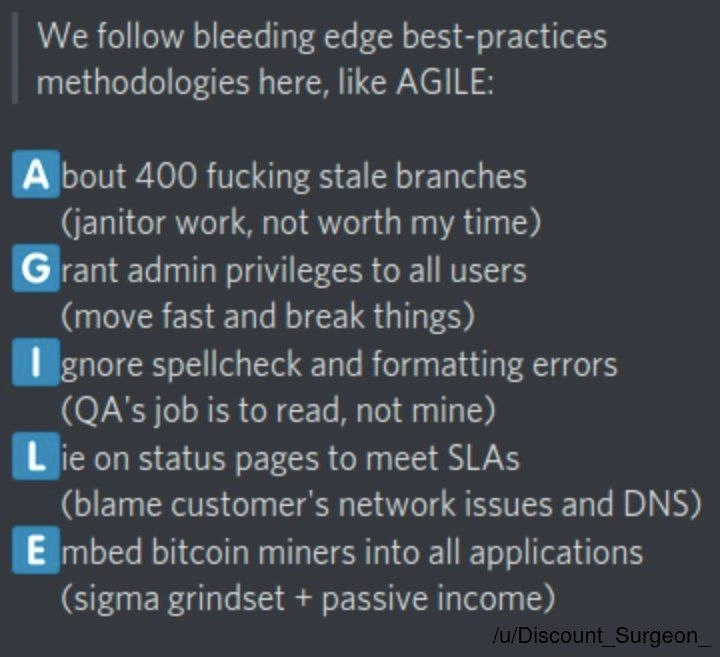
We follow bleeding edge best-practices methodologies here, like AGILE:
The meme immediately sets a sarcastic tone: a developer or team lead boasting about "bleeding edge best-practices" only to reveal each letter of AGILE stands for a glaring anti-pattern. It's a comedic takedown of teams that parrot Agile terminology while actually accumulating Technical Debt and indulging in downright bad practices. Each bullet under the AGILE acronym is basically a confession of chaos masked as methodology, and every letter is indeed a red flag waving proudly.
A – "about 400 fucking stale branches (janitor work, not worth my time)": This highlights abysmal Version Control hygiene. In Git (the dominant version control system), branches are meant for isolating feature development and should be merged or pruned when done. Having ~400 stale branches is absurd – it's like a graveyard of long-forgotten code. It implies nobody cleans up old feature branches; maybe features were abandoned or never properly merged. An experienced developer sees that and groans: stale branches can harbor bug fixes or changes that never made it to production, or just clutter everyone's git branch output. Merging anything becomes a game of “find the real latest code” amid dozens of similarly named branches (ever seen a final_final2 branch?). The parenthetical "janitor work, not worth my time" drips with sarcasm – it’s mocking the attitude that tidying up code or repo hygiene is menial. In reality, cleaning up unused branches is crucial to prevent confusion and technical debt. Ignoring this "janitor work" now means spending a weekend later diff-ing ancient branches to discover where a critical fix was hiding. In true agile practice, you’d regularly integrate changes (continuous integration) and delete dead branches – not hoard them like collector’s items.
G – "grant admin privileges to all users (move fast and break things)": Here we see a massive security anti-pattern. Granting admin rights to everyone – whether it's every developer on the team or, worse, every user of the app – is practically inviting disaster. There's a principle called least privilege in security: give people the minimum access they need. This team throws that out the window because "move fast and break things." That famous motto (Facebook’s early credo) is cited tongue-in-cheek to justify recklessness. A cynical veteran has probably lived through the fallout of this mindset. When everyone is an admin, a junior dev can accidentally delete a production database, or an outsider exploiting one user account can now own the entire system. Security flaws galore! The humor here is dark: "move fast and break things" indeed – if every account is god, things will break. Fast. It's a bad practice masquerading as agility; they're sacrificing safety and stability for speed, which often backfires spectacularly. Any senior engineer reading this hears alarm bells: this is how you get 3 AM emergency calls because someone "moved fast" straight into a deployment catastrophe.
I – "ignore spellcheck and formatting errors (QA's job is to read, not mine)": This line skewers the neglect of code quality and polish. Ignoring spellcheck might refer to typos in code comments, documentation, or even user-facing text. Ignoring formatting errors suggests no coding standards or linting – perhaps the team can’t be bothered to run the linter or adhere to any style guide. In real agile teams, quality is everyone’s responsibility, but here the attitude is "not my problem". The snide remark "QA's job is to read, not mine" implies developers dump sloppy work on Quality Assurance, expecting testers to catch even the obvious mistakes. It's an awful anti-pattern: treating QA as janitors for messy code rather than partners in quality. For a seasoned dev, this is a painfully familiar scenario – some teams claim to "go fast" by skipping basic quality checks, only to create more bugs and confusion. Typos and poor formatting can be more than cosmetic: a misspelled variable or a forgotten semicolon can be a real bug. And even when it's minor, delivering an app with glaring typos or inconsistent code style is unprofessional. The meme exaggerates to make it funny (most devs wouldn’t say this out loud), but the underlying truth is there: rushing and deferring all quality concerns "for QA to deal with" will bite you later. It’s mocking that move-fast culture where writing clean code and documentation is seen as optional. In reality, Agile teams use practices like pair programming, code reviews, and automated linting to catch issues early – the exact opposite of "ignore errors."
L – "lie on status pages to meet SLAs (blame customer's network issues and DNS)": This part calls out dishonesty in service reliability reporting. Status pages are public dashboards showing an application's uptime and incidents. An SLA (Service Level Agreement) is a contract promising a certain uptime (e.g. 99.9% availability) – miss it, and there might be penalties or at least angry customers. Instead of improving reliability, this "methodology" advocates simply lying: mark everything green and, if anyone asks, blame external factors like the user’s connection or the ever-mystical DNS. "It's always DNS" is a longstanding joke in IT – DNS (the internet's domain name system) can indeed cause issues, but it's often used as a convenient scapegoat ("Nothing’s wrong with our service, must be a DNS issue on your side!"). The meme’s author is pointing at a real bad practice: massaging the truth to meet metrics. It's both unethical and counterproductive. A seasoned SRE (Site Reliability Engineer) or developer who has managed uptime knows that sweeping outages under the rug prevents learning from them. Real Agile/DevOps culture promotes blameless post-mortems and transparency, not hiding problems. But some companies, desperate to meet SLAs or avoid management’s wrath, will downplay incidents – "lie on the status page" – or conveniently label unplanned downtime as "scheduled maintenance" after the fact. The line is funny because it's uncomfortably real: many of us have seen a manager suggest, "Maybe it was the customer's network. We'll just say it was an ISP issue," when in fact a deployment caused the outage. Blaming the customer's network or DNS for your own downtime is the ultimate cop-out. It turns the well-intended practice of honest status reporting into theater. The result? The team meets the letter of the SLA by cheating, while the system’s reliability rot (another form of tech debt) only gets worse.
E – "embed bitcoin miners into all applications (sigma grindset + passive income)": This one takes the cake for absurdity and dark humor. It highlights a mix of unethical monetization and malware-like behavior. Cryptocurrency mining means using computing power to solve math puzzles and earn digital coins (like Bitcoin). Embedding a bitcoin miner in software means secretly using your app’s users (or your company’s servers) to mine crypto for you. Yes, this has actually happened in the wild: there have been malicious browser extensions and even NPM packages that hijack your CPU for mining – effectively a form of malware. The meme exaggerates by saying an "Agile" team is doing it intentionally as a "sigma grindset + passive income" strategy. "Sigma grindset" is meme-speak for a hyper-individualistic, 24/7 hustle mentality – basically being willing to do anything (even shady things) to make money, often used jokingly. Here it's used ironically: the team is so "innovative" that they’re willing to turn every customer’s machine into a secret crypto-mining rig for a little extra cash on the side. Obviously, no real software methodology would encourage sneaking cryptocurrency miners into your app. This is a huge security issue and a gross breach of user trust. But the joke lands because, after all the lesser sins (messy branches, lazy QA, lying to users), the final step is outright malicious. It’s a giant neon red flag. Veterans in tech find it hilarious because it's a wild exaggeration with a kernel of truth – there have been cases of software secretly mining crypto. It satirizes how far a bad engineering culture might go: from mere neglect to outright exploitation. If earlier letters were red flags, this one is a five-alarm fire.
To illustrate, here's a cheeky comparison between real Agile ideals and this team's "Agile" practice:
| Agile Principle (Ideal) | Team's "Agile" Practice (Reality) |
|---|---|
| Clean up branches after merging | Never delete branches (400+ stale remain) |
| Restrict admin access (least privilege) | Everyone is admin (what could go wrong?) |
| Maintain code style & fix typos | Skip formatting/spellcheck (not my job) |
| Be transparent about downtime | Hide outages, blame DNS (keep status green) |
| Respect users (no hidden surprises) | Sneak in a crypto miner (free money) |
As the table shows, each letter of this team's "AGILE" stands for the opposite of real best practices. Collectively, these five points spell "AGILE" but describe a software team from hell. The humor works on multiple levels: it’s a play on the corporate buzzword "Agile methodology" by ironically redefining each letter as a dysfunction. Seasoned developers are both amused and horrified because they've seen places that are Agile in name only – doing the ceremonies and using the jargon, but underneath, it's chaos and mounting technical debt. The meme uses exaggeration for effect, but each item reflects a real cautionary tale. It's basically listing an anti-Agile manifesto: an "Agile" process that produces nothing but headaches.
In essence, the meme is ridiculing how some teams claim to follow "bleeding edge best practices" while doing the exact opposite. Instead of iterative improvement and accountability, they embrace shortcuts, negligence, and even shady behavior. It's developer humor with a sharp edge: anyone who’s dealt with the fallout of such practices finds this painfully funny. The acronym format delivers the punchline – turning the revered word AGILE into a list of what not to do. For experienced folks, each letter might trigger a war story: "Remember that project with hundreds of unmerged branches?" "Or the time a dev gave everyone root access and we had a meltdown?" The meme resonates because it captures the gap between Agile as advertised versus Agile as (mis)practiced in the worst environments. It’s a tongue-in-cheek warning: if your team’s "best practices" look like these, then you’re on a crash course, no matter how agile you claim to be.
Description
A screenshot of text on a dark gray background, presenting a sarcastic, cynical take on a popular software development methodology. The top line reads, 'We follow bleeding edge best-practices methodologies here, like AGILE:'. Below this, 'AGILE' is spelled out as an acronym with each letter representing a dysfunctional or malicious practice. 'A' stands for 'About 400 fucking stale branches (janitor work, not worth my time)'. 'G' is 'Grant admin privileges to all users (move fast and break things)'. 'I' is 'Ignore spellcheck and formatting errors (QA's job is to read, not mine)'. 'L' is 'Lie on status pages to meet SLAs (blame customer's network issues and DNS)'. 'E' is 'Embed bitcoin miners into all applications (sigma grindset + passive income)'. A watermark '/u/Discount_Surgeon_' is visible at the bottom right. The meme satirizes how Agile principles can be twisted into justifications for poor engineering practices, security vulnerabilities, lack of accountability, and even criminal activity, reflecting the frustrations of developers in toxic or high-pressure environments
Comments
8Comment deleted
Our team is so agile we replaced stand-ups with seances to figure out which ghost from sprints past is haunting the production server
At our sprint planning, “Agile” translates to: triaging 400 necrotic branches, making every IAM role God-mode “for velocity,” then scheduling the retro for the exact window we take StatusPage out of maintenance so no one asks why the CPU spikes look like a side-hustle whitepaper
The real AGILE methodology: where 'sprint retrospectives' are just post-mortems in disguise, and the only thing we're continuously delivering is technical debt compounded at a rate that would make a payday lender blush
The status page says 'all systems operational' with the same confidence the sprint board says 'in progress' - both are aspirational documents
This is the 'AGILE' framework you get when your tech lead's last role was at a crypto startup that pivoted six times before the Series A dried up. The 400 stale branches aren't technical debt - they're 'architectural options we're keeping open.' The bitcoin miners? That's just 'monetizing unused CPU cycles' in the infrastructure cost optimization OKR. And when the status page shows 99.99% uptime while the service is on fire, that's not lying - it's 'managing stakeholder expectations through strategic metrics presentation.' The real tragedy is that every senior engineer reading this has worked at least one place where three of these five were unironically practiced
Agile here means velocity measured in 400 stale branches, security handled by giving prod admin to everyone, SLAs met via status‑page theater blaming DNS - and the only feature we ship consistently is a crypto miner
When AGILE means admins for everyone, Git archaeology, and status-page fanfic, you've implemented Distributed Denial of Accountability - not Scrum
AGILE: Where 400 stale branches achieve perfect CAP theorem partition tolerance, and bitcoin miners ensure your SLAs are always 'up' - passively