Skip to content
DevMeme
3896 of 7435
Actual Code, Imaginary Unit Tests
Testing Post #4242, on Feb 22, 2022 in TG

Actual Code, Imaginary Unit Tests

Why is this Testing meme funny?

Level 1: No Safety Net

Imagine building a tall stack of blocks but never checking whether the table is steady. It might stand for a while, but every new block becomes scary because the whole thing could fall. The meme is funny because there is lots of software on the left, but no tests on the right to catch mistakes when someone changes it.

Level 2: Tests That Aren't There

Actual code is the implementation: the functions, classes, services, scripts, and logic that make the software do something. In the image, that side is full of colored lines to show there is plenty of source code.

Unit tests are small automated checks that verify specific pieces of code. For example, a unit test might check that a password validator rejects short passwords or that a price calculator handles discounts correctly.

Test coverage is a way of measuring how much code is exercised by tests. High coverage does not guarantee quality, but zero meaningful tests means the team has very little automated protection.

Regression testing means checking that old behavior still works after new changes. Without tests, developers often have to click through the app manually or trust memory. That is slow and unreliable, especially as the codebase grows.

For a junior developer, the key lesson is that tests are not just for catching current bugs. They are documentation for expected behavior and a warning system for future changes. The empty right panel means the next person modifying the code has to guess what is safe.

Level 3: Coverage Vacuum

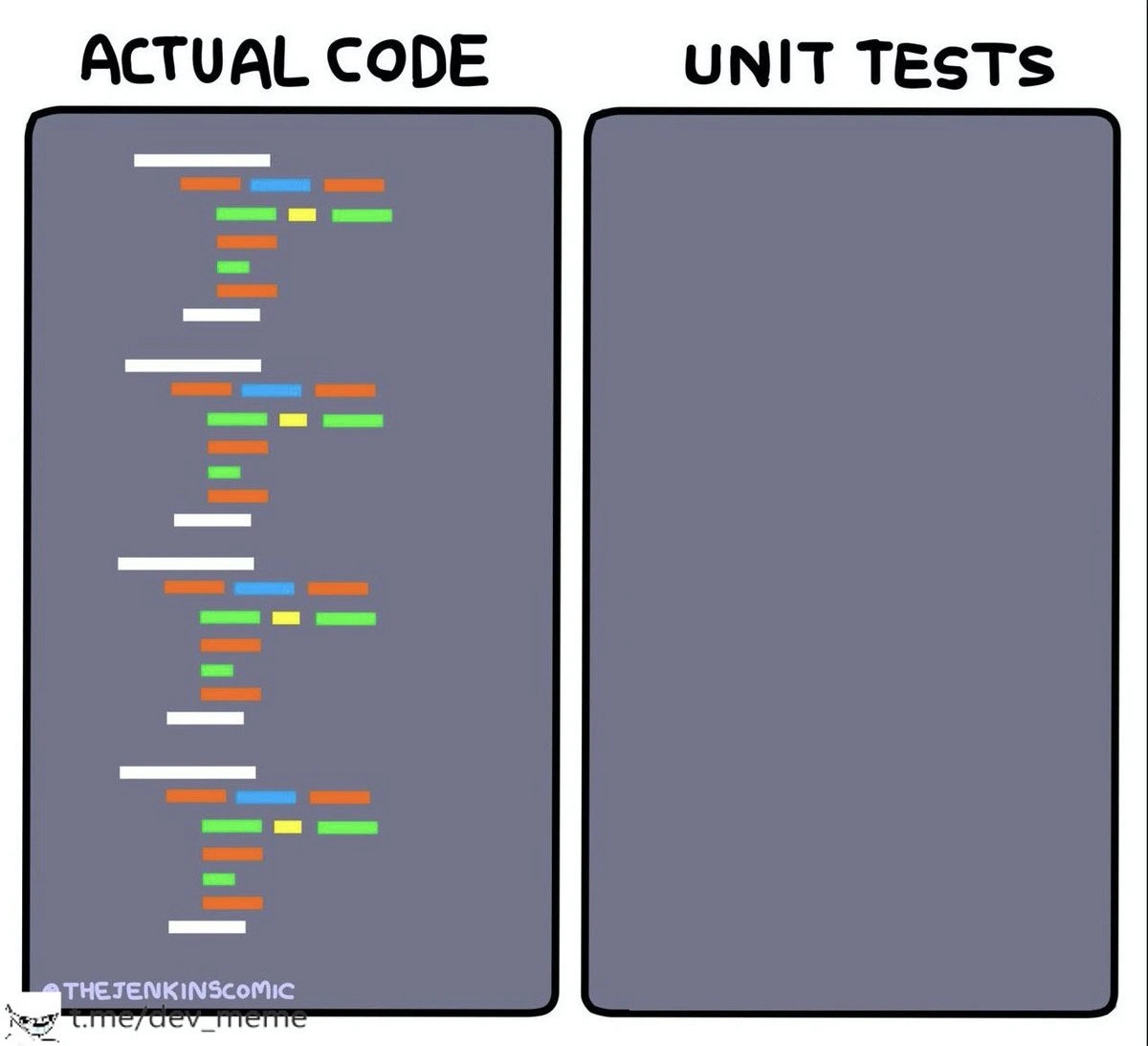
The comic has two labeled columns:

ACTUAL CODE UNIT TESTS

The ACTUAL CODE side is filled with colorful editor-like lines. The UNIT TESTS side is an equally large gray rectangle with nothing in it. That empty space is the joke, and it is doing the kind of damage only silence can do. The application has implementation, complexity, branches, and probably several opinions about state. The safety net is a blank wall.

This is not just "developers forgot tests." It is the industry pattern where production code is treated as visible progress and tests are treated as optional paperwork until a regression escapes. Product sees features. Management sees velocity. The deployment pipeline sees artifacts. Then a tiny change breaks something that "nobody would ever touch," and suddenly everyone discovers that confidence was being stored in vibes.

Unit tests are supposed to exercise small pieces of behavior in isolation: functions, classes, modules, validation rules, parsing logic, edge cases. They are not a complete quality strategy by themselves, but they are one of the fastest feedback loops developers can have. When that panel is empty, every future change becomes a negotiation with fear.

The meme also points at a subtle form of technical debt. Missing tests do not always hurt immediately. The code can ship, customers can use it, and the team can feel efficient. The interest arrives later, when refactoring becomes too risky, bug fixes need manual verification, and new developers are told, "Just be careful in that file." That sentence belongs in a postmortem template.

The watermark and comic style make it look simple, but the pain is real: an empty test suite changes team behavior. People avoid cleanup because they cannot prove they preserved behavior. They copy old patterns because changing them might break unknown callers. They over-test manually before every release, then still miss the one path a five-line unit test would have caught.

Description

The image is a comic-style two-column comparison labeled "ACTUAL CODE" on the left and "UNIT TESTS" on the right. The left panel shows a tall editor-like area filled with colored horizontal bars representing many lines of source code, while the right panel is an equally large empty gray box. A watermark at the bottom reads "@THEJENKINSCOMIC" and there is also a partial "t.me/dev_meme" mark. The technical humor is the all-too-common imbalance between production code and the nonexistent tests that are supposed to protect it.

Comments

16
Anonymous ★ Top Pick The coverage report is impressively fast when the test suite is just an empty directory with confidence issues.
  1. Anonymous ★ Top Pick

    The coverage report is impressively fast when the test suite is just an empty directory with confidence issues.

  2. @kulikov0 4y

    Definitely

  3. @captain_gaga 4y

    The question is, where are unit tests for unit tests?

    1. Deleted Account 4y

      🧠

      1. @captain_gaga 4y

        Damn man, that's the best query i've ever seen!

    2. Deleted Account 4y

      Unit test should represent simple operation which is not needed to be tested (Короче говоря если вы считаете что юнит тесты нуждаются в тестах, то вы не понимаете смысл юнит тестов (с) какая то статья на хабре)

      1. @karim_mahyari 4y

        Add fixtures and world falls apart in 'em

  4. @LonelyGayTiger 4y

    I'm in this picture and I dont like it.

  5. @daemon4647 4y

    What if I have unit tests, but not run them?

  6. @s2504s 4y

    It is life 😐 (жиза)

    1. @sylfn 4y

      not life (не жиза)

      1. @s2504s 4y

        You are lucky man (Везёт)

        1. @sylfn 4y

          s/lucky/fucking lazy/

  7. @sylfn 4y

    better empty both sides

  8. @ZgGPuo8dZef58K6hxxGVj3Z2 4y

    😂😂😂😂

  9. @Vivaldes 4y

    Fassbender: "Perfection"

Use J and K for navigation