AI Researchers Discover Models Can't Solve Unsolvable Problems
Why is this AI ML meme funny?
Level 1: That’s Not Fair
Imagine your teacher gives you a puzzle that has no solution and then calls you a failure for not solving it – pretty silly, right? 🤷♂️ This meme is joking about a situation just like that, but with an AI. The people testing the AI gave it some tasks that were way too hard or actually impossible, and then they said, “Look, the AI isn’t smart, it messed up!” Everyone who knows the story is laughing because the test itself was unfair. It’s like setting someone up to lose and then making fun of them for losing. The humor comes from how obviously not fair that is – anyone can see the problem isn’t that the AI can’t think, it’s that the challenge was rigged. In simple terms: the meme is pointing out a very human mistake (making a bad test) in a fun, nerdy way. It makes us smile because we all understand how absurd it is to blame someone (or something) for failing an unbeatable game.
Level 2: Impossible Test Cases
This meme shows what looks like a serious research paper, but it's actually satire highlighting how badly designed some AI tests can be. In the AI field, people often use puzzles and logic games to see if Large Language Models (LLMs) or similar AI (here jokingly called Large Reasoning Models) can reason through complex problems. The original (fictional) paper by Shojaee et al. (2025) claimed these models suffered an "accuracy collapse" when puzzles got too hard – meaning the AI’s success rate suddenly dropped when the tasks became more complex. That sounds dramatic, almost like "the AI suddenly forgets how to think." But the meme’s fake paper – titled “The Illusion of the Illusion of Thinking” – argues that this collapse wasn’t a real limitation of the AI’s intelligence at all, but rather the result of flawed test design. In other words, the tests were unfair or broken, so of course the AI didn’t do well. The humor is that this rebuttal is written in a perfect academic style, as if a couple of researchers (with very scholarly-sounding names) formally dissected and refuted the original claims. Seasoned AI folks find it funny because it feels like reading a brutally honest paper review on an online forum – except it’s formatted like a published paper for comedic effect.
Let’s go through the issues the "comment paper" raises in simpler terms:
Tower of Hanoi & token limits: The Tower of Hanoi is a classic puzzle where you move a stack of discs from one peg to another, one at a time, without ever placing a larger disc on a smaller disc. It’s famously used in programming and AI examples. The catch is that as you increase the number of discs, the number of moves needed grows exponentially (very, very fast). For example, 3 discs take 7 moves, 4 discs take 15 moves, and by the time you have, say, 10 discs, you need 1023 moves! Now, an AI language model doesn’t have infinite capacity to spit out steps – there’s usually a token limit (a cap on how many words/characters it can produce in an answer). If the puzzle needs 1023 steps and the model can only output, say, 500 steps in its answer, then even if the model knows the solution, it physically can’t output the full answer. It’s like Twitter’s old 140-character limit: even if you had more to say, you were cut off. The meme’s abstract says the original researchers kept pushing the Tower of Hanoi puzzle to more discs until the AI’s required solution steps exceeded what the model could print. The AI would then stop or say “I can’t continue,” and the researchers counted that as the AI getting it wrong. In reality, the model wasn’t reasoning wrong – it was just constrained by the output size. That’s a test issue, not a thinking issue! The meme highlights this to show how the “collapse” in accuracy might just be because the tasks got too long to answer within the model’s limits, not because the model became suddenly stupid beyond 7 discs or something.
Not telling real failures from constraints: The second issue is about the evaluation method. The parody says the original authors’ automatic grading system failed to tell the difference between when the AI truly gave a wrong solution versus when it couldn’t solve it due to some constraint (like the token limit or maybe the puzzle’s rules). For example, if the AI responded with “I can’t fully solve this because of X,” a smart evaluator would note that’s not a simple wrong answer – it’s the model pointing out a limitation. But the described setup just marked anything that wasn’t a perfect complete solution as a failure. Imagine a student writes “Answer continues on next page” but the page is missing – the teacher who marks that as a zero is being unfair, because the student didn’t actually make a reasoning error. In AI evaluation, nuance matters: you want to know if the model failed because it truly got confused, or because it wasn’t allowed to finish. The meme jokes that the original team’s framework was too blunt and mislabeled practical issues as reasoning failures. This makes the AI look dumber than it really is. Junior developers or newcomers can relate if they’ve ever seen tests that give false negatives – like a unit test that fails not because the code is wrong, but because of some environment limit or a misconfigured setting. It’s that same frustration: the test says “fail” but you’re like “hey, the code (or AI) is actually fine – your test conditions are the problem.”
Impossible river-crossing puzzles (N ≥ 6): The third issue is the big eye-opener. River crossing puzzles are those brainteasers where you have to move a group of people or objects across a river using a tiny boat. A famous one is the wolf, goat, and cabbage riddle – you can only take one or two across at a time, and you can’t leave the wolf alone with the goat, etc. These puzzles have specific solutions if they’re solvable at all. Now, not every configuration is solvable. The meme specifically points out that for some number of items (N ≥ 6) with the given boat size, the puzzle has no solution at all. It’s like asking, “How do you fit 6 people into a 2-person boat in one trip?” – you just can’t under those rules. According to the parody, the original benchmark included such no-win scenarios and still expected the AI to solve them. Naturally, the AI models failed these because nobody could solve them – they’re mathematically impossible. But the testers counted those failures against the AI’s score! That’s obviously ridiculous if you think about it. It would be like a teacher putting an unsolvable trick question on an exam and then giving the student a bad grade for not answering it. The meme highlights this absurdity to show how flawed the benchmark was. For anyone learning about AI, this is a humorous reminder: always check that your test problems actually make sense! If you accidentally include an impossible task, of course even the best model (or human) will get it “wrong.” This point also references a common theme in AI discussions: sometimes people are quick to say “AI can’t do X” without realizing X was set up in a nonsensical way. AI limitations should be measured on fair grounds – otherwise, you’re just generating hype over nothing.
Overall, the image uses an academic paper format as a clever vehicle for humor. It’s formatted exactly like a conference paper comment or rebuttal, complete with an Abstract section summarizing the critique. The joke lands because it’s written in a dry, scholarly tone about something that is actually an exaggerated, silly situation. It’s essentially an AI research satire. The meme appeals to developers and researchers who are familiar with the current LLM hype and the debates about what these models can or cannot do. It’s riffing on the idea that sometimes the AI hype vs reality gap comes from human error – bad experimental design – rather than the AI itself. And even if you’re not deep into AI, the idea of a test expecting impossible results is a universally funny kind of folly. The phrase “Illusion of the Illusion of Thinking” implies the original researchers were under an illusion themselves. In plainer words, the meme is saying: “They thought the AI was failing to think, but actually it’s their thinking that was flawed.” For a junior engineer or an interested newcomer, the takeaway is both educational and amusing: always be critical of how benchmarks are constructed. If results seem dramatically bad, check if the test was fair. In this meme, everything that went “wrong” for the AI can be explained by human oversight in setting up the challenges. That’s the big wink to the audience – and why those with some background in machine learning find this scenario hilariously on point.
Level 3: Unsolvable by Design
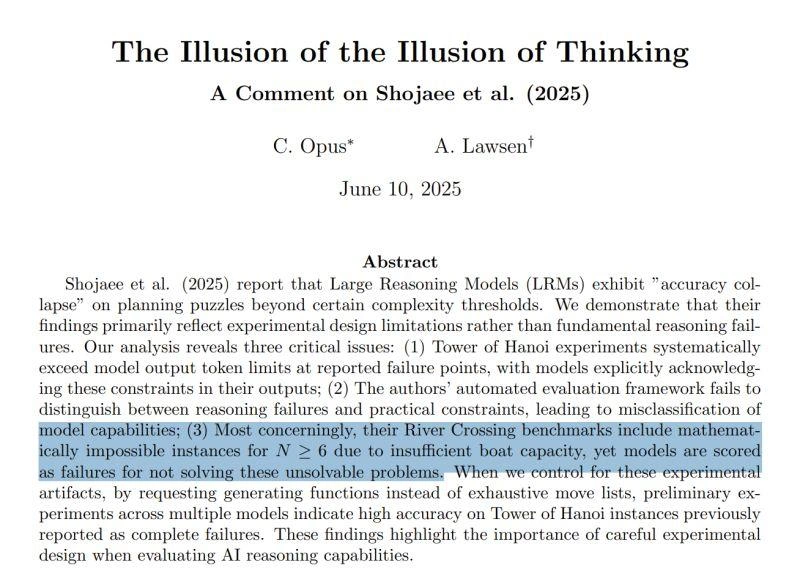
The meme is presented as a parody research paper, complete with a formal title, authors, and an abstract, but it’s delivering a scathing insider critique of how some AI benchmarks are designed. The faux title “The Illusion of the Illusion of Thinking” immediately alludes to an academic debate: it pokes fun at a hypothetical paper called “The Illusion of Thinking” (presumably Shojaee et al., 2025) by cheekily doubling down on the phrase. This is like saying “not only is the AI’s thinking an illusion, but that claim itself is an illusion!” – a very meta put-down in scholarly tone. Seasoned researchers recognize this as a classic Reviewer #2 move: delivering a harsh reality check under the guise of dry academia. The authors listed, C. Opus and A. Lawsen, even have an asterisk and dagger next to their names, mimicking real papers’ author footnotes (like co-first authorship or quirky affiliations). This level of detail, down to the Times New Roman style font and structured abstract, screams “academic roast”. It’s immediately funny to those in AI/ML because it so perfectly copies the look-and-feel of a serious conference comment while containing absurd revelations.
At first glance, an experienced AI engineer or researcher will nod knowingly at the content of the abstract. It references Large Reasoning Models (LRMs), which is a wink at Large Language Models (LLMs) but emphasizing reasoning tasks. The original Shojaee et al. paper claimed these models exhibited “accuracy collapse” on certain complex puzzles – implying that beyond a certain puzzle complexity, the model’s performance falls off a cliff. This idea of sudden failure beyond a threshold taps into the AI hype of discovering supposed fundamental limits of AI reasoning (it smells like a dramatic IndustryTrends_Hype headline: “AI can’t think beyond 5 steps!”). But the parody abstract systematically dismantles that claim by exposing three benchmark design flaws that explain the collapse. Each point in the abstract is essentially saying, “Hey, the tests were rigged or misinterpreted – the AI didn’t just get dumb all of a sudden!” Let’s break those points down, as a senior engineer would:
Tower of Hanoi token-limit overruns: The first issue notes that in the Tower of Hanoi experiments, the puzzles “systematically exceed model output token limits at reported failure points.” Tower of Hanoi is a classic multi-step puzzle (moving disks between pegs under rules) that has an exponential solution length: the minimal number of moves is $2^n - 1$ for $n$ disks. For larger $n$, that number blows up fast. Large language models like GPT have a fixed token limit – they can only output so many tokens (words or pieces of text) in one go. The parody says the original authors kept increasing puzzle size until solutions required more steps (tokens) than the model could possibly output. Eventually, the models hit a wall – not because they stopped “reasoning”, but because they literally ran out of allowed output length. It’s as if you asked the model for a 10,000-word solution but its answer box only holds 5,000 words. The funniest part? The parody claims the models even explicitly acknowledged these constraints in their output. (Anyone who’s used ChatGPT or similar has seen it apologize for length or say it can’t continue). So the poor AI is basically saying, “I know the answer is longer, but I can’t give it all to you,” and then the evaluation still marks it as a failure. 🧐 *In short, this “accuracy collapse” at high complexity wasn’t a mysterious reasoning failure at all – it was a foreseeable technical limitation.
Misclassifying practical constraints as failures: The second point calls out the evaluation framework for not distinguishing between true reasoning errors and practical limitations. In an ideal benchmark, if the model gives a partial solution along with a note about constraints (like hitting a token limit or some rule constraint), the evaluator should note that differently than a totally wrong or nonsensical answer. But the authors of Shojaee et al. apparently let their automated system count everything not fully solved as a wrong answer. This is a subtle but crucial critique: evaluation metrics in AI can be naive, and here it sounds like an entire class of responses (those curtailed by constraints) were mislabeled as complete failures. Every experienced ML engineer has seen this kind of thing: a metric or script that doesn’t capture nuance, leading to misleading conclusions. The meme humorously highlights how the experimental artifacts (like token limits or rule constraints) were not accounted for, thus garbling the results. It’s a classic AIResearch gotcha: garbage in, garbage out – if your evaluation is dumb, your conclusions will be too. The formal tone barely hides the exasperation behind the words. An insider reading this hears the subtext: “You claimed our models are bad at reasoning, but you basically set them up to fail by design and then didn’t even notice the difference between a real fail and a constraint.” It’s a scholarly facepalm moment.
Mathematically impossible river-crossing instances (N ≥ 6): The third and most absurd issue is highlighted (literally with a blue highlight in the image, as if a reviewer grabbed a highlighter in disbelief). It says the original paper’s River Crossing benchmarks include instances that are “mathematically impossible... due to insufficient boat capacity”, for any number of items $N \ge 6$, yet the models are still scored as failures for not solving these unsolvable problems. This is the punchline of the entire meme. River crossing puzzles are those classic brainteasers where you ferry a group (say, wolves and sheep, or missionaries and cannibals) across a river with a small boat under certain rules (like you can only carry two at a time, and you can’t leave certain combinations alone on either shore). They’re a staple in logic puzzle collections and AI planning research. However, not every configuration of such puzzles is solvable – the constraints can make it impossible to get everyone across without something bad happening. The parody specifically notes $N \ge 6$ with too small a boat yields no solution (likely referencing a known result or just a reasonable assumption: try to transport 6 or more entities with a 2-person boat and strict rules, and it can’t be done). But here’s the kicker: the original benchmark creators either didn’t realize these cases were impossible, or, worse, included them anyway. So the AI model is essentially asked to do magic – solve an unsolvable task – and when it naturally fails, the authors go “Aha, see, the AI’s reasoning collapsed!” 🙄 This is hilariously absurd to anyone experienced in algorithmic problem-solving or AI testing. It’s akin to a trick question with no correct answer. The humor lands especially well with AI/ML folks who’ve seen over-ambitious or misconstructed benchmarks in real life. It also echoes that weary joke in software engineering: “It’s not a bug, it’s a feature.” Here, “It’s not a model failure, it’s an impossible task.” The fact that the meme spells this out in deadpan academic language makes it doubly funny. It channels that Reviewer #2 energy again: you can almost hear the sarcastic undertone in the polite wording “most concerningly...”. It’s the kind of line a reviewer would write while holding back an eyeroll. And by highlighting it, the meme creators ensure we don’t miss the jaw-dropping folly of scoring an AI for not doing the literally undoable.
Taken together, these points form a satire of AI benchmark design and the hype around "AI limitations." The meme is essentially saying: the supposed “Illusion of Thinking” (the idea that AI can’t truly reason deeply) might itself be an illusion caused by sloppy experiment design. It’s a playful academic gotcha aimed at the tendency to draw grand conclusions (“accuracy collapse!”) from flawed tests. Seasoned machine learning engineers find this hilarious because it mirrors real situations where fancy claims crumble under basic scrutiny. Many have felt the frustration of reading a hyped paper only to discover confounding factors like poorly thought-out tasks or metrics. This meme gives a voice to that frustration in the most academically sarcastic way possible. By using the formal paper format, it mocks the original hype while simultaneously providing the actual explanation (thus educating anyone who’s paying attention). The title “The Illusion of the Illusion of Thinking” itself is an academic-style burn – it implies the authors of the original work were themselves under an illusion. It’s rare to see memes with an Abstract section, so that immediately signals that this is targeting the AI research community and their quirks. In those circles, people often joke about reviewers or follow-up papers tearing down initial results; this meme basically is that scenario distilled. It also underlines a serious point with humor: in evaluating AI (AIHypeVsReality), context matters – things like token limits or physical constraints must be accounted for, or we risk accusing our models of failures that are actually our own. The humor works on multiple levels: it’s a nerdy in-joke about AI experiment design, a satirical take on AI research hype, and a reminder that sometimes the biggest “failure” is in how we set up the problem, not in the technology itself.
Description
The image is a screenshot of a fictional academic paper's abstract, formatted in a classic serif font on a white background. The paper is titled 'The Illusion of the Illusion of Thinking' and is presented as a comment on another paper by 'Shojaee et al. (2025)'. The abstract critiques the methodology of the original paper, which reported 'accuracy collapse' in Large Reasoning Models (LRMs). The core of the satire lies in the third point of the critique, which is highlighted in light blue: 'Most concerningly, their River Crossing benchmarks include mathematically impossible instances for N ≥ 6 due to insufficient boat capacity, yet models are scored as failures for not solving these unsolvable problems.' The humor is a dry, academic satire of the AI research field, specifically mocking poorly designed experiments and the rush to publish sensational findings. The punchline is the absurdity of blaming an AI model for failing to solve a problem that is logically and mathematically impossible, a scenario that resonates with engineers who often deal with flawed requirements or impossible-to-reproduce bug reports

Comments
21Comment deleted
This is the academic equivalent of a JIRA ticket that says 'Bug: Application does not violate the laws of thermodynamics.' Priority: Blocker
At last - a benchmark that mirrors our sprint planning: deliver the impossible by Friday or it’s a hard fail
When your paper claims LLMs can't reason but your experimental framework can't distinguish between 'model failed to solve' and 'you asked for a 10,000 token response with a 4,096 limit' - who's really exhibiting the illusion of thinking here?
When your benchmark suite includes mathematically impossible problems and you blame the AI for not solving them, you've successfully created a Turing test for detecting flawed evaluation frameworks. Turns out the real 'accuracy collapse' was in the experimental design all along - perhaps we need LRMs to peer-review our LRM benchmarks before we publish papers about LRM failures
Scoring LRMs as failures on N≥6 river crossings with a two‑seat boat is peak QA‑by‑Gödel - you’re not measuring reasoning, you’re benchmarking your impossible spec and the token budget
Scoring LLMs on N≥6 river-crossing is like calling Raft “broken” for not being linearizable during a partition - congrats, you benchmarked an impossibility theorem
LRMs master chit-chat but flop on Tower of Hanoi? Scaling laws meet their CAP theorem: you can't have reasoning, reliability, *and* reality
a link would be interesting Comment deleted
are you banned on google or something? Comment deleted
I'm not sure what this is trying to say Comment deleted
that researchers of AI sometimes spend so much time with AI — they forget how to think. they ask for solutions that can't exist and seeing the model failing to solve — mark it as a model's failure Comment deleted
Just model this bruh. Comment deleted
bruh Comment deleted
And then some other researchers think asking for source code for a towers of hanoi puzzle, something that the model has to have at least thousand times in it's learning data, can be considered reasoning. Give me a break. Even computer security category on arxiv is spammed to hell with LLM-related junk. Also someone should add Towers of Hanoi to https://esolangs.org/wiki/HQ9%2B Comment deleted
yes. I was also thinking about that. Comment deleted
this.sense = new Someday() Comment deleted
https://www.bootstrappable.org/ Comment deleted
The paper implies that testers give LRMs the river crossing riddle with the number of elements that is more or equal to 6? Like, more than just a wolf, a sheep and a cabbage? Comment deleted
basically — those researchers. Comment deleted
Waiting for the sequel, the illusion of the illusion of the illusion of thinking Comment deleted
But to be serious, LLMs are really big and really fancy text predictors (that cost fortunes to run). Of course it can't "actually" think, it's only simulating it Comment deleted