The final lesson: How to be a real developer
Why is this DevCommunities meme funny?
Level 1: Using the Answer Key
Imagine you give a kid a puzzle or a math problem to solve, and you step away for a moment. Instead of working through the puzzle step by step, the kid quietly opens the answer book or googles the solution on a phone. When you come back, they proudly announce, “I solved it!” They did get the right answer, but they got it by copying it from the answer key rather than figuring it out themselves. It’s a funny and cheeky moment. In this meme, the same thing is happening with learning to code. The parent gave their 10-year-old a programming task to do. The kid didn’t know how to solve it right away, so they looked up the answer on the internet (specifically on a site where people share coding answers) and just copied the answer into their own work. The parent is joking, “Well, if my kid already knows how to find answers online like that, maybe my teaching here is done!” It’s humorous because the child found a clever shortcut. The kid showed they are resourceful – if they don’t know something, they know how to quickly find someone who does. That’s actually a pretty useful skill! The whole joke feels like when a student finds the answers to their homework in the back of the textbook: it’s not the intended way to learn, but it sure was effective in getting the job done, and you can’t help but laugh a little and be a tiny bit proud of their craftiness.
Level 2: When in Doubt, Stack Overflow
Let’s break down what’s happening here in simpler terms. A 10-year-old was given a coding challenge by their parent (who is acting as the teacher at home). The parent knows only the basics of programming, so they set a task and leave the child to figure it out. What does the kid do? They turn to the computer and search for help. They might type the question or error message into Google. Pretty quickly, they find a result from a site called Stack Overflow where someone had asked almost the same question. On that page, there’s an answer with a piece of code that solves the problem. The child simply copies that piece of code and pastes it into their own program. The problem is instantly solved without the child having to write the solution from scratch. The parent comes back, sees this, and jokingly asks, “Is my job complete?” as if to say, "Well, I guess my kid already knows how to code now!" The humor here is that the kid didn’t exactly learn how the code works; they just learned that you can find answers online. But funnily enough, that is a huge part of real-world programming!
Now, what is Stack Overflow? It’s one of the most popular websites in the world for programmers seeking help. Think of Stack Overflow as a giant question-and-answer forum specifically for coding problems. If you get stuck on a coding issue or see an error you don’t understand, you can search for it on Google, and very often a Stack Overflow page will pop up where someone has asked the same thing. Other programmers post answers there, often including sample code that fixes the issue. The best answer (as judged by votes or marked with a green check by the original asker) usually appears near the top. For example, if you wonder "How do I sort a list in Python?" or "What does this error message mean?", someone on Stack Overflow has probably answered it. Dev communities like this are incredibly helpful when you are learning to code. They’re essentially knowledge-sharing platforms. In fact, it's so common to use Stack Overflow that there’s a running joke about developers being dependent on it. StackOverflow dependence means a coder might lean so heavily on copying solutions from the site that they struggle to code without an internet connection. It’s exaggerated humor, but it points to how often we use online answers.
This copy-paste approach to coding is something almost every beginner (and plenty of experienced devs) practices. On the positive side, it teaches beginners that programming is not about memorizing everything but about knowing how to find information. If someone else has already solved a problem, why not reuse their solution? This can save tons of time. Many juniors (new developers) learn by example: they search for a problem, read the code that works, and try to apply it. Over time, by doing this, patterns start to emerge and the newcomers actually learn how the code works. In a way, it’s like learning by looking at the answer and then working backwards to understand it. On the negative side, if you just copy code without trying to understand it, you might not progress in learning. For instance, if our 10-year-old keeps copying solutions every time without asking "why does this code work?", they might get stuck when faced with a slightly different problem that isn’t answered online. That said, copy-paste coding is practically a rite of passage; it’s a phase in the learning-to-code journey. Most programmers will admit that when they started out, they copied code from websites or tutorials. And that’s okay, because you have to start somewhere. Eventually, as you gain experience, you rely less on direct copying and more on adapting ideas or writing your own code. But even seniors will copy the occasional snippet to save time (and then tweak it as needed).
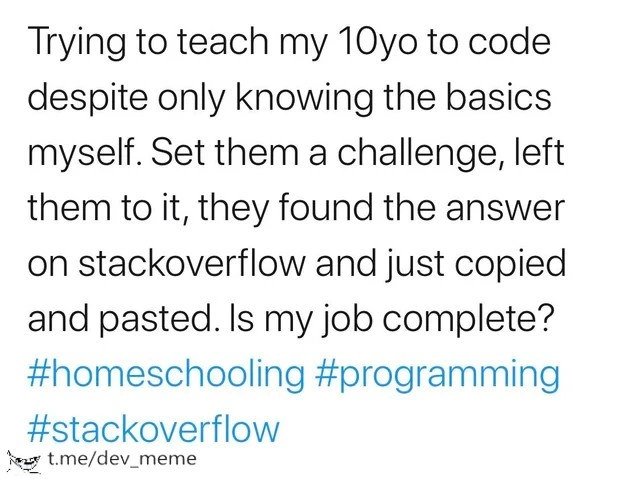
The meme itself is formatted like a tweet, which gives it a familiar, anecdotal vibe. The text is plain black on white (just like a Twitter post), and the hashtags at the end are colored light-blue, making it look just like a real tweet on a phone screen. The hashtags #homeschooling, #programming, and #stackoverflow hint at the context and punchline:
- #homeschooling: This tells us the setting – the child is being taught at home, by a parent, rather than in a regular school classroom. (Back around 2020, a lot of parents were doing homeschooling due to global events, so it became common to share these kinds of experiences online.)
- #programming: This simply flags that the topic is about coding. It’s why the parent set a coding challenge and not, say, a math or history task.
- #stackoverflow: This one is the comedic kicker. By tagging the name of the website where the answer was found, the parent is essentially winking to other programmers reading the tweet. It’s saying, “Psst, the kid used Stack Overflow to cheat/solve it.” Anyone who codes will immediately get the reference and likely chuckle, because we’ve all been there.
When the parent quips, “Is my job complete?”, it’s a loving, humorous jab at themselves and at coding culture. It suggests that perhaps the only lesson the kid really needed was how to search for answers online. The parent is joking that if the child can use Stack Overflow effectively, maybe that’s 90% of real programming education done right there! Of course, in reality, there's more to learn – logic, debugging, algorithms, etc. – but the joke is that being able to find and use existing solutions is such a big part of programming work. For a junior developer or a child just starting out, discovering this trick is like discovering a magic shortcut. It’s both funny and a little impressive: the kid essentially figured out how developers solve problems in real life. The parent (who admits they only know the basics) might even be a bit relieved or proud, thinking, “Wow, my kid outsmarted the challenge by finding the answer – that’s what real programmers do!” So, in summary: the meme humorously portrays that moment when a newbie coder learns that looking up answers on Stack Overflow is a big part of coding, and the parent jokes that their teaching job is already done because of it.
Level 3: Stack Overflow University
So many seasoned engineers smirk at this scenario because it reveals the "secret handshake" of the programming craft: Stack Overflow-driven development. The meme’s tweet-style text (complete with bright blue hashtags like #homeschooling, #programming, #stackoverflow) describes a parent trying to teach a 10-year-old to code at home. The parent, only knowing basic programming themselves, leaves the child with a coding challenge. When they return, the kid has solved it by doing what nearly every developer does in a crunch – they googled the problem, landed on a Stack Overflow answer, and simply copied and pasted (hit Ctrl+C then Ctrl+V) the code solution. The tongue-in-cheek question “Is my job complete?” hits home because it playfully suggests that mastering this one skill – finding and reusing code from the internet – might be the most practical lesson in programming.
In the software industry, this practice is extremely familiar. There's even a half-joking term for it: copy-paste coding or Stack Overflow programming. It means exactly what it sounds like – writing code by piecing together solutions found online, especially from Q&A communities. Why do developers do this? Because modern programming involves tapping into knowledge from Dev Communities that have already solved similar problems. No one can remember every API call or obscure error message off the top of their head. Instead, knowing how to quickly search for an error and find a trusted snippet on Stack Overflow is a vital skill. In fact, many senior developers would argue that being resourceful with documentation and community knowledge is more important than memorizing syntax. Stack Overflow has become akin to a communal brain for programmers – a place where the collective memory of the developer world is just a search query away. It’s not uncommon for a codebase to contain a chunk of code lifted straight from an answer (perhaps one by the legendary user Jon Skeet or another high-rep guru) that saved the day. Honestly, half the code running in production probably originated from a Stack Overflow answer with a few hundred upvotes.
For those who've been in the field a while, the workflow often looks like this:
- Encounter a problem or error message.
- Copy the error message (or type a description of the problem) into Google.
- Click the most promising Stack Overflow result (the question that sounds exactly like your issue).
- Scroll straight to the highest upvoted answer or the one with the green checkmark (the accepted solution).
- Copy the code snippet from that answer.
- Paste it into your project and adapt as needed (or sometimes not at all, if you're feeling lucky).
- Run the code. If it works: victory! 🎉 If it doesn’t, refine the search terms and go back to step 2.
Sound familiar? That’s essentially what the kid did on their first try. This little StackOverflow dependence trick is practically the daily routine of software development. Seasoned devs chuckle because we’ve all been that kid, watching our code magically work after pasting a solution we barely understand at first. The meme is winking at this shared experience.
So the parent in this meme is half-jokingly acknowledging that their child discovered this process on their own. They set a task, stepped away, and when they came back the kid had basically bypassed the whole lecture by using community-sourced knowledge. It’s as if the kid thought, “Who needs a teacher when I have the internet?” And honestly, that's a big part of how real developers learn new things on the job. It's an amusing reversal of roles: the parent thought they'd be the teacher, but the child independently leveraged Stack Overflow as the teacher instead. The hashtag #homeschooling underscores that this learning happened in a home setting (a nod to the days when many were schooling at home), but the real schooling came from the online programming community.
Joking aside, the tweet hints at a deeper truth: programming isn't about knowing everything by heart, it's about knowing how to solve problems. And often, solving problems means finding out if someone else has already solved it. There's a well-worn saying among developers:
"Being a great programmer isn't about knowing all the answers; it's about knowing where to find the answers."
The child in the meme exemplified this wisdom in a hilarious way. Of course, experienced devs also know the caveats: blindly copying code can backfire. You might import a bug or a solution that doesn't quite fit your situation. It's one thing to grab a quick fix from Stack Overflow, but understanding why that fix works (and double-checking it’s appropriate for your version or context) is crucial in the long run. In this case, a 10-year-old might not yet grasp the underlying concepts of the code they pasted, but they demonstrated the kind of resourcefulness and initiative that seasoned engineers use daily.
In other words, the parent's facetious question "Is my job complete?" is funny because of course the teaching isn’t truly over — the kid still has plenty to learn about why that code works and how to write their own solutions. But in that moment, the parent recognizes that the child has picked up an essential developer trait: being able to independently find solutions. If programming had boy-scout or girl-scout badges, the kid just earned their “Stack Overflow Scout” badge at age 10. 😄 In a tongue-in-cheek way, the parent is saying: hey, my kid can code like a real developer now — they know how to Google the answer! From a senior perspective, that indeed feels like a proud (and funny) milestone. The job’s not really complete, but the kid is certainly on the right track!
Description
A text-based image, likely a screenshot of a tweet or social media post. The text reads: 'Trying to teach my 10yo to code despite only knowing the basics myself. Set them a challenge, left them to it, they found the answer on stackoverflow and just copied and pasted. Is my job complete?'. Below the main text are the hashtags #homeschooling, #programming, and #stackoverflow. A small watermark for 't.me/dev_meme' is at the bottom. The humor is a classic meta-joke about the software development profession. While the parent is ironically questioning their teaching, the child's actions - encountering a problem, searching for a solution online, and using an existing answer - perfectly mirror the daily workflow of many professional developers. The joke implies that the child has already mastered the most essential real-world programming skill: effective use of Stack Overflow

Comments
7Comment deleted
The child has already graduated from 'Hello World' to 'Hello, I'd like to report a duplicate question.'
Your work’s done when the kid copies the snippet, omits the CC-BY-SA attribution, adds a “// TODO: optimize later”, and labels it production-ready - congrats, you’ve raised an enterprise-grade engineer
Congratulations, your child has successfully completed the onboarding process for a senior engineering position at a Fortune 500 company
Ah yes, the time-honored tradition of passing down generational knowledge: 'Child, I shall teach you the ancient ways - Ctrl+C, Ctrl+V, and the sacred art of changing variable names just enough to avoid detection.' The kid's already mastered the core competency that took most of us years to admit we rely on. They've essentially speedrun the entire 'learning to code' experience: skip the tutorial, Google the problem, find a Stack Overflow answer from 2012 with 847 upvotes, paste it in, and ship it. Honestly, they're ready for their first startup CTO role - they've already demonstrated they can deliver solutions without fully understanding them, which is basically 80% of architecture decisions at scale anyway
If they already copy‑pasted the accepted answer from 2011, renamed it util_fix(), and CI stayed green, congratulations - you’ve replicated 80% of enterprise code provenance
You've accelerated their dev career past fundamentals straight to senior-level 'it works, ship it' pragmatism - congrats on birthing SO's next top contributor
Almost - next lesson is ignoring the accepted answer from 2011, checking version compatibility, and writing a test before pasting; that’s when StackOverflow‑driven coding becomes engineering