
Blocked Stack Overflow Policy Meme Explained
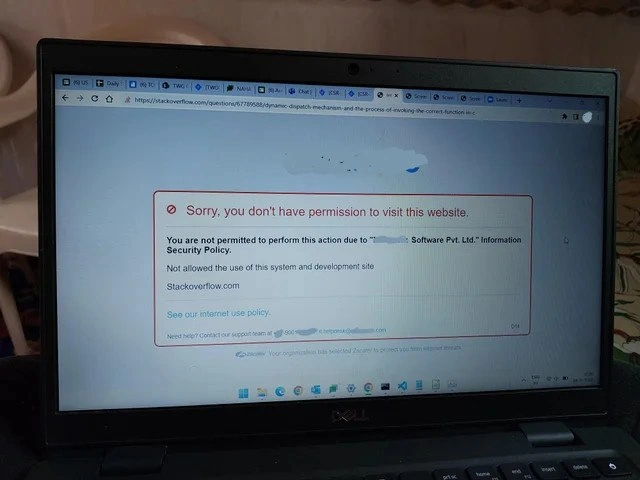
A laptop screen shows a corporate access-denied page for Stack Overflow under an Information Security Policy. The dive unpacks content filtering, developer productivity versus security theater, and why searching is part of diagnosis—not laziness.
Level 1: Locked Tool Cabinet
This is like hiring someone to fix your sink, then locking the toolbox and handing them a rulebook about why tools are dangerous. The rule may have been made for safety, but now the person cannot do the job, and everyone still expects the sink to be fixed.
Level 2: The Forbidden Answer
Stack Overflow is a question-and-answer site where programmers ask about errors, language behavior, libraries, tools, and debugging problems. Developers use it the way mechanics use manuals and repair forums: not because they know nothing, but because the exact failure often depends on a strange detail someone else has already seen.
The page in the photo is a company access-control block. Content filtering means software decides which websites employees may visit from a work device or network. Corporate IT teams often use filters to block malware, phishing, piracy, adult content, or sites that could leak data. In this case, the blocked site is a normal developer reference site, so the filter feels absurd.
The visible warning says:
See our internet use policy.
That line is part of the joke because it replaces a practical answer with a policy document. A junior developer might encounter this during their first job and realize that "the codebase" is only half the challenge. The other half is the environment around the code: VPNs, permissions, browser restrictions, internal approvals, endpoint security agents, and help-desk tickets that arrive three hours after the problem was urgent.
The many tabs along the top of the browser also make the scene feel real. Debugging often means comparing search results, documentation, issue threads, and examples. When the one site most likely to explain the weird error is blocked, the developer is forced to work around the company before they can work on the software.
Level 3: Policy Versus Production
The image is a bleak little workplace fable: a developer opens Stack Overflow, and the corporate filter responds with:
Sorry, you don't have permission to visit this website.
The blocked destination shown on the warning is Stackoverflow.com, which is why the meme hits so hard. Stack Overflow is not a random entertainment site in developer culture; it is the informal public memory of software engineering. It contains bug explanations, compiler error discussions, odd framework behavior, version-specific workarounds, and the occasional answer from the person who actually wrote the library. Blocking it under an Information Security Policy turns a productivity dependency into contraband.
The senior-level pain here is not "developers are helpless without copy-paste." That is the lazy version of the joke. The sharper version is that modern software work is too broad for any one engineer to memorize every API, edge case, migration path, browser quirk, dependency warning, and runtime error. Good engineers search constantly because searching is part of diagnosis. A policy that blocks that research channel does not create secure developers; it creates slower developers with better excuses and more screenshots of access-denied pages.
The warning text includes the wonderfully bureaucratic line:
Not allowed the use of this system and development site
That phrasing is corporate IT poetry: vague enough to justify itself, specific enough to stop the work, and written as if the browser personally disappointed a committee. The meme is CorporateSecurity colliding with DeveloperProductivity. Somewhere, a policy engine sees "forum," "user-generated content," or "external site" and declares victory. Meanwhile, the engineer still has a production issue, a failing build, and fifteen browser tabs across the top because the first fourteen did not contain the one cursed answer about a missing semicolon in a YAML file.
There is a real security discussion hiding inside the joke. Public technical sites can contain bad advice, outdated snippets, unsafe commands, and code that should never be pasted into production. Companies also worry about data leakage when employees post internal stack traces or proprietary code. Those risks are legitimate. But blunt content filtering is the sledgehammer version of governance: it optimizes for auditable denial instead of informed behavior. Training developers not to paste secrets is useful. Blocking the encyclopedia and calling it risk reduction is how you get shadow workflows, phone tethering, and "I found the answer on my personal laptop" as an enterprise architecture pattern.
The post message says this would be enough to make someone rage quit, and the image earns that exaggeration. The laptop screen is not showing a crash, a fired employee, or an angry boss. It is showing something colder: the company has made the basic act of learning feel unauthorized.
Blocking Stack Overflow for security is a bold way to replace copy-pasted answers with copy-pasted despair.
1984
It says a lot about society...
It's like restricting books usage, as they provide information
It's not 1984
It's 451
Imagine the gigachads who work there
Вот пидорасы (Very bad persons)
Few years ago boss asks me to not visit StackOverflow when I am in work. Not because he was despotic (he was but this is not a point why) but because I often answer to other people questions and only somethimes looking for help stuff for me.
what if their policy is whitelist based?
Well, https://youtu.be/AS3kA_AtRTo