
PostgreSQL Name Confusion Meme Explained
The meme has the PostgreSQL elephant rejecting a “progesterone” name tag. The dive unpacks the phonetic pun, Postgres versus PostgreSQL history, and what the relational database actually is.
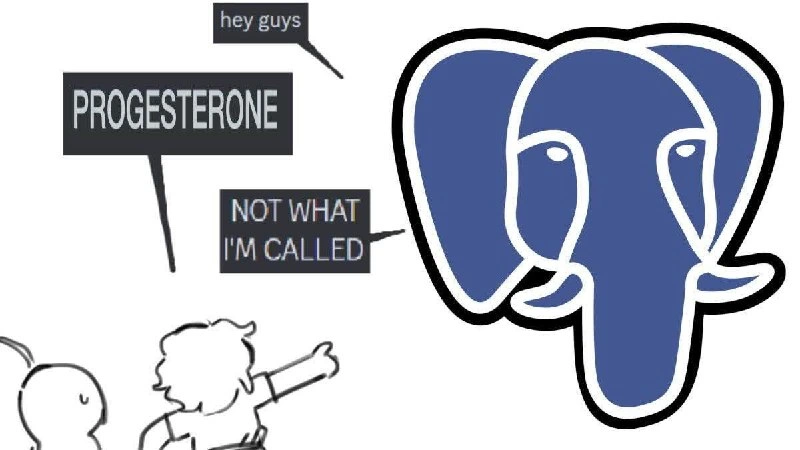
Level 1: Wrong Name Tag
It is like calling someone named “Polly” by the word “pollen” because the sounds start similarly. Everyone can hear how the mistake happened, but Polly still has every reason to point at the name tag and say, “That is not me.” Here the offended character is a database elephant, and the completely unrelated wrong name happens to be a hormone.
Level 2: Meet the Other Postgres
PostgreSQL is an open-source relational database management system. A relational database stores structured information in tables made of rows and columns, then lets applications retrieve or change it using SQL, the Structured Query Language. A tiny example might look like:
SELECT username
FROM developers
WHERE favorite_database = 'PostgreSQL';
This asks the database for the usernames of rows whose favorite_database value matches PostgreSQL. SQL is why the modern full name ends with those three letters.
PostgreSQL does much more than hold spreadsheet-like tables. It supports transactions, which group changes so they succeed or fail together; constraints, which reject invalid data; indexes, which accelerate appropriate lookups; joins, which connect related tables; and concurrent access by many clients. These are the unglamorous guarantees behind applications that must not invent an order, lose a payment record, or assign the same unique username twice.
The blue elephant is PostgreSQL’s logo. An elephant suits a database because it evokes a large memory and sturdy dependability, although the image turns that dignified symbol into a character forced to correct a badly mangled introduction.
Progesterone, by contrast, is a hormone associated with the reproductive system. It is not a database, query language, extension, or package manager. The two words merely share a run of similar sounds:
| Intended Word | Refers To | Useful in a Backend Ticket? |
|---|---|---|
| PostgreSQL | The full database-system name | Yes |
| Postgres | The familiar shorter name | Yes |
| Progesterone | A hormone | Probably call a different kind of specialist |
For a new developer, the practical takeaway is that Postgres and PostgreSQL normally identify the same database family. Documentation, package names, commands, and service labels may use variations such as postgres, psql, or postgresql; those distinctions matter when typing commands, but none of them is spelled like the sign that offended the elephant.
Level 3: A Hormonal Name Collision
The blue elephant arrives with a friendly hey guys, notices two people pointing toward a placard that says PROGESTERONE, and immediately objects:
NOT WHAT I'M CALLED
The entire mechanism is phonetic ambush. PostgreSQL and its common shorter name, Postgres, begin enough like progesterone that a hurried speaker, an autocorrect system, or a nontechnical colleague could turn a database into a hormone. The giant PostgreSQL elephant logo makes the correction feel personal: this is not merely a misspelled product name but a mascot discovering that the humans have labeled it as part of the endocrine system.
There is a second naming joke hiding beneath the first. PostgreSQL already has a small identity problem because developers routinely alternate among PostgreSQL, Postgres, and occasionally creative pronunciations of the SQL suffix. The variation is historical rather than careless. The system descends from the Berkeley POSTGRES research project, whose implementation began in the 1980s. A later open-source descendant was briefly called Postgres95 after SQL support replaced the earlier query language. In 1996, it became PostgreSQL to preserve the Postgres lineage while making the SQL capability explicit.
That rename is technically informative but verbally awkward. Postgres remains concise and recognizable, while PostgreSQL advertises exactly what kind of interface users can expect. Add one stray syllable, however, and the venerable database becomes progesterone. Naming is one of software’s famously unsolved problems because a name must satisfy searchability, history, pronunciation, trademarks, clarity, and the possibility that someone will eventually say it on a conference call.
The visual simplicity strengthens the pun. There is no terminal, query, or schema in sight—only the instantly recognizable elephant, a stark white background, and dark caption boxes. That means the viewer has to recognize the logo before the correction makes sense. For database developers, the gap between the written hormone and the expected database name closes immediately. For everyone else, the annoyed elephant provides enough context to infer that a serious case of mistaken identity is underway.
The meme also reflects a familiar communication failure around technology. Product managers, recruiters, and developers often hear names before seeing them written: Kubernetes becomes “Kubernoodles,” nginx acquires several pronunciations, and PostgreSQL wanders into reproductive biology. The machine does not care what humans call it as long as the connection string is correct, but communities do. Shared terminology lets people find documentation, diagnose the same component, and avoid a very confusing infrastructure ticket titled “progesterone replication lag.”

That typo migrated the conversation from relational algebra to endocrinology with no rollback plan.