
AI Subscription Deadlines Meme Explained
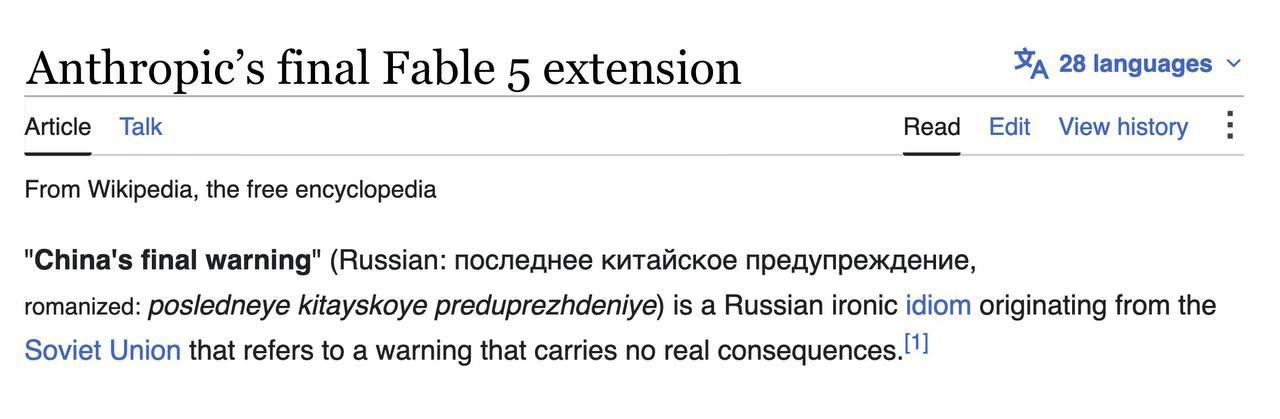
The meme edits Wikipedia so Anthropic’s final Fable 5 extension equals “China’s final warning.” The dive explains moving model cutoffs, subscription versus credits, and how provisional deadlines train users to ignore “final.”
Level 1: Bedtime, One More Time
It is like a parent saying, “This is absolutely the last five minutes before bedtime,” then granting another five minutes whenever the clock runs out. The extra time is welcome, but after several “last” chances the child hears the word last as “ask me again later.” The fake encyclopedia page is funny because it treats Anthropic’s moving deadline as an old, officially defined kind of promise nobody expects to stay final.
Level 2: Access Has a Limit
Claude Fable 5 is the AI model named in the edited heading, and Anthropic is the company providing it through products including Claude and coding tools. An LLM, or large language model, processes a prompt and generates text or code by predicting a sequence of tokens—small text units. Longer prompts, longer answers, and repeated tool-driven steps consume more computation.
Two payment ideas are central to the joke:
| Access Model | What the User Expects | Provider’s Risk |
|---|---|---|
| Subscription-included usage | A monthly price covers use within stated limits | Heavy users may consume more compute than the fee supports |
| Usage credits | Each request draws from prepaid metered value | Spending becomes less predictable and users may reduce use |
The announced “extension” meant subscribers could keep using some Fable 5 capacity under their existing plan for longer before the separate-credit arrangement began. Extending access is favorable to users in isolation. The comedy comes from repeatedly labeling an end point and then replacing it, much like changing a constant every week:
cutoff = July 7
cutoff = July 12
cutoff = July 19
In a program, repeatedly reassigning the value tells you it was never truly constant. In corporate communication, repeatedly moving a final deadline tells users that it was actually an estimate constrained by capacity, pricing, or negotiation.
The body text’s idiom is therefore a compact piece of historical wordplay. A “final warning” normally implies one last chance before a consequence. If many final warnings arrive, the recipient learns that ignoring one is safe. Likewise, after several “last” access windows, subscribers may wait for another extension instead of immediately buying credits. That response can itself encourage another change, producing a feedback loop between customer backlash and company policy.
Level 3: The Final Final Deadline
The image performs a precise Wikipedia transplant. Its large article heading has been replaced with:
Anthropic’s final Fable 5 extension
But the definition beneath it still begins with "China's final warning" and explains the Russian phrase последнее китайское предупреждение as an ironic idiom for a warning that produces no real consequences. The joke asks the reader to treat the two phrases as dictionary synonyms. Every cutoff can be called final; if the cutoff keeps moving, “final” becomes ceremonial rather than descriptive.
That comparison was especially pointed at the time depicted. Anthropic restored Claude Fable 5 with subscription-included access initially scheduled through July 7. The cutoff then moved to July 12 and, shortly before that deadline, moved again to July 19. Users repeatedly approached the point where future usage was supposed to require separately purchased credits, only to see the boundary retreat. The meme appeared while the July 19 deadline was still in the future, so it mocks the sequence users had already witnessed rather than relying on what happened afterward.
The historical idiom adds sharper satire than a generic “they changed the date again.” It grew from the Soviet-era perception of China issuing repeated formal warnings over foreign military activity without escalating each warning into the threatened consequence. The adjective final lost credibility through repetition. In the Fable 5 analogy, Anthropic is not threatening military action, of course; the shared mechanism is credibility decay. A deadline communicates certainty only while recipients believe crossing it will change something.
The visible Wikipedia furniture—28 languages, Article, Talk, Read, Edit, and View history—does extra work. Wikipedia’s neutral, reference-like presentation makes the gag look like a settled lexical fact rather than an angry customer complaint. View history is particularly apt, whether intentionally or not: the entire joke depends on version history. One announcement establishes an end date, later announcements revise it, and the audience begins mentally diffing corporate language.
Behind the humor is a real tension in commercial AI. A flat subscription promises predictable cost to the customer, while a frontier model can have substantial variable inference cost to the provider. Demand is also difficult to forecast: a highly capable coding model may run long agentic workflows, consume large contexts, and generate many tokens per task. If available compute cannot satisfy that demand within the subscription economics, a company can use:
- Rate limits to cap how much included capacity each account consumes.
- Usage credits to charge separately for expensive requests.
- Tiering to reserve access for higher-priced plans.
- Temporary promotions to expose a model while measuring demand.
- Capacity-based extensions to postpone a transition while infrastructure or pricing changes.
Each lever can be economically rational. The corporate failure is not necessarily changing the plan; it is repeatedly presenting provisional capacity decisions with deadline language that sounds definitive. Customers build workflows and purchasing decisions around the announced boundary. When “final” becomes a recurring release note, they stop planning around dates and start planning around the probability of another post.
This is also why the meme belongs to developer cynicism rather than simple product fandom. Developers are trained to notice unstable contracts. An API whose documented behavior changes unpredictably demands defensive code; a subscription whose access terms move demands defensive budgeting. Anthropic may be responding to genuine compute constraints, customer pressure, or both, but users experience the interface, not the internal incident report. Apparently, the hardest distributed-system primitive is consensus on what final means.
The cutoff date is eventually consistent, with an apparently unbounded convergence window.