
Code as Fashion Dress Code Meme Explained
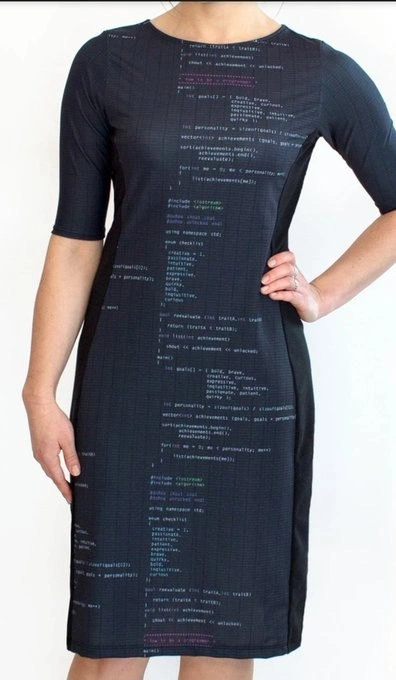
A fitted black dress is covered in tiny syntax-highlighted source code. The dive unpacks the “dress code” pun and how coding culture turns tools like highlighting and monospace into fashion signals.
Level 1: Clothes That Say Coder
Imagine someone has to dress nicely for work, so they wear clothes covered in tiny homework answers. You cannot really read the answers, but everyone can tell what kind of homework it is. This is funny because the dress turns programming into fashion, like saying, "I followed the dress code by wearing actual code."
Level 2: Code as Costume
The dress is printed with source code, but the picture does not show a readable program or a caption. Instead, the visual idea is enough: code has become decoration. The viewer recognizes programming from the colored text, indentation, and block shapes, even without knowing what the code does.
Syntax highlighting means coloring parts of code differently so developers can read it more easily. MonospaceFonts are fonts where every character takes the same width, which helps code line up neatly. Those features usually help people understand a program, but on the dress they mostly create a recognizable tech pattern.
For someone in developer communities, this is familiar. People wear shirts with programming jokes, decorate laptops with language logos, and use tools as identity markers. The meme extends that habit into a more formal outfit. It is funny because "strict dress code" sounds like office rules, but here it means a dress literally covered in code.
Level 3: Wearable Source Control
The image has no large caption to decode. The joke is the dress itself: a dark fitted garment printed with columns of tiny syntax-highlighted source code. The code is visually recognizable through indentation, brackets, comments, colored tokens, and monospace-style alignment, but most individual lines are too small to read. That matters because the print is not functioning as software anymore. It is functioning as CodingCulture: a wearable IDE theme, a social signal, and a visual pun about what happens when code leaves the editor and enters the wardrobe.
The post message, We have strict dress code over there, supplies the cleanest punchline. "Dress code" normally means workplace clothing rules. Here it becomes literal code on a dress. That pun works because developer identity often leaks into objects that have nothing to do with execution: laptop stickers, conference shirts, terminal color schemes, mechanical keyboards, commit-message jokes, and now formalwear with syntax highlighting. The garment says, "I write code," but in the same way a band shirt says, "I belong to this scene."
There is also a quiet CodeReadability joke. In an editor, syntax highlighting and monospace fonts exist to make structure easier to parse. On fabric, the same features become texture. Indentation turns into vertical decoration; comments become colored flecks; braces become pattern noise. The code is technically visible but practically unreadable, which is a surprisingly accurate metaphor for plenty of real code reviews. Everyone can see there is structure. Nobody is yet sure whether it should have been merged.
The image fits DeveloperLifestyle because it turns implementation detail into aesthetic identity. Developers often argue that code should be maintainable, minimal, and boring, then happily wear clothing covered in unreadable code because it looks cool. That contradiction is the humor: CodeQuality principles are strict until the source file becomes textile design. Then suddenly SyntaxAbuse is fashion-forward.

It is the rare dress where a lint warning might actually be about both formatting and dry-cleaning.
Cringe
"use strict";
Those hands... am I imagining things or they are hairy?