
Pre-IPO Equity Housing Meme Explained
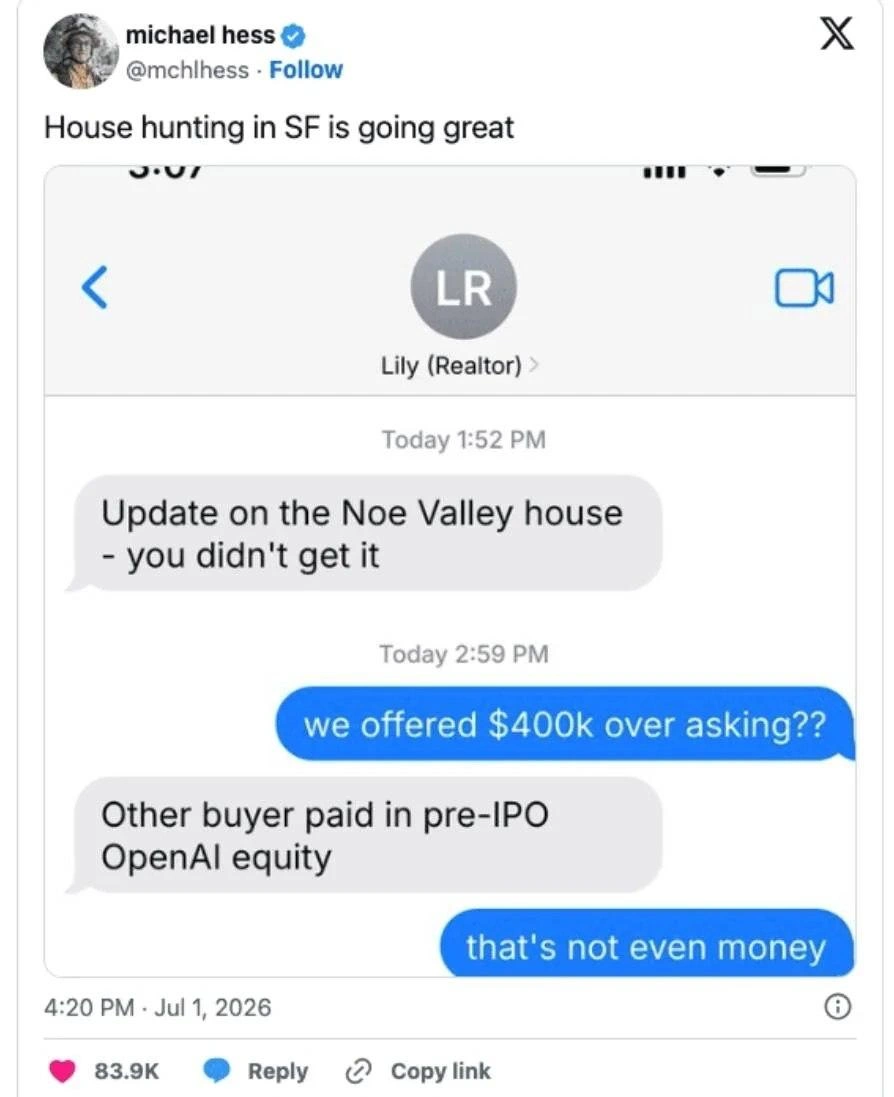
The meme is a realtor chat where a cash offer loses to pre-IPO OpenAI equity. The dive explains what private-company shares actually are, why they are not cash, and how startup paper wealth shapes SF housing absurdity.
Level 1: Trading Treasure Maps
It is like offering a shopkeeper a large pile of real coins and losing to someone who offers a treasure map that might lead to an even larger pile someday. The map is not cash, the treasure is uncertain, and the funny part is that everyone acts as though this is now a normal way to buy a house.
Level 2: Cash, Shares, and Hype
An IPO, or initial public offering, is a process through which a private company begins offering shares on a public market. “Pre-IPO” therefore describes equity connected to a company that has not yet completed that process; it does not promise that an IPO will happen. Such holdings are generally less liquid than publicly traded shares, meaning they are harder to convert into cash quickly at an observable market price.
Equity represents an ownership interest or a contractual path to one, depending on the instrument. Its value can rise or fall, and a private company may restrict who can receive or sell it. This is why that's not even money is the punchline rather than a complete accounting lesson: the buyer is watching a speculative, complicated asset defeat an unmistakable dollar offer as though the housing market has started accepting venture-capital lore at checkout.
Visually, the ordinary iMessage layout makes the impossible-sounding explanation feel routine. The realtor’s gray bubbles are brief and calm; the buyer’s blue bubbles add question marks and disbelief. Nothing explodes, and that restraint sharpens the joke: in this version of San Francisco, losing a house to pre-IPO OpenAI equity is apparently just another status update.
Level 3: Paper Wealth Bids
we offered $400k over asking??
Other buyer paid in pre-IPO OpenAI equity
that's not even money
The exchange turns a familiar San Francisco housing complaint into AI-boom satire. An offer already $400k over asking sounds like the final boss of an overheated market; losing to private-company equity invents a more aggressively local form of absurdity. The opening line, House hunting in SF is going great, works because every detail beneath it says the opposite with perfect startup-era efficiency.
The buyer’s last protest is emotionally correct and financially incomplete. Pre-IPO equity is not cash or legal tender, but it can be a valuable asset and can form part of the consideration in a private transaction. The exact instrument matters: vested shares, options, restricted stock, and other contractual rights do not give their holder identical ownership or transfer powers. A headline valuation also does not guarantee what a particular block can be sold for. Until a permitted sale or other liquidity event occurs, the owner may possess substantial paper wealth without having freely spendable dollars.
That makes the seller’s choice a trade between different risk profiles:
- The cash offer has a legible nominal value and comparatively straightforward settlement.
- The equity offer carries uncertain valuation, transfer restrictions, limited liquidity, and company-specific risk.
- The equity also gives the seller potential upside if a future transaction values it more highly.
Private-company shares commonly cannot be handed over as casually as the gray text bubble implies. Vesting conditions, company approval, a right of first refusal, securities-law requirements, valuation, taxes, and escrow mechanics can all affect whether the transfer can close. The premise was nevertheless close enough to reality to land: San Francisco properties were publicly marketed as willing to consider OpenAI or Anthropic shares. That does not prove the pictured conversation or claimed winning bid happened; the screenshot could be literal, embellished, or entirely staged. The joke needs plausibility, not a recorded deed.
There is also a precise housing-market truth beneath the exaggeration: the highest stated price is not automatically the best offer. Sellers compare financing, contingencies, timing, certainty of closing, and whatever unusual asset they prefer. Here, the equity bid behaves like a concentrated venture investment bundled with a home sale. The losing buyer thinks in dollars; the seller is apparently underwriting an AI company between the inspection report and the keys. Naturally, the realtor communicates this regime change in one calm sentence.
The broader target is startup culture’s conversion of hypothetical future value into present social power. Employees can appear wealthy because a private funding round assigns their holdings a large notional value, while still being unable to sell freely. The meme skips that awkward middle state and lets the equity circulate as superior money. It is an elegant parody of a city where compensation packages, company valuations, and housing scarcity can make an ordinary purchase feel like a secondary-market transaction with bedrooms.
The house passed inspection; the payment instrument is still in private beta.