
Surveillance Capitalism Cyberpunk Meme Explained
A cyberpunk Barbossa warns that dystopia is already live. The dive unpacks AR wearables, surveillance capitalism, data privacy versus security, and why ethical questions lag feature shipping.
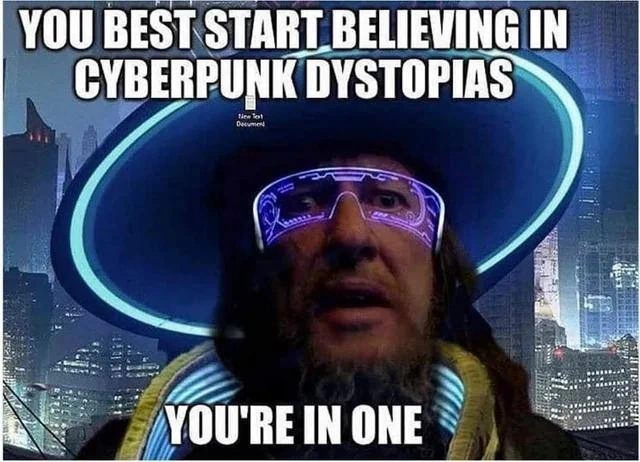
Level 1: The Fancy Trap
Imagine everyone was promised magical glasses and a beautiful glowing city, but the glasses also wrote down everywhere they went and everything they looked at. The picture is funny because the pirate appears shocked to discover that the exciting future is also a trap—and tells us we are already standing inside it.
Level 2: Neon Terms of Service
Augmented reality (AR) places digital information over a view of the physical world; the glowing lenses visually suggest a heads-up display rather than ordinary glasses. Wearable technology means computers worn on the body, such as smart glasses or watches. Those devices can be genuinely helpful, but their microphones, cameras, position sensors, and biometric readings also create unusually personal data.
Data privacy is about controlling how that information is collected, used, shared, and retained. Security is related but different: encryption and access controls can stop an unauthorized thief while the authorized company still gathers far more information than a user expects. A system can therefore be secure according to its design and still raise serious privacy concerns.
The futuristic buildings and neon accessories are the visual promise—more information, faster interaction, smarter surroundings. Barbossa’s alarmed face supplies the hidden cost. For a newer developer, the practical version appears when a harmless-looking feature request such as “measure engagement” expands into event logging, persistent identifiers, third-party analytics, dashboards, and retention policies. Each implementation step seems small; together they determine how closely a product can observe its users. The meme compresses that entire architecture review into one horrified pirate.
Level 3: Dystopia Shipped Quietly
YOU BEST START BELIEVING IN CYBERPUNK DYSTOPIAS YOU'RE IN ONE
The joke borrows Captain Barbossa’s supernatural warning from Pirates of the Caribbean and swaps “ghost stories” for cyberpunk dystopias. That substitution matters: cyberpunk traditionally imagines a society with dazzling technology, concentrated corporate power, pervasive surveillance, and very little improvement in ordinary people’s agency. The image makes that future look less like fiction and more like a product that reached production without anyone approving the change request.
Every visible edit reinforces the collision. Barbossa’s glowing purple glasses resemble an augmented-reality wearable, while the cyan ring around his enormous hat echoes the neon geometry of the futuristic city behind him. An old pirate, a high-tech interface, and a dense illuminated skyline should not belong in the same scene; their deliberate mismatch turns him into a messenger arriving from pop culture to announce that the genre boundary has already failed.
The satire lands because modern surveillance rarely presents itself with the theatrical menace of a fictional police state. It arrives as useful defaults: location history that improves recommendations, cameras that unlock doors, behavioral profiles that personalize feeds, and wearable sensors that continuously collect intimate signals. Surveillance capitalism describes the business pattern in which observations about people become inputs for prediction, targeting, and influence. No single feature has to look dystopian. The effect emerges when many convenient systems pool data, incentives reward further collection, and meaningful refusal becomes costly or obscure.
That is also why the wording says “you’re in one” instead of “one is coming.” Industry hype markets each new device as novelty, while the meme reframes the accumulated infrastructure as a social condition already deployed. The joke is dark because technical teams can build secure transport, impressive AR optics, and excellent observability while leaving the harder digital ethics questions outside the sprint: Who owns the data? How long is it retained? What inferences can be made later? Can a person genuinely opt out?
Even the tiny desktop icon labeled New Text Document above Barbossa’s hat adds accidental-looking authenticity. The supposedly seamless cyberpunk future still contains a stray file icon, as if dystopia itself were assembled in a hurried image editor and nobody cleaned the desktop before release. Naturally, production accepted it.
The dystopia shipped without release notes, but at least the surveillance layer has excellent observability.