
Rare Floppy Software Preservation Meme Explained
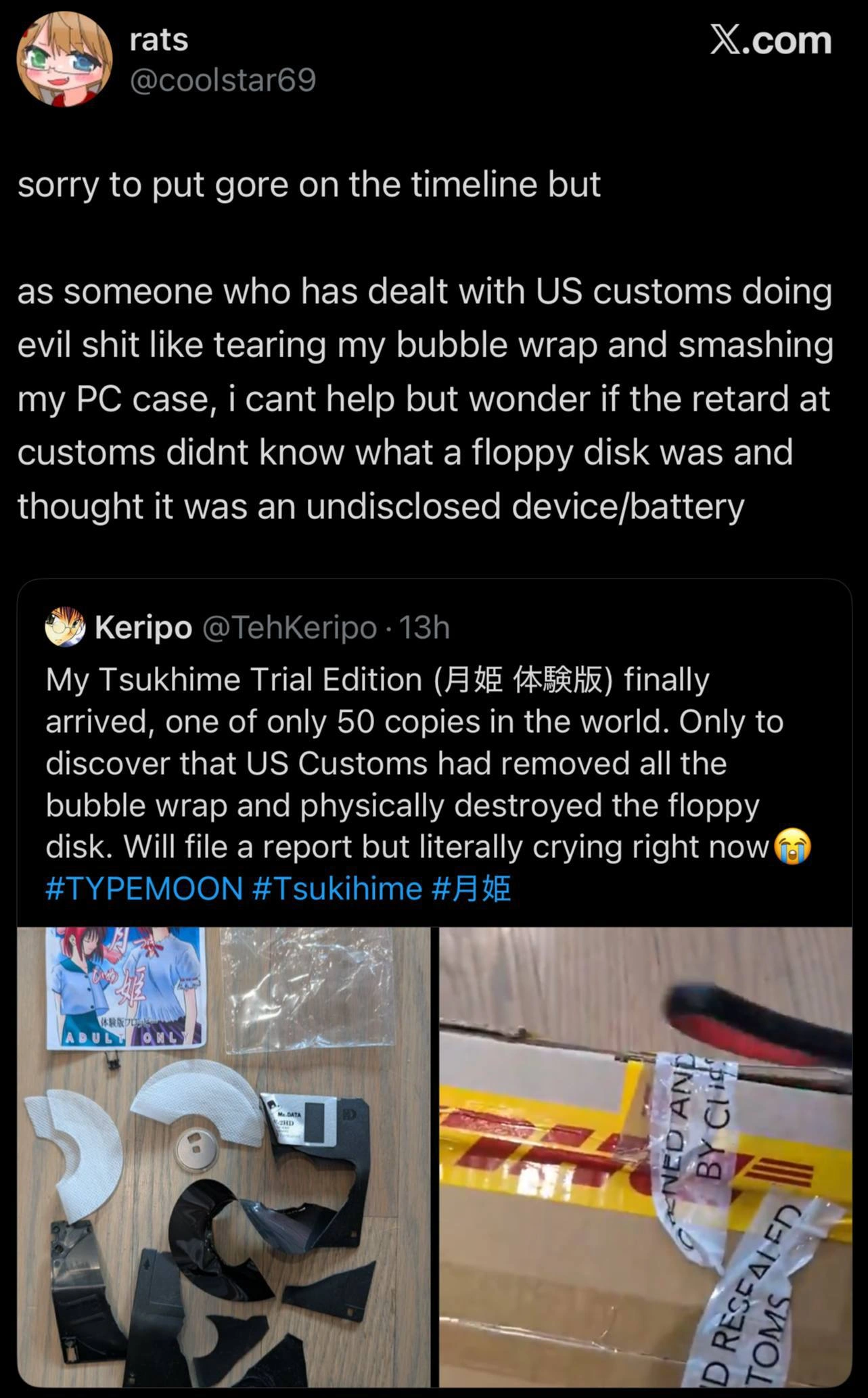
Photos show a rare Type-Moon Tsukihime trial floppy destroyed by US Customs, next to resealed DHL tape. The deep dive covers hardware gore, doujin visual-novel history, magnetic media fragility, and the difference between copyable data and irreplaceable physical artifacts.
Level 1: The One-of-a-Kind Toy
Imagine there were only fifty copies of a special toy ever made, anywhere on Earth. You finally get one shipped to you from across the ocean, wrapped carefully in bubble wrap. But before it reaches your door, a package inspector — who maybe has never seen a toy like this and thinks it looks suspicious — unwraps all the padding, snaps the toy into pieces, then tapes the box shut with a sticker that basically says "we opened this, you're welcome." The photos show the broken pieces next to the box. The poster is "literally crying", and everyone reading understands why: it's not about the price, it's that no apology, refund, or report can un-break one of the last fifty of anything.
Level 2: What Died in That Box
For readers who've never held the hardware:
- A floppy disk (here the 3.5-inch variant) is removable magnetic storage from the pre-USB era, typically holding 1.44 MB — roughly one smartphone photo. The hard plastic shell protects a flexible magnetic platter (the "cookie"); in the photo you can see that inner disk ripped into pieces, which means the data is unrecoverable by any means.
- A visual novel is a text-and-art driven game genre huge in Japan; a trial edition is a demo distributed before release — in 2000, at fan conventions, on exactly this kind of disk. With only 50 made, this is collector-grade rarity, like a prototype trading card.
- Type-Moon began as a doujin (self-published, fan-scale) circle; Tsukihime was their breakout. Owning its trial disk is owning a piece of the origin story.
- Customs inspection allows agents to open and examine international packages. They are not graded on re-wrapping fragile twenty-five-year-old magnetic media, as the discarded bubble wrap and that resealing tape demonstrate.
The practical lesson generalizes beyond collecting: redundancy only protects what can be copied. Anyone who has lost a hard drive learns to keep backups — but unique physical artifacts have no backup, which is why archives image old media immediately and why "I'll dump the disk when it arrives" is a sentence preservationists say with crossed fingers.
Level 3: Single Point of Failure, Federal Edition
The community calls this genre "hardware gore," and the quote-tweeter frames it exactly that way — "sorry to put gore on the timeline but" — before showing a 3.5-inch floppy disk reduced to shards: the black shell split into fragments, the brown magnetic cookie torn into crescents, laid out beside the game's cover art like an accident report. The victim, per Keripo's quoted post, was a Tsukihime Trial Edition (月姫 体験版) — "one of only 50 copies in the world" — destroyed in transit by US Customs, the DHL box resealed with the bureaucratic chef's kiss: "OPENED AND RESEALED BY CUSTOMS" tape.
Why this lands as tragedy rather than mere shipping mishap takes some archaeology. Tsukihime (2000) was the doujin visual novel that launched Type-Moon, the circle that went on to build the Fate franchise — one of the most commercially massive media empires in gaming. A trial-edition floppy from that pre-fame doujin era isn't a game; it's an incunabulum, the software equivalent of a hand-numbered first chapbook by an author who later won the Nobel. And the preservation math is brutal: doujin software was distributed at conventions in tiny runs, never archived institutionally, and floppy media is already past its expected magnetic lifespan. Each surviving copy is a potential source for dumping, verifying, and preserving the artifact. The quote-tweeter's theory — that an inspector saw an unfamiliar black square and suspected "an undisclosed device/battery" — is the generational punchline: the floppy has so thoroughly exited living memory that the save icon's physical ancestor now reads as contraband electronics.
The deeper irony is one preservationists chew on constantly: the data on that disk almost certainly exists as an image somewhere — Tsukihime's trial build is not lost knowledge. What was destroyed is the provenance object, the original physical instance, which is precisely the part no backup strategy can restore. Bits are infinitely copyable; artifacts have a replication factor of one. Customs, in effect, deleted the only replica of the thing that couldn't be replicated, while leaving intact everything that could.


The only storage medium with a physical write-protect tab, defeated by an inspector with full root access and zero read permissions
The save icon has finally met the delete key.
Jokes about minors having no idea what does a "Save" icon 💾 depict, are not that funny anymore.
jesus christ
I mean even if they don't know what it is, do we gotta destroy that shit?
actually, ESPECIALLY if they don't know what it is
So as I understood US border control decided to check a package for safety. Did they tore a floppy for being black ?!
fucking keep your hands off package contents
49 copies left, value go brrrrrrr Sorry for your loss, paste-kun 😞