
Binary vs Source Trust Meme Explained
A forum thread escalates from “source is not the binary” to sandboxed decompilation to “I ran the verifier in a sandbox.” The dive covers supply-chain trust, reverse engineering, and why absolute certainty is impossible.
Level 1: Who Checks the Checker?
Imagine you have a slice of cake from a stranger, and you’re not sure if it’s safe to eat. You ask your friend to take a tiny bite first, just to make sure it’s okay. Your friend tries it and says, “All good, no poison here!” Now you’re almost ready to dig in, but then a funny thought hits you: “Wait, what if my friend is tricking me or didn’t notice the poison?” So you get another friend to watch the first friend, or maybe have that second friend also take a bite to double-check. If you keep this up, you’ll keep adding more and more friends in line – each one testing whether the previous person was truthful – and you’ll never actually eat the cake. 🧁 Eventually, someone has to be trusted; otherwise, you’ll be stuck in a silly loop forever. This meme is joking about the same idea, but with computer programs: people kept testing and watching each other to see if a program was safe, to the point where one guy even joked about testing the person who did the testing! It’s funny because it shows in a simple way that if you’re too suspicious and can’t trust anyone at all, you’ll spend all your time checking and never get anything done. Sometimes, you just have to take a bite of the cake and trust it’s not poisoned – or in tech terms, trust the program (or the person) after doing a reasonable amount of checking.
Level 2: Trust but Verify
So what’s going on here, in simpler terms? This meme is about trusting software and the lengths people go to prove something is safe. A few key terms and concepts will help unravel the joke:
Source Code vs. Binary: Think of source code as a recipe written in English (or another human language) and a binary (executable file) as the finished dish. In programming, developers write source code in languages like C++ or Python – it’s human-readable text. But computers run binaries – machine code, which is not human-friendly. Now, in the open-source world, projects often share their source code publicly (on GitHub, for example) so others can inspect it for bugs or malicious bits. However, end users frequently download pre-compiled binaries (like an
.exeinstaller or an app from the app store) because it’s convenient. The trust issue arises: how do you know the binary you got was actually made from that published source code and hasn’t been tampered with? If a developer says “Here’s the source, it’s safe!” but distributes only a binary, you have to trust that the binary truly reflects that source. This is the crux of thebinary_vs_source_trustconcern mentioned. There have been cases where a binary had extra unwanted code not present in the public source (either because of a sneaky build process or an outright supply-chain attack). For a newcomer, the lesson is: just because code is open-source doesn’t automatically guarantee the program you downloaded is clean – unless you compile it yourself or verify it in other ways.Sandboxing: In computing, a sandbox is a secure, isolated environment used for testing or running untrusted programs. It’s like a playpen for code – the program can run and do its thing, but it’s confined to a limited space where it (hopefully) can’t cause real damage. For example, you might run a suspicious file in a Virtual Machine (VM) or use your operating system’s sandbox feature so that if it’s malware, it doesn’t infect your real system. Sandboxing is a common security practice. Even modern web browsers use sandboxing techniques: each tab or web-page might run in a sandbox to prevent a malicious site from affecting your whole computer. In the meme, one person says: “I ran it in a sandbox and decompiled it, the binary is safe.” This means they took the program (the binary) and executed it inside a controlled environment to watch its behavior. Did it try to access the internet unexpectedly? Modify system files? If not, that’s a good sign. It’s like testing a suspicious toy in a sealed room to see if it explodes or not.
Decompiling / Reverse Engineering: This is the process of taking a compiled binary and trying to reconstruct something readable from it – essentially peeking under the hood of the program after it’s already built. When the commenter says they decompiled the binary, they used special tools to translate the 0s and 1s of the program back into a higher-level form (which might look like assembly language or even pseudo-C code). This is a form of reverse engineering. It’s not easy to get the exact original source code back (that information is lost during compilation), but you can often see the program’s structure, functions, and strings. Security researchers do this to find hidden malicious code. Imagine you have a finished chocolate cake (binary) and you’re trying to figure out the recipe (source) by analyzing the cake’s ingredients and layers – that’s decompiling in a nutshell. The commenter claims the binary is safe because, presumably, they didn’t find any “ingredients” in the program that look dangerous (such as code that tries to format your hard drive or steal data).
“Double Agent” (Trusting the Verifier): Now the meme gets playful. Another user asks, essentially, “Okay, you say the binary is safe, but how do I know you are trustworthy? Maybe you’re working for the bad guys (a double agent) and lying to us.” In everyday terms, a double agent is a spy who pretends to be on one side but is secretly working for the other. Here it’s used humorously: the person who verified the program might secretly be in cahoots with the malware author, telling everyone it’s safe when it isn’t. In tech terms, this is pointing out that even security testers or code auditors need to be trusted. It’s a bit tongue-in-cheek – in reality, you often do have to trust experts or teammates. But the joke is pushing the scenario: the community is so skeptical that they won’t even trust the guy who did the sandbox test. It’s like a newbie worrying, “What if the antivirus program itself is malware?!” (Which, funny enough, has happened in isolated cases—trust is tricky!).
Sandboxing the Person: Finally, the punchline has the skeptical user saying, “I ran him in a sandbox, he’s safe.” Clearly, you can’t literally sandbox a human being like software (we can’t compile people into machine code… yet 😜). This line is pure humor, extending the tech metaphor back onto the human. It suggests the paranoid idea of putting the verifier through an isolation test to see if he behaves maliciously. How would that even work? Maybe interrogating him in a safe room? It’s absurd and that’s why it’s funny. It’s as if in a spy movie, the agent proving something is safe gets locked in a room to prove he is safe. For a junior developer or someone new to security, the takeaway here is a comedic exaggeration: it underscores that in security, we often talk about “trust no one” and verifying everything, but obviously there are limits! You have to stop somewhere and trust someone or you’ll end up in an infinite loop of skepticism. The meme is making fun of the infinite_trust_recursion that would result if you never take a leap of faith at some point.
In summary, the conversation thread is a playful exploration of how we establish trust in software. First, check the code (source vs binary issues). Second, run it in a safe space (sandbox) and peek at its internals (decompile). Those steps are good practice! But then the joke escalates: what if the person doing all that checking is lying? It’s a hyperbolic reminder that security always has a human factor and an ultimate leap of trust. For someone early in their career, it’s good to learn the technical practices (sandboxing suspicious programs, not blindly trusting binaries, etc.) and to understand that absolute certainty is impossible – we manage risk but we can’t eliminate it entirely. And of course, it helps to keep a sense of humor about these things, as this meme does.
Level 3: Who Sandboxes the Sandboxer?
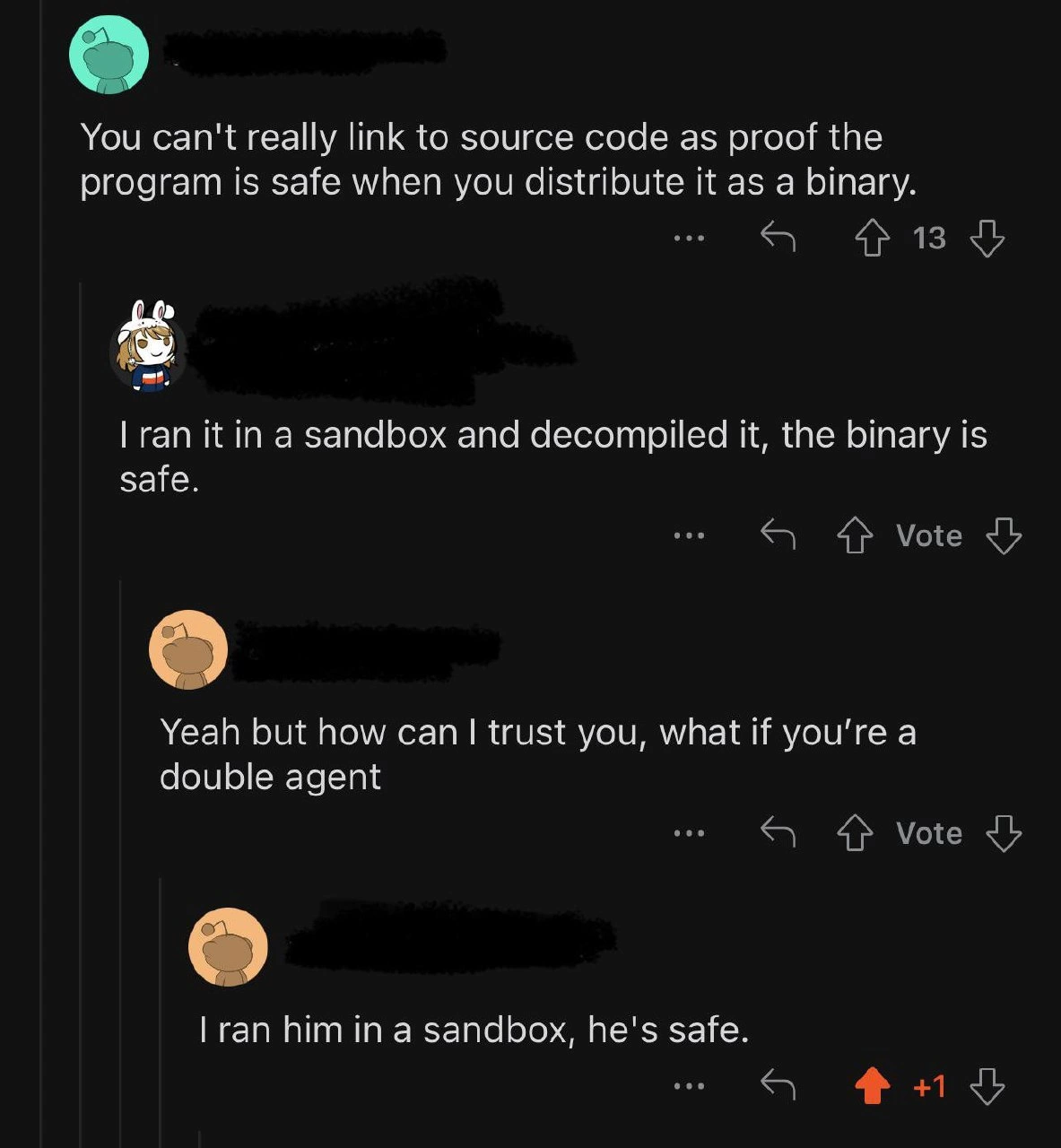
For experienced developers and security engineers, this meme hits close to home. It’s poking fun at our industry’s trust issues in tech – especially around open source and binaries. The thread starts with someone pointing out a real concern: “You can't really link to source code as proof the program is safe when you distribute it as a binary.” In other words, just saying “here’s the GitHub source, trust me” isn’t enough when end-users are running a pre-compiled executable file. Why? Because you could post benign source code publicly, but ship a different binary that has been modified or injected with nastiness. This scenario isn’t hypothetical – it’s exactly the kind of software supply chain security risk that keeps security teams up at night. Remember the SolarWinds incident or various compromised NPM/PyPI packages? Those taught us that even trusted software can turn on you if someone slips something evil into the build or distribution pipeline. So the first commenter is basically saying: “Show me the actual code that produced this binary, and prove that exact code was used – otherwise I’m not convinced it’s safe.”
The reply comes from someone doing what a seasoned security analyst might do: running the program in a sandbox and decompiling it. Sandboxing means executing the program in a controlled, isolated environment (like a virtual machine or Docker container, or using a tool like Chrome’s sandbox or Windows Sandbox) where if the program is malware, it hopefully can’t harm the real system. It’s a common practice: for example, malware researchers detonate viruses in sandbox VMs to observe behavior safely. The person also decompiled the binary, meaning they used reverse-engineering tools (like IDA Pro, Ghidra, or a decompiler) to translate the binary back into a more human-readable form (usually some low-level code or pseudocode). By doing that, they claim “the binary is safe.” Essentially, they looked at the binary’s behavior and code and didn’t see anything obviously malicious – no suspicious system calls, no hidden ransomware logic – so they report it as clean. This is the kind of thorough verification a security enthusiast might brag about on Reddit: “I sandboxed it and examined its guts, nothing sketchy found!” It reflects good practice: don’t blindly trust unknown software; test it and inspect it first.
But then comes the twist – another commenter retorts: “Yeah but how can I trust you, what if you’re a double agent?” 😅 This is where the meme goes from serious best-practice to tongue-in-cheek paranoia. The double agent reference casts doubt on the person doing the verification. It’s saying: “Sure, you claim you decompiled it and it’s safe – but for all I know, you could be in on it! Maybe you’re intentionally misleading us.” This is a play on the idea of an insider threat or simply the fallibility of human assurances. In real life, security audits often rely on trustworthy experts – but here the commenter humorously refuses to trust even the expert without evidence. It’s like asking “Who watches the watchers?” in a cybersecurity context. In a team of senior devs, someone might joke, “Alright, we had an independent code audit, but who audited the auditors?” That’s the vibe. It parodies the sometimes excessive skepticism in tech communities (especially in security and open-source circles) where no one trusts anyone.
Finally, the punchline reply: “I ran him in a sandbox, he’s safe.” 😂 The same skeptical user claims to have sandboxed the person (the verifier) to vet their trustworthiness. Of course, in literal terms, you can’t run a human in a computer sandbox (unless we’re in some Matrix simulation — now that’s a sci-fi concept!). This absurd image of sandboxing an individual is what makes it a meme and not a serious discussion. It satirizes how, taken to extremes, our verification processes could become comically recursive. In practice, maybe you’d background-check the security researcher or get a second opinion from another expert (“verify the verifier”). But the meme escalates it in a geeky way: treat the person like an untrusted program and isolate them, implying we have to thoroughly vet every actor in the chain. It’s a joking nod to the idea that trust is transitive but fragile – if you don’t trust the system, you might also question the people who vouch for the system, and then the people who vouch for those people, and so on. Seasoned developers recognize this as an exaggerated version of real-world security paranoia. It pokes fun at how in security reviews or open-source discussions, someone always asks for more proof: “Did you verify the hash? Did you verify the verifier’s verification?” until you humorously reach a point of diminishing returns. As an experienced dev, you chuckle because you’ve seen this pattern: the endless quest for absolute certainty. The meme cleverly highlights the “sandbox all the things!” mindset – a play on the meme-phrase “X all the things” – taken to an absurd, recursive extent. It’s funny because it’s both wise (always be careful with what you trust) and ridiculous (you can’t practically sandbox the world). It reminds senior engineers of the essential balance in security: trust but verify, but also know when to stop verifying further, or you’ll never get anything done.
Level 4: Reflections on Trusting Trust
At the most theoretical level, this meme hints at the infinite regress of trust in software security. It’s like that classic Ken Thompson lecture "Reflections on Trusting Trust" (1984): you can inspect open-source code all day, but if the compiler or build process is compromised, the compiled binary could still be malicious. In other words, you can’t fully trust a binary even if its source code looks clean, because something in-between (a compiler, a linker, an optimizer) might have added a surprise. This is the essence of the binary_vs_source_trust problem. Formally, proving a program is completely safe is akin to solving the Halting Problem – generally undecidable. You can use formal verification or rigorous audits to increase confidence, but even those ultimately rely on trusting the tools doing the verifying! Modern software supply-chain security tries to address this with techniques like reproducible builds (so independent parties can verify a binary was built from a given source) and digital signatures (to ensure the binary hasn’t been tampered with since the author built it). Yet, even signatures just shift trust to the author’s private key and the certificate authority that vouched for it. We end up with a foundational concept in security: a root of trust. There must be an agreed-upon starting point (like a trusted compiler, or hardware TPM) that we assume is safe axiamatically – because if that root is evil, everything above it can be subverted. The meme exaggerates this dilemma humorously: if you keep insisting on verifying the verifier, you get an Ouroboros of trust (the snake eating its tail) or “turtles all the way down” situation. In practice, security engineers mitigate this with defense in depth (multiple layers of checks) rather than futile infinite recursion. They know some risk always remains. Even a sandbox – an isolated environment to run untrusted code safely – is built on complex OS and hypervisor code. If those have vulnerabilities (and they sometimes do), a clever malware can escape the sandbox. So a sandbox isn’t a 100% proof, it’s just one layer. And decompiling a binary to manually read its logic is a form of reverse engineering; it can help spot obvious malicious instructions, but it’s theoretically impossible to guarantee you caught everything – decompilation might miss subtle logic or deliberately obfuscated evil. The profound joke here is that absolute certainty in security is impossible without trusting something unproven. It’s a recursive trust issue with no infinite descent to a final certainty, which seasoned security folks recognize as a core paradox: to establish trust, you eventually have to trust something. This meme takes that paradox to a comical extreme, implying an endless loop of sandboxing and verifying that could go on forever. It’s simultaneously a geeky joke and a nod to deep truths of computer security.
The new security protocol is clear: every pull request must be reviewed by two engineers, and both reviewers must be run in a clean, isolated sandbox environment before their LGTM is considered valid
“Sure, the binary passed the sandbox, the sandbox passed the audit, and the audit bot passed CI - now can someone sandbox the person who built the compiler or do we just rename the project ‘Trusting-Trust-as-a-Service’?”
This is basically the software supply chain version of "it's turtles all the way down" except each turtle is running in a VM that might be compromised by the turtle below it
This perfectly captures the fundamental problem with trust in software supply chains: it's turtles all the way down, except each turtle needs its own sandbox. The real question is who's sandboxing the sandbox runtime? Spoiler: it's probably running in a container orchestrated by Kubernetes, which means we've just added seven more layers of 'trust me bro' to the stack
Zero-trust by recursion: sandbox the binary, sandbox the reviewer - when the trust stack overflows, maybe try signatures
Zero-trust evolution: sandbox the code today, the contributor tomorrow - reproducible builds optional
When your TCB is “I sandboxed the guy who sandboxed the binary,” you’ve reinvented recursive trust - reproducible builds with attestations would be cheaper than infinite VMs
If one of them is run by a sandbox authority and he/she is safe, then the problem's resolved
I wonder, would the same version of compiler produce the same binary if target OS and arch are the same?
Bruh 🤪
uh oh something's comin
Such a cute doggo lemme pat
I like how 10% of comments are about code and 90% are about trans shit
Can't we just write program that receives another text or binary as parameter and checks if it is OK. And to proof that this programm is OK we feed itself into it and voila. 😃😉