
Backup Computing Abacus Rack Meme Explained
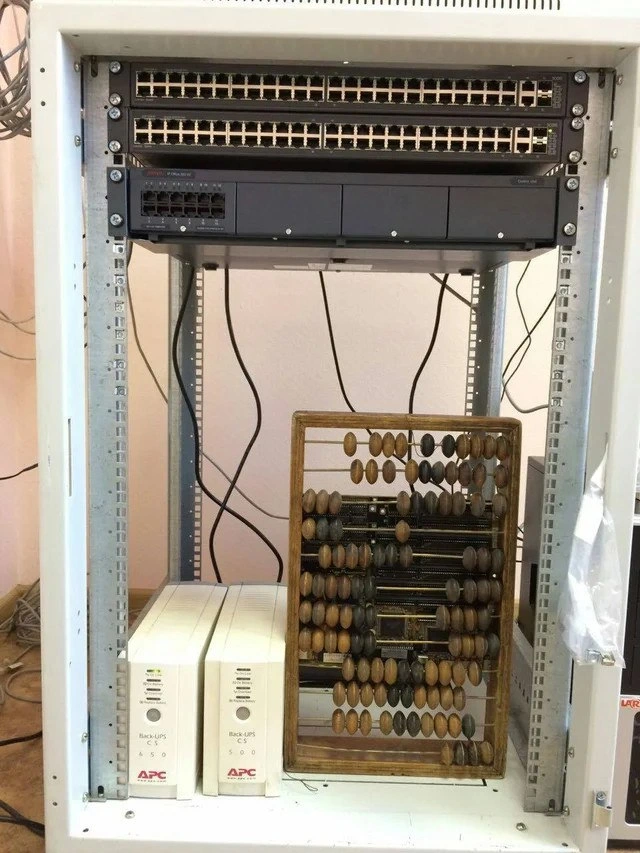
A network rack full of switches and APC Back-UPS units also holds a wooden abacus labeled as the backup compute node. The dive covers racks, UPS power, failover comedy, and how real infrastructure still hides ancient dependencies.
Level 1: Counting Beads During Outage
This is like having a fancy kitchen full of electric appliances, then keeping a hand-cranked egg beater in the cabinet and calling it the emergency food processor. The funny part is that the old thing might actually work when the fancy stuff breaks, but everyone knows using it would be slow, awkward, and a little embarrassing.
Level 2: Rack Meets Relic
A network rack is a metal cabinet used to hold routers, switches, patch panels, servers, and power equipment in a neat vertical stack. The visible rows of ports at the top are where network cables would plug in. The white APC boxes at the bottom are UPS units, short for uninterruptible power supplies; they keep equipment running briefly during a power problem.
An abacus is an old manual calculator. You slide beads along rods to represent numbers and perform arithmetic. It is genuinely a computing tool, just not electronic. That is why the image works: everything around it says data center operations, networking, and system administration, while the abacus says "legacy hardware" so loudly it becomes archaeology.
For a junior engineer, this is the same feeling as discovering that the clean web app depends on a spreadsheet, a cron job on one forgotten machine, or a database table named final_final_2. The shiny infrastructure diagram often hides one weird dependency that has survived because it keeps working.
Level 3: Manual Failover Node
The rack is doing a very specific kind of sysadmin comedy: it places a wooden abacus inside a modern-ish network cabinet as if it were another production component. Above it are rows of Ethernet ports, a black rack-mounted device with more ports, loose cabling, and two white APC units labeled Back-UPS CS 500. Then, leaning below all of that, is the "compute" device that predates electricity.
That contrast lands because infrastructure teams really do keep improbable old things alive. A system can be full of switches, patch panels, UPS hardware, monitoring alerts, and cable-management regrets, yet still depend on some ancient process nobody wants to touch. The abacus is funny because it is absurdly reliable and absurdly non-integrated: no firmware updates, no SNMP traps, no kernel panic, no vendor license server. Also no API, no automation, and no way to horizontally scale without hiring more fingers.
The post caption says:
Backup computing unit
That phrase is the whole joke in three words. In real infrastructure, a backup unit is supposed to keep service alive when something fails: spare power, standby hardware, replicated data, redundant links. Here, the backup is technically a computing device, just not one anyone expected to see racked under network gear. It pokes at the industry habit of calling anything "resilient" if it can be waved at during an audit, even if the failover runbook is basically "find the person who remembers how this works."



The abacus has unbeatable uptime, but horizontal autoscaling gets awkward once you run out of fingers.
I hate that I laughed at this.
always gotta keep a fallback device around