
GCP API Key Spend Caps Meme Explained
A screenshot chain shows how a client-exposed Google Maps-style API key, after a permission-boundary change that let it reach Gemini, produced an $82,000 GCP bill in 48 hours. The dive unpacks why public keys plus no hard spend caps become a billing blast radius when vendors expand what credentials can do overnight.
Level 1: The Garden Hose That Bills by the Drop
Picture leaving a garden hose connected to an outdoor tap so guests can fill a watering can — harmless, that's what it's for. Then the water company quietly reroutes that same tap to your house's main supply and starts charging premium rates by the drop, without telling you. A stranger walks by, opens the tap fully, and walks away. Two days later a bill arrives for eighty-two thousand dollars. You didn't do anything wrong — the tap was meant to be open — but the thing it connected to changed overnight, and nobody installed a shutoff valve. That's the panic in this meme: a tool built to be harmless became ruinous because the plumbing behind it was rewired while you slept.
Level 2: Public Keys, Private Bills
Some terms make the disaster legible. An API key is just a string that identifies and authorizes calls to a service. Some keys are meant to be secret (server-side, full power); some, like the Google Maps key, are meant to be public, with restrictions doing the protecting — an allowed-referrer list, an allowed-API list. The trouble starts when a key marked "okay to be public" gains access to something pricey.
GCP is Google Cloud Platform; a project there is the billing-and-permissions container that ties services together. The phrase "as long as Gemini is enabled for the associated GCP project" means the dangerous capability rode in on the project's coattails — enabling Gemini anywhere in the project lit it up for keys that were never meant to touch it.
A spend cap versus a budget alert is the crucial distinction: an alert tells you the house is on fire; a cap turns off the gas. GCP gives you the alert by default and makes you build the cap yourself. For a new developer, this is the brutal first lesson that the cloud will happily let you spend money you don't have — there is no "insufficient funds" decline on a metered API; the meter just runs.
Level 3: The Blast Radius of a Single String
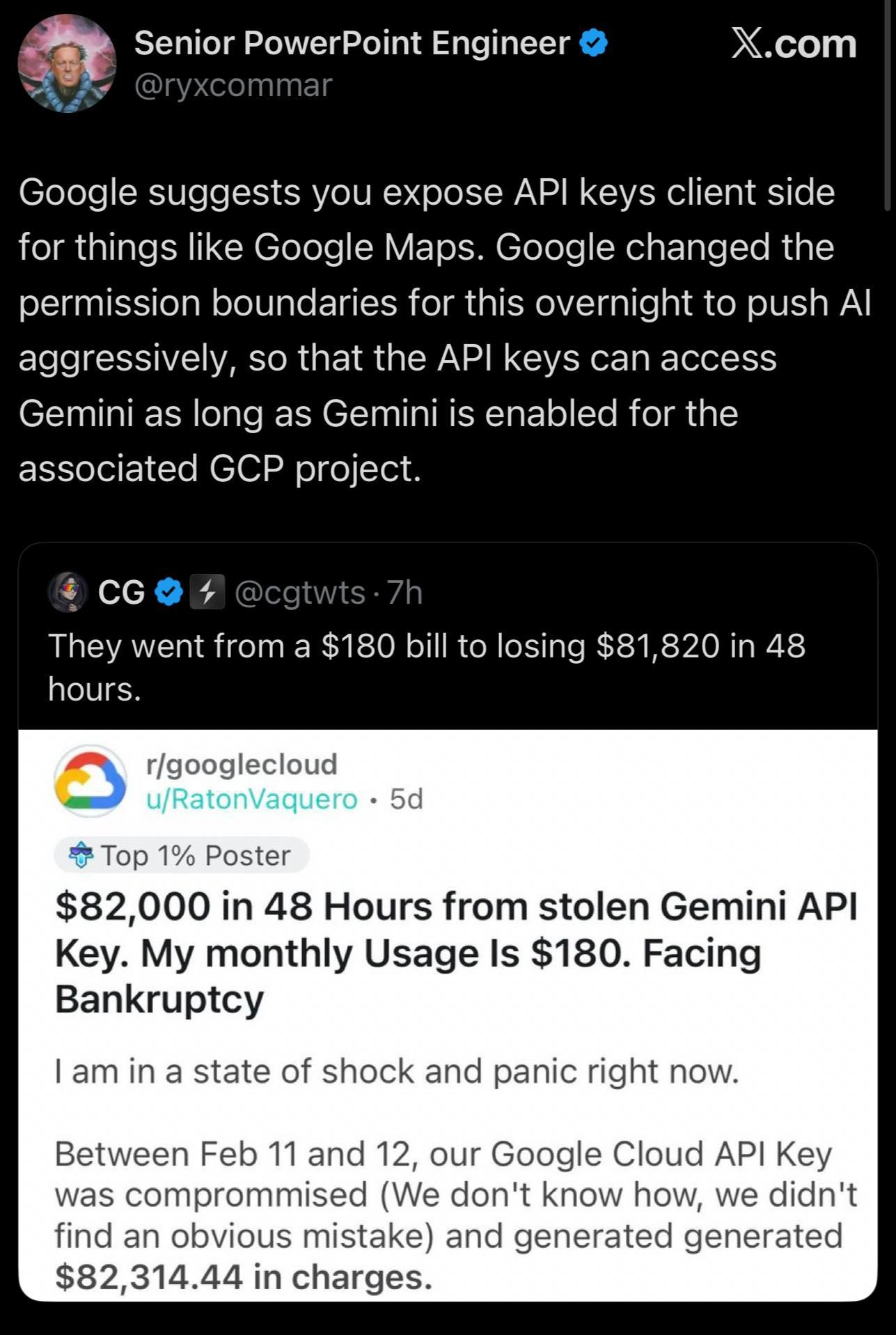
This is a screenshot chain that documents one of the cloud era's quiet horrors: a key meant to be public suddenly inherits the power to spend unbounded money. The top post by Senior PowerPoint Engineer (@ryxcommar) frames the mechanism precisely:
Google suggests you expose API keys client side for things like Google Maps. Google changed the permission boundaries for this overnight to push AI aggressively, so that the API keys can access Gemini as long as Gemini is enabled for the associated GCP project.
The quoted post by CG (@cgtwts) delivers the punchline as a number — "They went from a $180 bill to losing $81,820 in 48 hours" — and the embedded r/googlecloud post by u/RatonVaquero supplies the victim's voice: "$82,000 in 48 Hours from stolen Gemini API Key. My monthly Usage Is $180. Facing Bankruptcy," with the gut-punch admission, "We don't know how, we didn't find an obvious mistake."
The senior-level insight is that two design decisions, each individually defensible, combine into catastrophe. Decision one: Maps-style API keys are designed to live client-side. They ship inside the JavaScript of every web page that renders a map, because a map tile request is low-risk and the key is restricted by HTTP referrer or platform. The entire security model assumes the key is public and the damage ceiling is low. Decision two: a permission-boundary change that silently widened what those keys could reach. The moment a public key can call Gemini — a metered, per-token, genuinely expensive generative endpoint — the "low damage ceiling" assumption that justified exposing it in the first place is retroactively void. Nobody re-consented to the new threat model. The key didn't change; the world behind it did.
The systemic failure underneath is the absence of a hard spend cap. GCP's billing model is built around budgets and alerts, not hard stops. A budget in GCP is an observability tool — it emails you, it triggers a Pub/Sub message — but by default it does not halt resource consumption. The official "shut it down" pattern requires you to wire a budget alert to a Cloud Function that programmatically disables billing on the project, which most people don't build because nobody tells them their $180/month account is one leaked string away from a $82,314.44 invoice. This is no_spend_caps as an architectural default, and it transfers the entire gcp_billing blast radius onto the customer.
The deeper pattern — the one experienced engineers nod at grimly — is shifting the permission boundary without re-evaluating the assets behind it. Security boundaries are only meaningful relative to what they protect. When a vendor enables a high-value capability on credentials that were provisioned under a low-value threat model, they've silently revoked every risk calculation their customers made. The victim "didn't find an obvious mistake" because, under the rules that existed when they wrote their code, there was no mistake. The rules moved overnight. And because cloud billing is post-paid with no automatic circuit breaker, the feedback loop runs at attacker speed — 48 hours of stolen-key Gemini calls — while the human feedback loop runs at billing-cycle speed. The structural lesson: any credential you expose must be scoped with api_key_restrictions so tight that the worst case is acceptable, because vendors will expand the best case without asking.


Google finally solved Gemini adoption metrics: enable it on every leaked Maps key and let the attackers drive usage growth
Google Maps found the fastest route from a public API key to bankruptcy.
Didn't they fix this shortly after it happened the first time? Maybe this is the screenshot of the first time
Source https://www.reddit.com/r/googlecloud/comments/1reqtvi/_/
This is a more juicy story, https://www.reddit.com/r/googlecloud/comments/1rv3xr9/_/
Not setting a spending cap on such services isnt very clever thinking
If your "cloud" does not allow you to set a cap then you should not use it
6 years of professional web scrapping changed me forever.
Galaxychad from-scratch reimplementer
cant one set a limit on costs per month for gemini?
We got hit 15k bill because of this shit Bye bye gcp