
Phishing Email Social Engineering Meme Explained
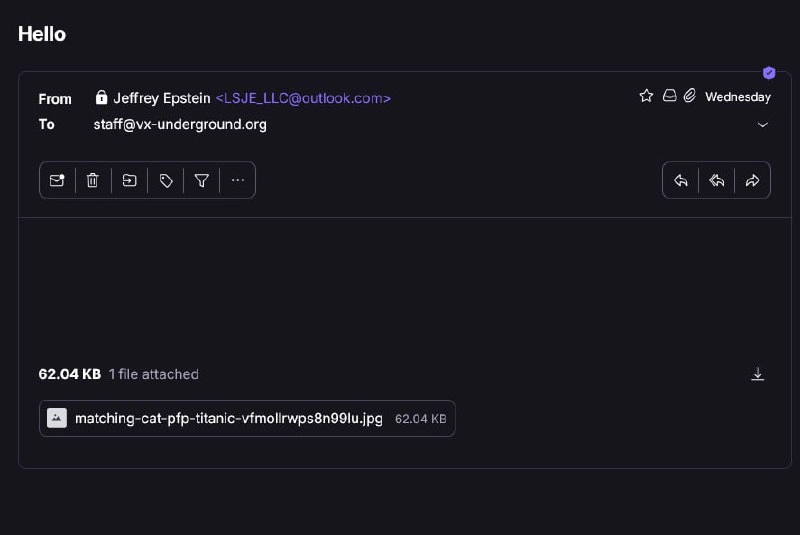
A dark-mode inbox shot shows an empty Hello email from a notorious display name to a malware-research inbox, with only a JPEG attachment. The dive separates spoofing from account takeover, explains SPF/DKIM/DMARC limits, and why curiosity is the social-engineering lever.
Level 1: The Mystery Package
Imagine receiving a package labeled only “Hello” from the name of someone who could not possibly have mailed it, with a strange little photo inside and no note explaining why. You would not eat, plug in, or open whatever was in the box just because the label had a lock symbol. The picture is funny because the package was sent to people whose job is spotting dangerous packages, yet its sheer weirdness is also what might make them want to inspect it.
Level 2: Why Nobody Clicks Hello
Phishing is an attempt to manipulate someone into revealing information, opening a file, visiting a login page, transferring money, or taking another unsafe action. Social engineering is the broader technique of exploiting human expectations and emotions instead of—or alongside—technical vulnerabilities.
This message displays several common warning signs:
- The subject is only
Helloand the body provides no context. - The sender identity is extraordinary and, taken literally, impossible.
- The attachment was not requested.
- The long filename does not explain why the recipient should trust it.
- The message relies on surprise and curiosity rather than a verifiable request.
An email address can be misleading in two main ways. With spoofing, a sender forges some identifying fields so the message merely appears to come from another source. With account takeover, someone obtains access to the genuine mailbox and sends through it. The second can be more convincing because messages may pass normal domain checks and appear in the real account’s Sent folder.
The safe response is to avoid opening the file on an everyday workstation, verify the situation through an independent channel, and give the original message to whoever handles security. “Independent” matters: replying to the suspicious email asks the possibly compromised account whether it is compromised. For a research organization, analysis should happen in an isolated environment with logging and disposable state.
The comedy comes from how dramatically the message fails the ordinary-context test. A legitimate sender normally explains who they are, why they are writing, and what the attachment contains. Here, 1 file attached is almost the entire pitch. The recipient must invent the missing story, which is exactly what curiosity-driven social engineering wants.
Level 3: Identity Not Included
The screenshot assembles the purest possible security-awareness nightmare: a blank dark-mode message titled Hello, apparently from Jeffrey Epstein <[email protected]>, sent to [email protected], with nothing to explain the lone attachment matching-cat-pfp-titanc-vfmollwps8h99lu.jpg. Even before the historical context, this is the visual grammar of social engineering: recognizable sender name, almost no prose, and an object that asks curiosity to do the attacker’s work.
The February 7, 2026 post timing makes the image more specific than a generic phishing joke. In the immediately preceding days, public discussion around released Epstein records claimed that credentials exposed in those records had been used to access this old Outlook account. The person named in the sender line had died years earlier, so the screenshot cannot sensibly represent a new message authored by him. It could depict activity by someone controlling the account, a spoofed message, or a fabricated screenshot; the pixels alone cannot decide among those possibilities. That uncertainty is central to the joke. A notorious identity has been reduced to an email costume worn to deliver what appears to be a cat picture.
This distinction matters technically because display identity, message authentication, and human authorization are different claims:
- The display name
Jeffrey Epsteinis ordinary text and proves essentially nothing. - The visible address says what mailbox the message claims to be from, but the screenshot omits the raw headers needed to examine its route.
SPFcan indicate whether the sending server was permitted for a domain.DKIMcan verify that a domain signed selected message content and that the signed parts were not altered afterward.DMARCconnects those checks to the domain shown to the recipient and supplies a policy for failures.
Even perfect SPF, DKIM, and DMARC results would not prove that the intended account owner pressed Send. If an attacker or curious third party controls a real Outlook account, the provider may legitimately send and sign the message on that person’s behalf. Email authentication can establish which infrastructure handled the message without establishing whether the human using the account was authorized. The protocol stack is a diligent passport clerk who cannot tell that someone stole the passport.
The small lock-like icon and purple shield visible in the interface should be treated just as cautiously. Depending on the client and configuration, interface badges can describe transport, encryption, sender verification, or another account state. They are not universal proof of authorship, and a screenshot does not let an analyst inspect what the icon meant in that session. Trusting a tiny badge while ignoring an impossible sender is how security training turns into performance art.
The attachment is suspicious, but the image does not show that it contains malware. Its visible clues are only a JPEG-looking extension, an odd generated-looking name, and a size of 62.04 KB. File extensions and declared MIME types are labels, not guarantees. A defensive analyst would preserve the original message, calculate a cryptographic hash, inspect its magic bytes and metadata, scan it with multiple tools, and open it only in a controlled environment if further examination were justified. Image parsers have had vulnerabilities, files can be polyglots, and a benign picture can still carry tracking or hidden data—but none of those possibilities should be promoted to fact without examining the bytes.
The recipient adds the final layer. vx-underground is known as a malware-research and hacker-culture community, making it a comically difficult audience for the oldest “mysterious attachment” routine. At the same time, experts are not immune to curiosity; unusual samples are exactly what researchers open for work. The targeting therefore exploits professional interest rather than naïveté. The adversarial pitch is effectively: “You would never click a suspicious file—but surely you will analyze this one.” Same click, better job title.
To investigate the message rather than merely react to it, a responder would want the complete .eml or .msg source, not this crop. Useful evidence would include the Received chain, Authentication-Results, DKIM signature, Message-ID, envelope sender, provider timestamps, attachment hash, and account audit logs. Those artifacts could separate direct account use from spoofing and screenshot theater. Until then, the responsible wording is purported sender and possibly suspicious attachment, not a confident claim of phishing or malware.

When your phishing email is so obvious that even the spam filter forwards it to the malware research team for entertainment purposes
Zero trust was invented for moments when a dead man emails a malware archive a cat JPEG.