
Frontend API Keys Meme Explained
An anime “bad advice” meme jokes that env vars are optional once you hardcode an API key in front-end code. The deep dive covers secrets management, why browser JS cannot hide keys, and proxying sensitive calls through a backend.
Level 1: Secret in Plain Sight
Imagine you have a secret treasure map that you want to keep safe. Normally, you might hide the map in a locked box in your room so no one else can see it. Using environment variables is kind of like keeping secrets in a locked box away from prying eyes. Now, the meme is joking that someone did the exact opposite: they took their secret map and taped it to the front of the house for everyone to see! If you do that, well, you obviously don’t need a secret hiding box anymore – because the secret isn’t a secret at all. 🗺️🔑
In the same way, an API key is like a special password that should be kept hidden (so only you or your app can use it). A smart way to hide it is to keep it out of the front-end code (that everyone can look at) and maybe only put it on the safe server side. But the joke here says: “Who needs to hide it, if you just put that password right in the open for the user?” It’s funny because it’s a ridiculously bad idea. It’s like a friend confidently telling you, “You don’t need to lock your door at night if you leave it wide open!” — which completely misses the point of why we lock doors or hide secrets.
So, the meme is making us laugh by showing someone giving very silly advice with a straight face. Even if you’re not a tech expert, you know sharing a secret publicly defeats the purpose of it being a secret. Developers find it funny (and a bit cringe) because it’s a reminder that sometimes people do exactly this with their code without realizing the trouble, and it’s joked about here in a simple, exaggerated way.
Level 2: Hardcoding Secrets
Let’s break down the technical terms and concepts so that a newer developer (or someone early in their career) can understand why this meme is funny and important:
Environment Variable: In programming, an environment variable is a configuration value that is set outside your code, often in the system or deployment environment. Think of it as a note your app reads at runtime: e.g. an app might look for
API_KEYin its environment, rather than having the key written in its code. This way, you can keep secrets (like passwords, API tokens, database URLs) out of your codebase. For example, in a Node.js server you might have:const apiKey = process.env.API_KEY; // read the API key from the environmentThe actual key might be provided by your cloud host or a
.envfile that isn’t committed to Git. If someone looks at your source code repository, they see onlyprocess.env.API_KEY, not the real key. EnvironmentVariable usage is a best practice for keeping secrets and config separate from code.Hardcoding an API Key: This means writing the actual secret key directly in your code. For instance, in a front-end app you might see something like:
const apiKey = "ABC12345VERYSECRET"; // ❌ Hardcoded API key (bad practice!)
fetch(`https://api.example.com/data?key=${apiKey}`)
  .then(res => res.json())
  .then(data => console.log(data));
Here the string
"ABC12345VERYSECRET"is the real key, visible to anyone reading the code. Hardcoded secrets are problematic because if your code is ever exposed (and front-end code is always exposed to the end user), your secret is exposed too. Also, if you push this code to a repository (especially a public one on GitHub), you’ve essentially given the world your credentials. This is the core of the meme’s joke: if you do this, you’ve made environment variables (our intended solution to avoid hardcoding) irrelevant.API Key: An API key is like a password or ID token that a client uses to authenticate or identify itself to an API (a service or backend). For example, a weather data service might require an API key so that only authorized users (or paying customers) can use it. Security 101: API keys must be kept secret if they grant any privileged access or cost money to use. Exposing an API key is akin to exposing your password online.
Front End vs Back End: The front end of a web application is the part that runs in the user’s browser — all the HTML, CSS, and JavaScript that get downloaded and run on your machine when you visit a website. The back end is the server side – code running on a server that the user doesn’t see directly (like the web server or database). This distinction matters for secrets:
- Back-end code is private: Only the server executes it, so secrets stored in environment variables on the server (or in server code, though that’s not ideal either) are not sent to the user. If configured correctly, a user can’t just open the server’s code or memory. That’s why environment variables on a server are effective for hiding secrets.
- Front-end code is public: When you build a web app (say with React, Angular, or plain JS), all that code gets sent to the user’s browser. If there’s an API key in there, even if you tried to hide it, it’s findable. A user can press F12 to open DevTools, inspect the network calls or source code, and boom – they see the key. So if you included a secret in front-end code, you’ve essentially pasted it on a public bulletin board. The meme points out the absurdity: of course you “don’t need” to use an env var to hide a key if you’ve foolishly put the key in plain sight on the front end.
Why use environment variables? Early-career devs often learn about environment vars after maybe making the mistake once. Suppose you wrote a cool front-end app that calls some service and you hardcoded the credentials. Maybe you even pushed it to a GitHub repo to show friends. Next thing, you get an email from the service: “Your API key has been revoked due to misuse” or worse, your account got charged because someone found your key. That’s a hard lesson. The correct approach is usually:
- Don’t trust the front end with secrets. If a call truly needs a secret key, have your front end make a request to your own back-end service. That back end can read the real key from an environment variable (safe on server side) and then contact the external API. The front end never sees the real key.
- If you must expose something to the front end (like using a third-party JavaScript library that needs a key), you’d typically use a public key or a key with very limited scope. Some API providers allow public API keys that are safe to use in front-end (usually because they have built-in limitations or they only identify the app but don’t grant broad permissions). Even then, you wouldn’t hardcode it directly in code that’s checked into GitHub. You might keep it in a build config and not share it publicly.
- Use a
.envfile (which you do not commit to source control) or a secrets manager. Many front-end build tools let you define environment variables that get substituted in at build time. But remember, this only hides the secret in your source repo, not in the deployed app. So you’d only do this for non-sensitive config or if you accept that it will be visible to users who look.
Security Misconfiguration: This term means configuring an application in an insecure way, often by mistake. Hardcoding secrets in the front end is a prime example of a security misconfiguration (basically a fancy term for “you set it up wrong and now it’s not secure”). Another common one is leaving default admin passwords in a deployed app. In our case, not using environment vars and exposing the key is a misconfiguration because the app isn’t supposed to be configured with secrets in the open. This is the kind of thing that more senior engineers might catch in a code review: “Hey, I see you committed an API key here – that’s a big no-no, let’s fix that.”
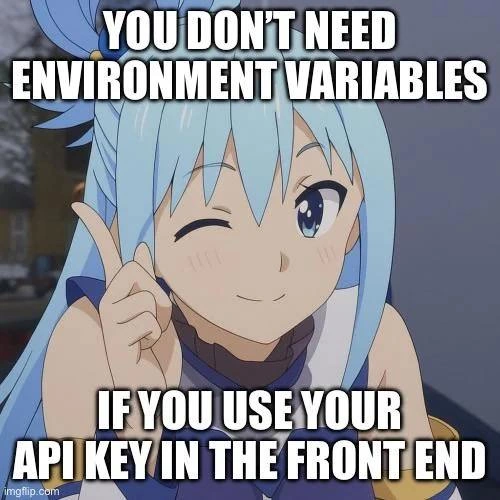
Now, why is the meme using an anime character? In developer meme culture, taking an image of an over-the-top expressive anime character confidently delivering completely wrong advice is a way to poke fun at bad practices. Here the character (Aqua, a comedic, often clueless character from KonoSuba) is shown winking and raising a finger as if giving a brilliant tip. The text of the meme is formatted in bold white Impact font, the classic meme style for shouting statements. The combination tells a story:
- The visual: a friendly-looking girl with a smug “listen to me, I have an idea!” face.
- The text: absolute garbage advice for handling secrets. This contrast is where the humor lies. It’s basically a “bad mentor” joke: Imagine a well-meaning but totally uninformed colleague leaning over and saying, “Oh, you can just put the API key right in the JavaScript, then you don’t have to worry about env vars at all!” A junior dev might not immediately see the issue, but anyone who’s been burned by leaked keys will instantly recognize how silly that sounds.
For a newer developer, the meme is a caution wrapped in a joke. It’s saying: don’t do this, with a laugh. Early in your career you might not realize the consequences, but now you know:
- Keep secrets out of front-end code.
- Use environment variables or other secure methods to store secrets on the backend.
- If someone tells you “nah, just hardcode it for convenience,” smile and know that’s Aqua-tier bad advice!
Level 3: Public by Design
At the highest level, this meme targets a security misconfiguration so blatant that it’s painfully funny to seasoned devs. The top text declares, “YOU DON’T NEED ENVIRONMENT VARIABLES”, and the bottom retorts, “IF YOU USE YOUR API KEY IN THE FRONT END.” This is essentially mocking the practice of hardcoded API keys in client-side code. An experienced developer immediately cringes because environment variables (or any proper SecretsManagement practice) exist to keep secrets out of your source code – especially out of code that runs in browsers.
Why is this funny to a senior engineer? It highlights an absurd loophole: if you commit the cardinal sin of embedding your API secret directly into your front-end JavaScript, you’ve effectively made environment-based security moot. It’s like saying “You don’t need a lock if you leave the door wide open” – technically true in the dumbest possible way. The humor comes from that absurd truth-in-the-negative: by doing the one thing you’re never supposed to do (putting a secret in public code), you indeed no longer “need” to bother with environment variables. It’s a dark, ironic joke that plays on shared industry pain.
Veteran developers have seen this scenario play out disastrously. The moment an API key is pushed to a public repo or exposed in a Single-Page Application (SPA) bundle, it’s essentially public information. There are entire bots crawling GitHub 24/7 for keys and credentials. A senior dev reading this hears alarm bells: “Oh no, someone put their AWS keys on GitHub again, time for a public_github_leak fiasco.” In real life, one leaked key can lead to:
- Unauthorized access: Attackers find the key and start hitting the API or cloud service, possibly racking up charges or stealing data.
- Service abuse: If it’s a paid API, your usage limits get maxed out by strangers, or you get a hefty bill because someone mined cryptocurrency with your cloud credentials.
- Key invalidation and emergency rotation: The team has to scramble to revoke the compromised key and update everything that used it (after the damage is done).
The meme’s image choice adds an extra layer for those in the know. It uses an anime character (blue-haired, winking, finger raised knowingly) — which appears to be Aqua from Konosuba, a goddess notorious for her useless advice and antics. Pairing a cutesy confident pose with horrible guidance (“Don’t bother with env vars, just slap your secret straight into the app!”) creates a jarring contrast. It’s FrontendHumor meets SecurityMisconfiguration in one frame. The soft-focus friendly anime vibe makes the terrible advice seem innocent, highlighting how naive such a mistake is. Seasoned devs laugh (or groan) because they’ve either:
- Mentored a junior who thought this was okay,
- Inherited a codebase littered with secrets committed in config files,
- Or embarrassingly recall doing this themselves early on and learning the hard way.
From a configuration standpoint, environment variables are a cornerstone of Twelve-Factor App methodology and good DevOps hygiene. We use them so that no sensitive credentials are hard-coded into the application. In a backend, you might have DB_PASSWORD or API_KEY set as an environment variable on the server, never checked into git. In modern pipelines, secrets might be injected at deploy time or stored in vaults – all to avoid exposure. So seeing someone skip all that and put an API key directly in front-end code feels like watching someone disable the seatbelts because they’re already driving on the wrong side of the road. It’s both horrifying and comically absurd.
The phrase “You don’t need environment variables if you use your API key in the front end” is impact-font wisdom at its finest – it sounds like advice, but it’s really a scathing punchline. It hints at a truth: environment variables offer zero protection if you’ve already exposed the secret. In a Frontend context, there’s a nuance here: unlike a server, a web client can’t truly hide a secret. Even if you use build-time environment variables in, say, a React app (e.g. REACT_APP_API_KEY in a .env file), that value ends up in the compiled bundle. Any user can pop open Developer Tools or prettify the JS bundle and find that key. So the meme is also a jab at misunderstanding how environment variables work in front-end builds. Some newbies think “I put it in an env variable, so it’s safe,” not realizing that in an SPA, it’s still hardcoded into the shipped code. The only real way to keep a key truly secret is to never send it to the client. You’d put the key on a server and have the front-end talk to that server, or use an API design where secrets aren’t required on the client side.
In summary, Level 3 exposition: This meme resonates because it exaggerates a common rookie mistake to highlight best practices by their absence. It’s a cathartic facepalm for experienced developers in Configuration and Security roles. They’ve fought this fire before, so they can chuckle at how blatantly the meme spells out the folly. The confident anime bad advice format (often used in DeveloperHumor) drives home the irony: if you’ve undermined all the safeguards, of course you don’t “need” them anymore! The result is equal parts hilarious and horrifying for anyone who’s been on an incident call because someone hardcoded a secret.



Sure, put the API key in the frontend. It's the fastest way to get your cloud provider to personally call you to ask why you're trying to mine bitcoin on their entire server fleet
Because nothing screams zero-trust architecture like committing your production Stripe key right next to App.jsx
The fastest way to turn your API rate limits into a distributed denial-of-wallet attack is to let Reddit find your keys in the minified bundle - at least the crypto miners will thank you for the free compute credits
Ah yes, the classic 'security through client-side obscurity' approach - because nothing says 'enterprise-grade architecture' like letting every script kiddie with F12 access your production API keys. Bonus points if you've also committed them to a public GitHub repo with 47 forks, ensuring your credentials have better distribution than most CDNs. At least when the bill for 10,000 unauthorized API calls arrives, you'll have a great story for your post-mortem about why environment variables and backend proxy patterns exist
Ship the key with the bundle; congrats - your CDN is now a planet-scale secret manager (aka NEXT_PUBLIC means EVERY_PUBLIC)
Frontend API keys: because nothing scales like accidentally funding your competitor's entire inference budget via public GitHub
Putting the API key in the browser isn’t configuration - it’s open-sourcing your credentials with minification; keep PagerDuty warmed up
Really I hate (as DevOps) see how a lot of devs put these ENV vars even on the repository because need a "static build" of the website and "nobody will search these keys inside my -obfuscated- javascript" 🔥
Naaaahhhh why yall wanna make me a weeb??!
i should make a crawler that detects common web frameworks, loads the page in selenium, clicks all buttons on the page, then observes network requests for free authentication headers
Question: If you have a php script in cpanel, is it possible to read it's contents? Since it's url will only run it and can only show the scripts output... Right?
You don't need a brain if you leave your API keys in frontend
I did try this once I can't stop laughing at myself
хочу розавую единарожку😅
I want a pink unicorn😅
I don’t know, so fuck did you want to?😄