
Firefox EULA Data License Meme Explained
A highlighted Firefox Terms clause grants Mozilla a nonexclusive, royalty-free, worldwide license on anything you upload or type. The dive decodes the legalese, why browsers need it for sync and navigation, and the privacy irony for a tracker-blocking product.
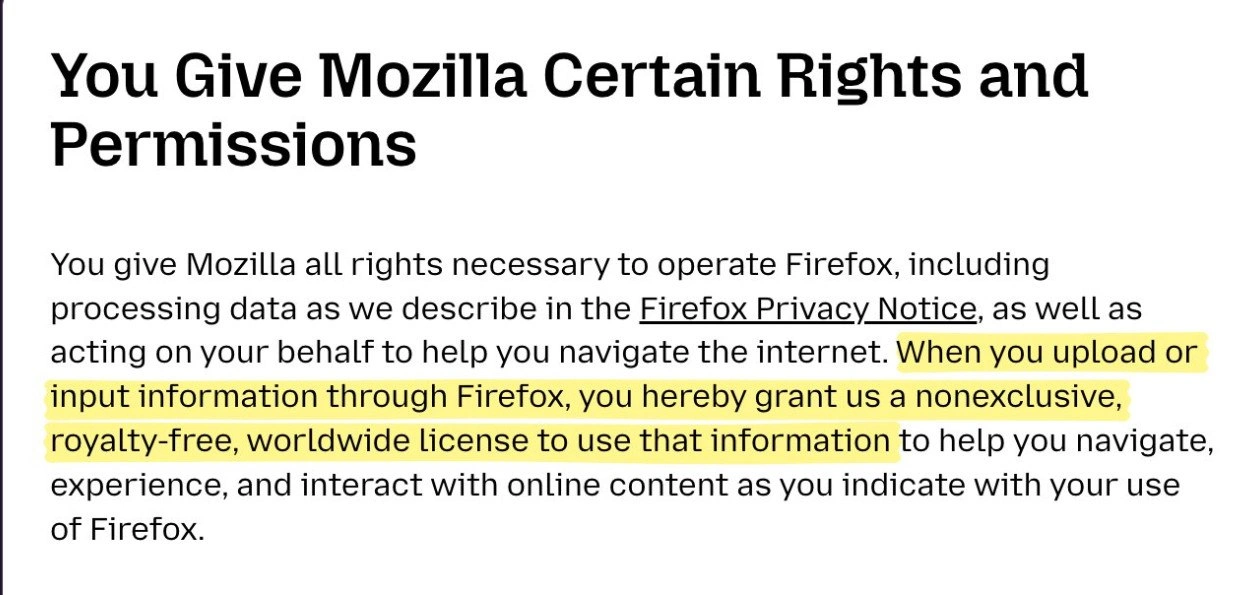
Level 1: No Takebacks, No Candy
Imagine you have a helpful friend named Foxy who offers to guide you through a big library (the internet). You agree, because Foxy knows all the shortcuts and interesting spots. But before you start, Foxy hands you a permission slip to sign. It says: “If you tell me or show me anything while we’re in the library, I’m allowed to use that information anywhere in the world, for free, to help guide you.”
In simple terms, if you give Foxy a toy or a secret so they can help you find a book, Foxy can now keep a copy of that toy or secret and use it later without giving you any candy (payment) for it. You still have your toy too (they didn’t steal it — it’s like a copy), but Foxy doesn’t owe you anything for using it. They promise they’ll only use it to help you navigate the library, because that’s what you asked for.
This sounds a little funny, right? It’s like, “Wow, I just wanted help finding books, and now I’ve basically said it’s okay for you to remember and use anything I tell you, anywhere, for free.” We trust our friend Foxy, and they likely won’t do anything bad — they just wrote that to protect themselves in case they need to, say, carry your backpack or copy a page to show you directions. But reading that permission slip out loud is a bit surprising! It’s the kind of thing that makes us giggle and think, “Gee, Foxy, you sure want a lot of permission just to be a guide!”
Level 2: Permission Granted 101
Let’s break down the key terms and why this excerpt looks so intimidating (and funny) to developers new and old. The image shows a snippet of Mozilla Firefox’s Terms & Conditions (T&C), specifically a section about permissions you give them. Terms & Conditions (or EULA – End User License Agreement) are those long documents you usually scroll past and click “Accept” on. They outline the rules for using the software and often include what the company can do with data you provide. Here’s what’s happening in that highlighted text:
“When you upload or input information through Firefox” – This means anything you do through the browser. Typing a website address, entering login info, uploading a file via a web form, or even letting Firefox store your credit card for autofill – all of that counts as you giving Firefox some information.
“you hereby grant us a license” – “Grant us a license” is legal talk for “you give us permission.” It’s like saying “Mozilla, you’re allowed to use my input.” Without this, technically Mozilla might not have the right to, say, copy that data to memory or send it over a network as part of the service.
“nonexclusive, royalty-free, worldwide license” – Let’s decode that:
- Nonexclusive: You’re not giving Firefox exclusive rights to your data. You still own whatever you input. For example, if you upload a photo through Firefox, you can still give that photo to someone else or post it elsewhere. Firefox isn’t the new owner; they just also have your permission.
- Royalty-free: Mozilla doesn’t have to pay you for this use. Royalty would be a payment for using someone’s content (like musicians get royalties for songs). Here, you’re saying “you can use what I input without paying me.” (Don’t worry, this is normal – nobody expects a browser to pay them each time it loads their data! This phrase just prevents legal confusion.)
- Worldwide: The permission is valid anywhere in the world. This matters because Mozilla’s servers or services that help run Firefox might be in different countries. If you’re using Firefox in Europe but their data center is in the USA, they need worldwide permission to handle your data across borders.
“to use that information to help you navigate, experience, and interact with online content as you indicate with your use of Firefox.” – This is explaining why they need the permission. Essentially, “to operate the browser for you.” When you type a URL or search query, the browser might send that info to a server to fetch the page or get suggestions. When you fill a form and hit submit, Firefox processes and transmits that data to the website you’re interacting with. The phrase “as you indicate with your use” is important: it means Firefox will only use your info in ways you ask it to. It’s not saying “we’ll take your data and do whatever we want.” It’s saying “we’ll do what you’re effectively telling Firefox to do with it.” (For example, if you use a Firefox feature that checks if a website password was leaked, Firefox might upload your password in a safe way to a server to compare – but only because you used that feature, thus you indicated that use.)
For a junior developer or anyone not fluent in legalese, this all sounds super heavy. But it’s actually common. Most software and online services have similar clauses. The reason devs find this funny (and a bit scary) is the contrast: Mozilla Firefox is known for championing user Privacy. They fight tracking and even have a cute fox logo that people trust. Yet their legal docs still have the same broad language you’d see in big tech company policies.
This is also a PrivacyConcern and a compliance lesson. If you work at a company, you might be tasked to review such terms before using a tool. Imagine you just built an internal app with sensitive data and you consider using a third-party plugin or browser extension. You’d have to read the T&C to ensure you’re not accidentally giving away rights to company data. This Firefox clause in the meme is an example of text that would make a dev pause and go “Hmm, is this okay under our data policy?” It hints at things like GDPR compliance too – under GDPR (Europe’s strong privacy regulation), a company must be transparent about data usage and have a lawful basis. Here, Firefox is obtaining your consent via the T&C to use your data for providing the service. It’s basically covering the “lawful basis” for handling your data.
To sum up at this level: The meme shows how Firefox’s T&C asks for broad permission to use your data. It’s written in thick legal jargon that developers learn to decode. We find it a bit humorous because it’s so formal and sweeping – like asking for the keys to the kingdom just to open a door. But every browser or online service has a similar key; it’s just rare to see it highlighted in yellow and shared as a meme! Now you know why that text is there: it sounds scary, but it’s mainly there to let Firefox do its job (navigate the web) without legal trouble, and it’s nonexclusive (you haven’t sold your data, just lent it). Still, it reminds us that reading the fine print can reveal surprising things about our everyday software.
Level 3: One Clause to Rule Them All
At a senior engineering level, this meme highlights the jaw-dropping scope of Firefox’s Terms & Conditions. Seasoned devs know that modern software EULAs often sneak in broad permissions, but seeing Mozilla’s “nonexclusive, royalty-free, worldwide license” spelled out in big bold letters still triggers a double-take. It’s that EULA_tldr moment: “Wait, by using Firefox I just handed Mozilla global rights to anything I type into it?!”
From a DataPrivacy and Security perspective, this clause is an ironclad legal safety net. Why so overreaching? Because even privacy-friendly browsers like Firefox collect some data or perform cloud-based actions to function. For example:
- Autocomplete & Suggestions: If Firefox offers search suggestions or URL autocomplete, it might send what you type to a Mozilla server or a search provider. Legally, that’s “uploading information.” They need permission to process it.
- Sync & Cloud Services: If you sync bookmarks, passwords, or open tabs, you’re uploading data to Firefox’s cloud. A broad license lets Mozilla store and copy that data across servers worldwide, without paying royalties (imagine invoicing your browser every time it saved a bookmark – absurd! 😅).
- Rendering & Caching: Even loading a webpage can involve copying data (your inputs, cookies, content) and temporarily storing it. The T&C basically says, “You allowed us to do that, remember?”
Experienced devs see humor here because it’s a classic case of fine print overkill – PrivacyConcerns meets legal paranoia. The highlighted text reads like Mozilla’s lawyers borrowed language from Big Tech’s playbook (where “worldwide royalty-free license” is as standard as semicolons in C code). It’s ironic given Mozilla’s pro-privacy reputation: the very browser known for blocking trackers is also saying “btw, we can use your data globally for free.” 😈
But the cynical chuckle comes with understanding the context. Why nonexclusive and royalty-free? Nonexclusive means you’re not selling your soul – you still own your data and can give rights to others too. It’s not like Firefox becomes the exclusive owner of your search history (phew!). Royalty-free means Mozilla doesn’t owe you a dime for using your inputs. That sounds obvious (who expects to get paid for typing a URL?), but it’s crucial legalese: it prevents bizarre scenarios where a user claims Firefox “commercially exploited” their data and demands a cut.
Senior engineers have been in those DataPrivacyAndCompliance meetings where someone asks: “Does using this tool violate our IP or privacy policies?” If you’re working on sensitive code or data, a clause like this raises eyebrows. GDPR fans might wonder, “Is this even compliant?” – After all, GDPR demands data minimization and clear purpose. Mozilla’s line does specify the purpose (“to help you navigate, experience, and interact with online content as you indicate”), which is lawyer-speak for “only to operate the features you use.” In theory, they can’t suddenly use your inputs for something wildly different without asking. But the sheer breadth (worldwide! forever! for free!) is both amusing and alarming to those of us who know how often such clauses get copy-pasted into terms.
In short, the meme lands with senior devs because it captures a shared industry absurdity: even the “good guys” have legal text that sounds like they’re claiming lordship over your data. It’s a reminder that no one reads the manual, yet the manual might say crazy things. We laugh, then nervously double-check the enterprise compliance checklist, thinking, “Did I just unknowingly agree to something big? Oh well, at least it’s nonexclusive!”



We spend weeks debating the right license for a 10-line open-source library, but click 'I Agree' on a 10,000-word EULA in 0.2 seconds to get our browser update
Firefox just claimed a royalty-free, worldwide license to everything I type - great, now my 3 AM outage post-mortems are officially open-source training data for their “Stack Overflow But With Your Secrets” model
We spent years fighting IE's monopoly just to end up granting every browser vendor a "nonexclusive, royalty-free, worldwide license" to our localhost:3000 typos and accidentally pasted API keys
Ah yes, the classic 'royalty-free, worldwide license' buried in a privacy notice - because nothing says 'we respect your privacy' quite like asking for perpetual rights to everything you type into our browser. It's the legal equivalent of 'trust me bro,' but with more lawyers and fewer GitHub stars. At least they highlighted it in yellow, so you can't say they didn't warn you before you clicked 'I agree' without reading
Firefox legal: “By typing, you grant us a nonexclusive, royalty‑free, worldwide license.” Cool - my keystrokes now have a clearer IP strategy than half our deps and better global rollout than our CD pipeline
Firefox: Open-source browser where your privacy notice ships with Mozilla's data-harvesting hooks pre-installed
Nothing says “privacy-first” like a ToS granting your browser a nonexclusive, royalty‑free, worldwide license to whatever you type; my DPIA just turned into a P0
Probably just try to comply with GPDR
I love how it stops highlighting right before it gets to the part where it tells you what it's used for, like "stop reading where it's convenient for our narrative"
Like MAYBE if there was actually something in the Privacy Notice, but this is a nothingburger.
Try tccboot
Literally compiles your entire linux kernel with tinyCC on boot
Can't believe there's a dude out here using the word retarded unironically in 2025, all while referring to how they're too uneducated to care about having reasons for having their own opinions. Please touch grass.
Actual misinformation, I just took this screenshot from their live repo. Verbatim: "we don't sell access to your data"
There's also a difference between their terms of use and their privacy policy. There's an if statement there for a reason, it's so that forks of Mozilla can decide whether or not they want to sell your data, it doesn't reflect mozilla's policy as to whether or not they will. They say themselves that this does not give them a license to sell your data.
you have no idea how many people do this
https://github.com/mozilla/bedrock/commit/d459addab846d8144b61939b7f4310eb80c5470e
Fuck you
i mean it's not bad that they don't sell data if you don't agree to tou
The privacy notice is a legal document. You can't just make up intentions behind words without defining them in the document.