
Mechanical Keyboard Collecting Meme Explained
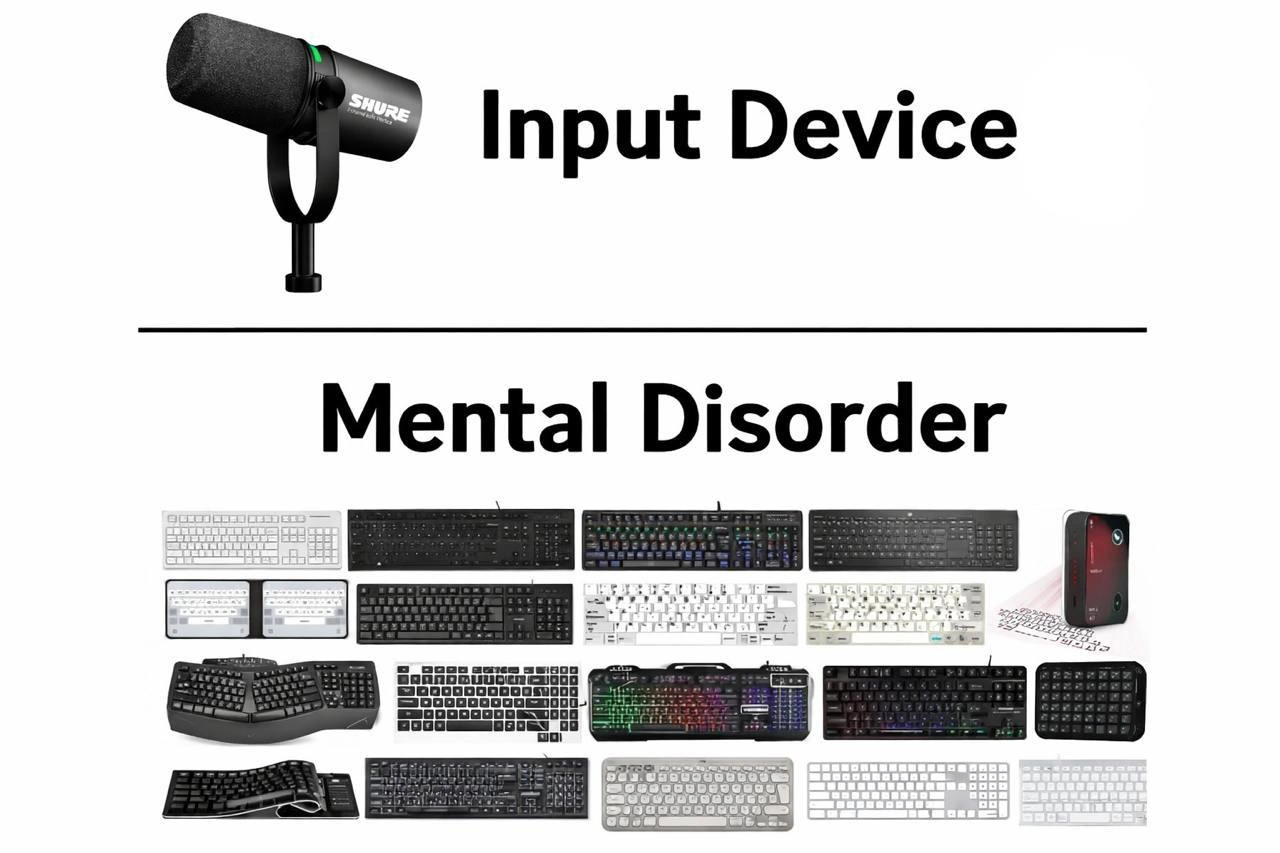
The meme contrasts a single Shure MV7 labeled Input Device with a collage of keyboards labeled Mental Disorder. The deep dive unpacks HID peripherals, keyboard subtypes from membrane to laser projection, and how desk-setup culture reframes collecting as engineering.
Level 1: One Hammer vs. a Garage Full of Hammers
Imagine someone who owns one good kitchen knife and cooks dinner every night, sitting next to someone who owns forty different spatulas — a bendy one, a glowing one, one that's actually just a flashlight that projects a picture of a spatula — and still mostly uses the same one every day. Both people are "buying cooking tools," but only one of them has a collection, and the meme jokes that the collection has stopped being about cooking at all. It's funny because the collector always has a perfectly logical reason for every single spatula, and everyone around them can see the truth: they just really, really like spatulas.
Level 2: HID, Switches, and Why People Own Twenty of These
An input device is anything that sends data into a computer — keyboards, mice, microphones, webcams. They mostly speak a standard protocol called USB HID (Human Interface Device), which is why you can plug any of these twenty keyboards in and they just work without drivers.
The keyboards shown represent real, distinct sub-species you'll encounter:
- Membrane keyboards — the cheap office default; a rubber sheet under the keys. Quiet, mushy, disposable.
- Mechanical keyboards — each key has its own physical switch. Enthusiasts argue endlessly about switch types (clicky, tactile, linear) the way coffee people argue about roasts.
- 60% / compact layouts — keyboards with the number pad, arrows, and function row amputated to save space. You access the missing keys through layers, like keyboard-shortcut inception.
- Ergonomic / split boards — bent or halved designs that keep your wrists straight. Usually purchased after the pain starts.
- Laser projection keyboards — a gadget that beams a keyboard image onto your desk. Cool for nine minutes, then you discover typing on a table hurts.
The Shure MV7 up top is a hybrid USB/XLR microphone beloved by podcasters and remote workers. It represents the "buy once, done" philosophy — the exact opposite of how keyboard people operate. Early in your career you'll meet a coworker who owns a drawer like the bottom panel. They will explain each board to you. Budget thirty minutes.
Level 3: N+1 Redundancy for One Pair of Hands
The structural joke here is a taxonomy violation. The top panel grants a Shure MV7 — a $250 podcast microphone — the neutral, clinical label Input Device. The bottom panel takes the other canonical input device, the keyboard, and reclassifies an entire grid of them as "Mental Disorder." Both claims are technically about HID-class peripherals; the punchline is that quantity flips the category. One microphone is gear. Twenty keyboards is a condition.
And the collage is doing forensic work. Look at what's actually in it: a beige full-size membrane board, several anonymous black office slabs, an RGB rainbow-backlit gaming deck, an ergonomic split/contoured board, a roll-up flexible silicone keyboard, a laser projection virtual keyboard (the red box casting a glowing keyboard onto the desk), a chunky thumb-typing mini board, low-profile wireless minimalists, and white Apple-style chiclets. This isn't a random pile — it's the complete archaeological strata of the hobby. Every developer who fell down this rabbit hole recognizes the progression: "my wrists hurt" → split ergo board → "actually what about switches" → group buys, lubed stabilizers, artisan keycaps → a drawer that looks exactly like this image.
The deeper satire targets the rationalization engine of desk setup culture. Each keyboard in that grid was, at purchase time, a defensible engineering decision: the 60% saves desk space, the ergo split prevents RSI, the projection keyboard is for travel, the membrane one is "for the office so nobody hears me." The hobby launders consumption as optimization. Meanwhile the microphone owner made one decision and stopped — which, to a collector, is the genuinely incomprehensible behavior. There's also a quiet irony for anyone who's priced this out: the keyboard pile probably cost less than a serious mechanical habit, because none of these are the $400 custom aluminum boards. This is the entry-level version of the disorder. It gets worse.
The original post caption riffs on "voice input" users — the implication being that people who talk to their computers get a sleek microphone and moral superiority, while typists get a diagnosis.


One microphone is an input device; twenty keyboards is just N+1 redundancy for a single point of typing
The collection supports N-key rollover; the desk supports maybe three.
Steering wheel
Vine ciders.
vine cider... i'd like me some vine cider...
Good luck trying copy paste some code with a voice
Jokes aside I started using voice input recently with my architecture convos spanning across multiple compactings and beyond. Input quality lacks a bit as with text I take some pauses to phrase properly, while speech is vague at times. But I haven't experienced results quality degradation yet, so it seems fine...
imagine having to move you lips to input data
average startup office workspace in 2026