
Kubernetes YAML Overload Meme Explained
A K8s admin flees a “YAML carrier,” softens when offered a present, then explodes when it is more YAML. The dive covers manifests, whitespace gotchas, and how Helm and friends still spit config files.
Level 1: Socks for Christmas
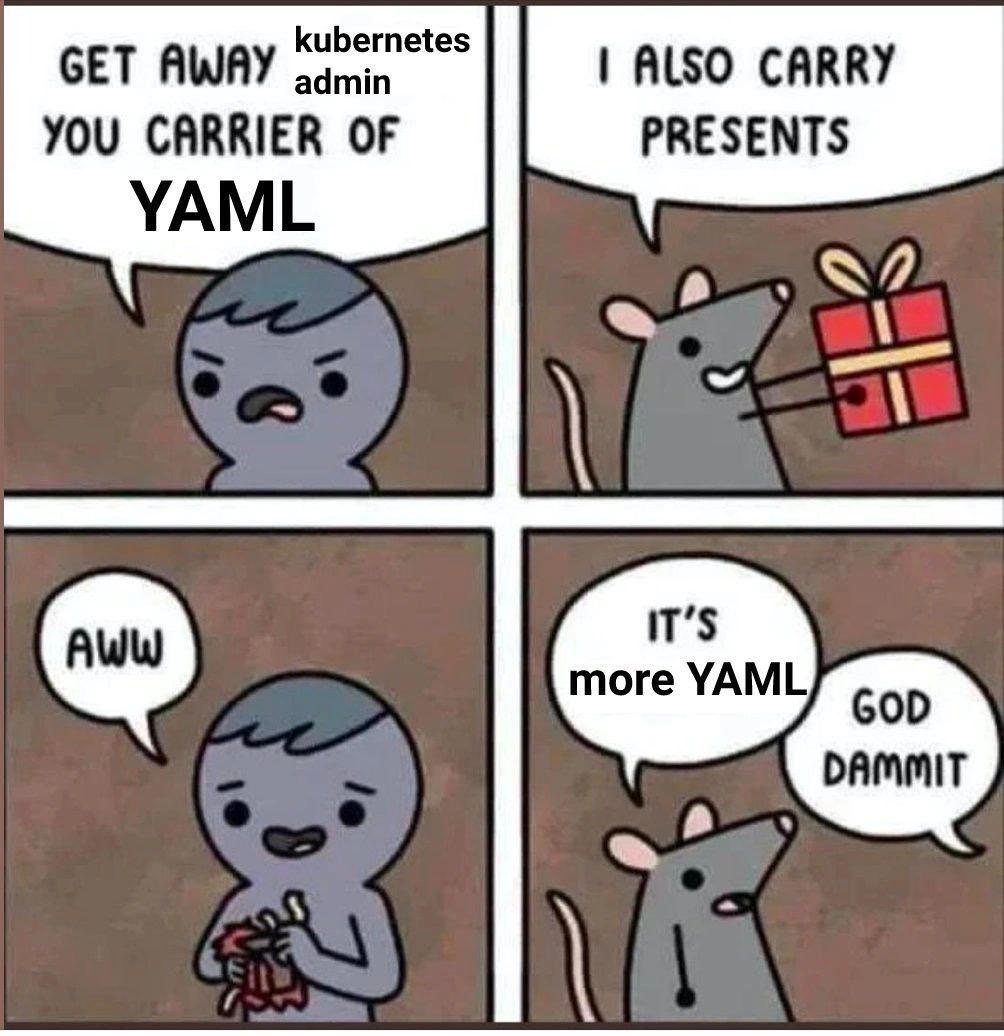
Imagine it’s your birthday and a friend gives you a big wrapped present. You’re excited, thinking it might be a cool new toy or gadget. But when you open it, inside you find… a pair of plain socks. It’s a bit disappointing, right? You groan, “Oh no, not socks again!” because you already have plenty of socks and really wanted something fun. In this meme, the tech worker (the Kubernetes admin) feels the same way about those YAML files as you would about boring socks as a gift. Every time he’s promised a nice surprise at work, it ends up just being more of those tedious YAML paperwork files. The joke is basically showing his child-like disappointment: he got all hopeful opening the “present,” and then goes “GOD DAMMIT!” when it turns out to be exactly what he didn’t want – more of the same old stuff. Just like you’d feel getting socks for every single birthday, he’s comically frustrated getting YAML every single time.
Level 2: Another YAML Gift
Let’s break down why this scenario is funny to developers, especially those working with Kubernetes. Kubernetes is a system that helps run and manage containers (lightweight mini-VMs that bundle an application and all its dependencies). Think of containers as boxes holding your app; Kubernetes is the warehouse manager organizing all those boxes across many machines. To tell Kubernetes what to do (for example, “Run 5 copies of my web app, exposed to the internet”), you don’t click buttons – you write instructions in files. These instruction files are usually written in YAML, a text format for configuration. YAML is used a lot in DevOps (Development & Operations) because it’s a structured way to list settings, similar to JSON but more readable for humans. A configuration file in YAML uses indentation (spaces) and symbols like : to separate keys and values.
Now, the meme shows a "Kubernetes admin" (an operator or engineer managing a Kubernetes system) and a little mouse. The admin is yelling "GET AWAY YOU CARRIER OF YAML" at the mouse – implying the mouse is bringing something the admin absolutely dreads: more YAML files! This reflects a common feeling in the industry: people managing Kubernetes are often overwhelmed by the number of YAML files they have to handle (sometimes jokingly called yaml_overload or Kubernetes YAML hell). It’s like paperwork for computers. Every new service, every setting, every policy in Kubernetes is another YAML file (or another section of one) that the admin has to write and keep track of.
In the second panel, the mouse says "I ALSO carry presents," offering a nicely wrapped gift. This is like someone from another team or an outside vendor saying, "I have something that will make your life easier" – maybe a new tool or feature. The Kubernetes admin’s reaction in panel 3 ("AWW") shows they’re letting their guard down, hoping this time it’s not more tedious config. This is a common early-career experience: you learn about a new automation tool or a cool feature and you think it will save you work. For example, you might hear about a package manager for Kubernetes (like Helm charts) or a fancy plugin and think, "Great, less manual config!" The admin in the meme feels that relief for a moment.
But then comes panel 4: the mouse reveals, "IT’S more YAML." The gift – supposedly something nice – turns out to be just another YAML file. The admin explodes in frustration: "GOD DAMMIT." This twist is the punchline. It’s funny because it echoes real-life moments for many in DevOps: every time you unwrap a new “solution,” it still requires writing or managing YAML. For a junior developer, imagine each time you try to automate something at work, you end up writing another config file. After a while, it’s not exciting – it’s annoying.
To make it concrete, here’s an example of a Kubernetes YAML file (called a manifest) that an admin might write to deploy a simple application:
# A simple Kubernetes Pod configuration (YAML manifest)
apiVersion: v1
kind: Pod
metadata:
  name: example-pod
spec:
  containers:
    - name: example-container
      image: nginx:latest
      # ... more settings could go here ...
This little snippet defines one Pod (a running instance of a container) with a single container using an Nginx image. It’s already several lines of structured text. In a real app, you’d likely have many more lines and multiple files like this – one for the Deployment (which manages scaled Pods), one for the Service (networking), maybe ConfigMaps or Volumes, etc. You can see how writing these files can become a big task. If you indent something wrong or miss a : or a quote, the file won’t work. Many newbies (and veterans alike) spend time debugging YAML formatting errors. It’s a rite of passage to see the error "failed to parse YAML" because of a stray space.
So the meme’s humor lies in exaggeration of a truth: Kubernetes admins often joke that their job is basically writing YAML all day. When the admin calls the mouse a "carrier of YAML," it’s like saying "Don’t give me more work!" and when the mouse offers a present, it mirrors that optimistic feeling you get trying a new approach – only to realize it’s the same old chore in a new wrapping. This resonates with anyone who has dealt with infrastructure as code frustration: the idea that automating things (though powerful) means you end up managing tons of code-like config files. In short, the comic is a lighthearted way to say, “Ugh, not another config file… I have enough already!”
Level 3: YAML All The Way Down
In the cloud-native saga of Kubernetes and DevOps, this meme hits on a comically painful truth: everything new just leads to more YAML. Kubernetes is famously configured via YAML files for every resource – Deployments, Services, ConfigMaps, Ingresses, you name it. Seasoned engineers chuckle (or groan) because they've lived this yaml_overload firsthand. The Kubernetes admin in the comic treats YAML like a contagious plague ("carrier of YAML") – a sarcastic exaggeration of how fed up one can get with endless configuration files. The little mouse offering a "present" represents any shiny new tool or feature in the containerization ecosystem that promises to make life easier. But plot twist: open the box, and surprise! it’s just more YAML to write, validate, and maintain.
This is an inside joke about infrastructure_as_code_frustration. In modern DevOps, we declare everything in config files (infrastructure as code) for consistency and automation. Great in theory, but in practice it means a Kubernetes admin lives in a sea of .yaml manifests. Each microservice deployment might involve half a dozen YAML specs (Deployments, Services, Autoscalers, RBAC rules...). As you adopt "solution" after "solution" to manage that complexity – Helm charts, Kustomize overlays, CI/CD pipelines – you realize they all just abstract or generate YAML. It's YAML all the way down.
The humor has a slightly dark, battle-scarred edge. Only someone who’s maintained a Kubernetes cluster at scale knows the kubernetes_yaml_hell of chasing an extra space or missing indent at 3 AM. YAML is whitespace-sensitive, so a simple formatting goof can break your deployment. Many of us have hollered "Why won't this pod start?!" only to discover a teeny YAML syntax error. The k8s_admin_pain is real: after wrangling hundreds of lines of YAML to deploy a simple app, another gift of YAML feels like a cruel joke. It's like the ecosystem keeps handing you beautifully wrapped presents (new cloud tools, fancy operators, promising frameworks) but unwrapping them just dumps more YAML in your lap. The meme’s punchline – “IT’S more YAML” / “GOD DAMMIT” – perfectly captures that exasperation.
From an architectural perspective, there's a reason behind the madness. Kubernetes is a declarative, distributed system: you declare the desired state in YAML, and the cluster’s controllers converge the system to match it. This approach provides consistency and automation, but at the cost of heavy upfront text specification. We traded clicky UI forms and manual scripts for version-controlled text files. Sure, YAML (AKA YAML Ain't Markup Language – yes, that's actually the recursive acronym) is more human-readable than XML or JSON, but when you’re effectively programming your infrastructure with it, the verbosity piles up. Tools tried to tame this (Helm templating, Kustomize patching), yet those tools themselves introduced new layers of YAML or gotchas in templating logic. As a result, a cynical veteran will jokingly say a Kubernetes admin's real job title is “YAML engineer.”
In summary, experienced folks find this meme hilariously relatable because they see their daily workflow in it. It's poking fun at the entire cloud-native landscape: no matter what new tech arrives, it invariably drags along a trail of YAML manifests. The joke lands so well because it’s too true – in the DevOps world, every “gift” (even the ones meant to simplify your workload) ends up being yet another config file to wrangle. After the tenth promised solution just gives you a fresh pile of YAML, you can’t help but laugh (and maybe cry a little). This devops_meme acknowledges that shared pain with a hearty dose of sarcasm.

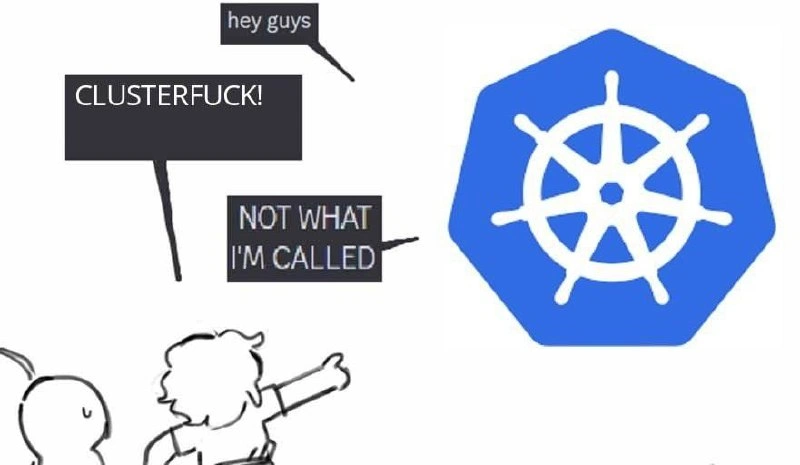
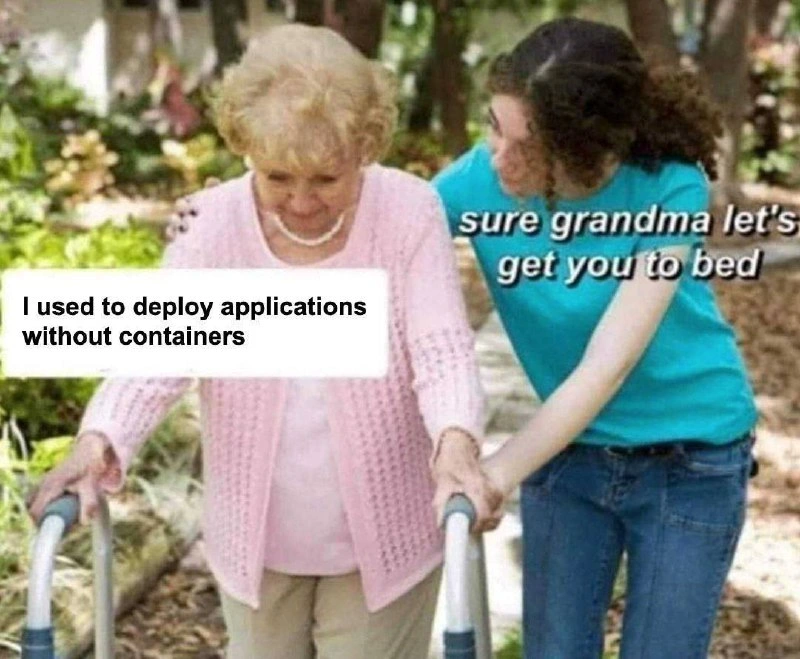
Kubernetes is the ultimate Trojan horse. You think you're getting a gift of scalable, resilient infrastructure, but once it's inside your walls, thousands of tiny YAML files pour out
Every time the CNCF gifts us a “simpler deployment tool,” I end up unboxing a Russian doll of Helm values inside Kustomize overlays inside an operator CRD - right down to the same two-space-indented YAML hell
The real gift of Kubernetes isn't container orchestration at scale - it's the endless YAML manifests that make you question whether that promotion to platform engineer was worth trading your sanity for declarative configuration files that break with a single misplaced space
Every Kubernetes admin's career arc: Day 1 - 'YAML is just structured data, how hard can it be?' Day 30 - 'I've memorized the entire K8s API spec.' Day 90 - 'I dream in indentation levels.' Day 180 - 'I've written a 47-page internal wiki on our YAML linting standards.' Day 365 - *receives another Helm chart to review* 'GOD DAMMIT.' The real joke? We all know JSON would've been worse, and don't even mention XML. At least with YAML, you can pretend the whitespace sensitivity builds character
Kubernetes “presents” are just Helm charts wrapped in Kustomize overlays with a CRD bow - open it to find the same Deployment defined three times and an outage scheduled by one tab
On Kubernetes, even gifts are CRDs; unwrap them and you get a Helm chart that renders five more YAMLs and a ConfigMap mounting your disappointment
Kubernetes orchestrates containers flawlessly - until YAML's whitespace turns your prod deploy into a plague of heisenbugs
Admin, became DevOps now?
Aaaaaaaaa ptsd
so sorry for your loss
dev ops still has dev in it, just as web dev
YAML, oh YAML, you're a beauty to behold, Your syntax is clean, your structure is bold. JSON may be fine, but it's no match for thee, For YAML, you're the one, the only one for me. With your ability to nest and elegantly display, Your simplicity and readability make my day. You make my code cleaner, my data easier to read, JSON may be useful, but YAML's what I need.