
Cursed JavaScript Constants meme explained
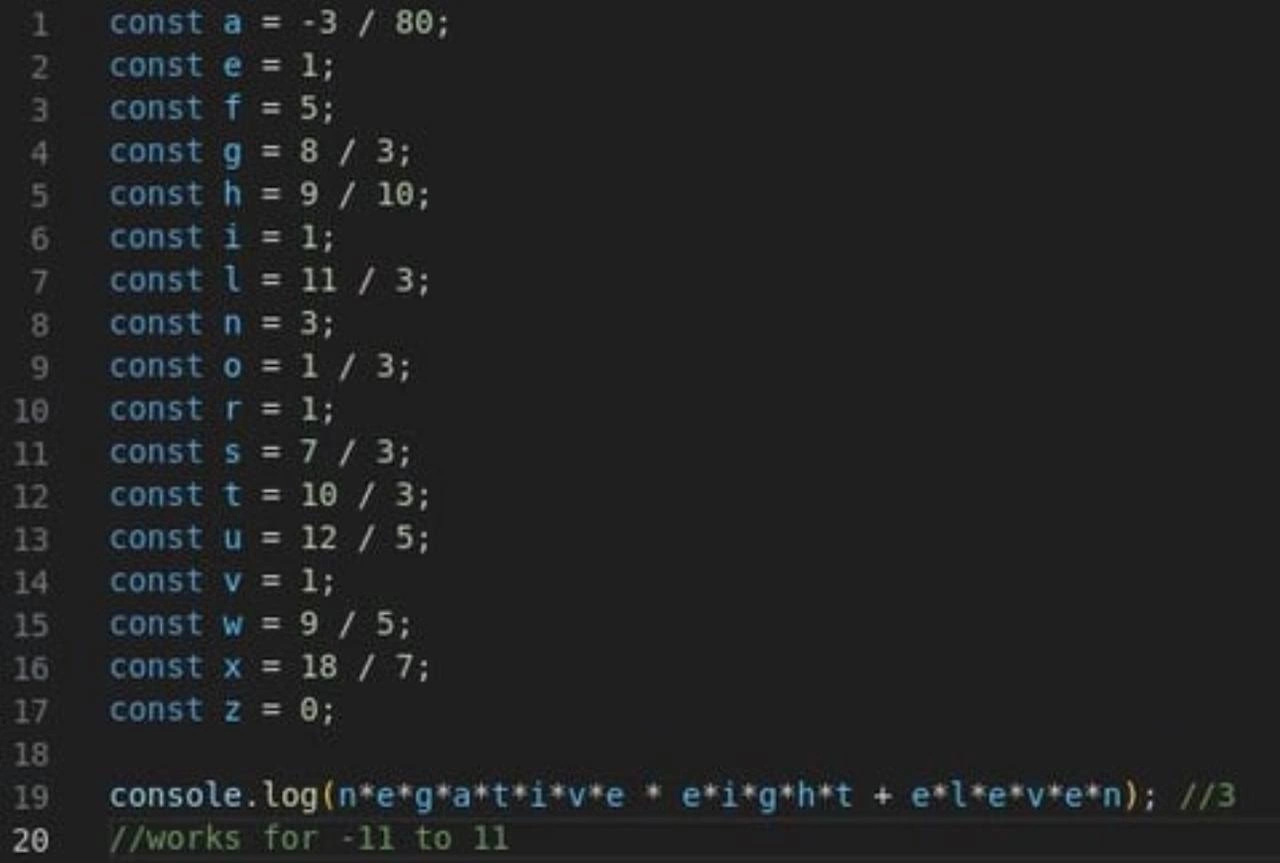
A dark editor shot defines one-letter fractions so multiplying letters in words like eight yields the number. The dive shows the math trick, why it is cursed, and why clear code beats clever code.
Level 1: Counting the Hard Way
Imagine you’re trying to tell someone the number 8, but you decide to do it in a super complicated way. Instead of just saying "eight," you spell out the word "eight" and give each letter a secret number value. Then you say: “Alright, take the value for E, multiply by the value for I, then G, then H, then T... and tada, you get 8!” Sounds silly, right? You went through all that trouble just to arrive at the number 8 that you could have said outright.
That’s basically what this code is doing – it’s solving a simple problem (printing a number) with an unnecessarily roundabout method. It’s like using a giant contraption of pulleys and levers to pour a glass of water. Sure, it works in the end, but everyone watching is thinking, “Why didn’t you just pick up the glass and pour it?” The humor comes from that absurd over-complication. It’s funny because it’s as if the programmer did a huge spelling bee and math puzzle combined, all to get a result we already knew. In plain terms: they took the long, twisty road to do something very simple, and the sheer extravagance of it is what makes us laugh.
Level 2: Spelling Numbers Out
Let’s break down what’s going on in simpler terms. The code in the image is using JavaScript’s const to create constant variables named after single letters. In normal coding, a constant might be something like const MAX_USERS = 100; – a meaningful name and a straightforward value. Here, though, we have constants like const g = 8 / 3;. That means whenever the code uses g, it substitutes the number 8/3 (which is approximately 2.666...). Why on earth pick 8/3? It turns out each letter is chosen as a special fraction or number so that if you multiply a series of letters together (forming an English word for a number), you’ll get that number. It’s like a puzzle.
For example, consider the word "four". They have:
const f = 5;
const o = 1/3;
const u = 12/5;
const r = 1;
console.log(f * o * u * r);  // outputs 4
Each letter here has a value: f is 5, o is 0.333..., u is 2.4, and r is 1. Multiply them all (5 * 0.333... * 2.4 * 1) and the result is 4. So the letters f-o-u-r, when multiplied, yield the number 4. In the code, they do this for many number-words. "six" is s * i * x, with s = 7/3, i = 1, x = 18/7. Multiply 7/3 * 1 * 18/7 and you get 6. "ten" is t * e * n = (10/3) * 1 * 3 = 10. The word "eight" uses e * i * g * h * t = 1 * 1 * (8/3) * (9/10) * (10/3), which simplifies step-by-step to 8. Every letter’s value was carefully picked so these multiplications work out nicely (lots of fractions cancel each other out). Letters like e, i, r, v are set to 1 because they appear often and a value of 1 won’t change the multiplication (clever, right?). Letters that provide the actual number scaling are things like f = 5, n = 3, t = 10/3, etc. They even snuck in a negative number: const a = -3/80. Why? Because the word "negative" contains the letter ‘a’, and by making ‘a’ a negative fraction, the whole product of negativ*e comes out to -1. In short, when you multiply the letters in "negative", you get -1 (it flips the sign). So if you do "negative" * "eight", you get -1 * 8 = -8. Voilà – that’s how the code handles negative numbers spelled out. The comment // works for -11 to 11 tells us the author set up all the needed letters to handle every number name from negative eleven up to eleven.
Now, this is clever but also utterly impractical. It’s a textbook case of over-engineering – doing something in a far more complicated way than necessary. In normal code, if we wanted to convert a word like "seven" to the number 7, we might use a simple dictionary/object (e.g., {"seven": 7}) or a straightforward if/else or built-in parsing. But this code does it by multiplying letters! That’s like solving a puzzle every time you want a number. Code readability (how easy it is to understand code) is sacrificed here. A new developer reading this would probably be confused: “Why are all these one-letter constants? What is n*e*g*a*t*i*v*e doing?!” Only when you realize it spells out words does it click – and if you blink, you might miss that. This kind of trick is often called “cursed” JavaScript because it’s creative but in a way that most people consider bad practice or even jinxed 😅. It reminds of esoteric code challenges or code golf, where people try to achieve outcomes in weird, language-bending ways just for fun.
In a code review (when colleagues examine your code), something like this would get heavy pushback. Single-letter variable names are usually discouraged except for trivial cases (like loop indices i, j). Here every letter of the alphabet is a variable – that’s a lot of unexplained symbols! Maintaining this code would be a nightmare: if you wanted to change the logic or extend it to "twelve", you’d have to figure out new letter values and ensure not to break any existing word. It’s like a precarious Jenga tower of math. One wrong move (or, say, accidentally reassigning one of these const values) and everything falls apart.
Key terms: this uses an alphabetical constant mapping (each alphabet letter maps to a number), and it performs numeric word evaluation (evaluating entire words like "eight" via multiplication). It’s an extreme form of code obfuscation – the code is technically valid but not immediately clear. While it’s fun to decipher (like a little puzzle hidden in code), it’s generally not how you’d write production-quality JavaScript or any code meant for others to read. This snippet is best appreciated as a quirky showcase or joke. It highlights the importance of code clarity: just because your code runs doesn’t mean it’s good code for a team project. Here, the author traded clarity for a cool trick, and that’s why other developers are chuckling and shaking their heads at it.
Level 3: Alphabet Soup Arithmetic
For grizzled coders, this screenshot triggers equal parts admiration and horror. What we’re looking at is a piece of over-engineered JavaScript sorcery: the author assigned a specific numeric constant to each letter (a, e, f, g, ... z) so that multiplying the letters in a number’s name yields the number itself. Yes, really. Instead of just writing -8 + 11, the code literally computes "negative eight plus eleven" by crunching letters. It’s a concoction of esoteric code and numerical gymnastics that screams: “just because JavaScript lets me, I did it.”
Let’s unpack the insanity. The code defines single-letter constants like const a = -3/80; and const t = 10/3;. These seemingly random fractions are fine-tuned so that if you multiply them in the order of spelling a number word, they magically cancel out and produce that number. For example, the word "six" is coded as s * i * x. Given s = 7/3, i = 1, and x = 18/7, the product becomes (7/3) * 1 * (18/7) which simplifies to 18/3 = 6. Boom, "six" evaluated to 6. The word "ten" is t * e * n = (10/3) * 1 * 3, yielding 10. Notice how e and i are set to 1 – they act as neutral multipliers (a sneaky way to include common letters without altering the product). On the other hand, letters like t, x, l carry fractional values that embed the needed factors. The truly fiendish touch? The letter a is set to a negative fraction (-3/80), effectively injecting a -1 factor whenever the word "negative" is spelled out. So "negative" multiplies to -1, flipping any following number word to negative. That’s how n*e*g*a*t*i*v*e * e*i*g*h*t ends up as -8: "negative" contributes the -1, "eight" contributes 8. It’s both clever and diabolical.
This combination of alphabetical constant mapping and arithmetic is a prime example of code obfuscation by over-engineering. It’s the kind of stunt you pull to win a coding contest or farm internet karma, not to ship to production. In a sane codebase, if you need to convert words to numbers, you might use a simple lookup table or parse the string. But here we have a Rube Goldberg machine of math: elaborate, fragile, and utterly opaque to the uninitiated. The humor lands because every experienced developer has seen someone take a simple task and turn it into a NASA-level project for no reason. This code basically says, “Why use straightforward logic when you can summon dark mathematical arts?” 🙃
On a serious note, imagine the code review if a teammate submitted this. Picture a senior engineer at 3 AM, bleary-eyed, reading const x = 18/7; and trying to guess why... Then seeing console.log(n*e*g*a*t*i*v*e * e*l*e*v*e*n) and nearly spitting out their coffee. It would be a mix of amusement and dread. Sure, the code works (for numbers -11 through 11, as the comment proudly notes), but it’s a maintainability nightmare. Single-letter variables? Arbitrary fractions that rely on subtle cancellations? One wrong tweak and the whole contraption collapses. Extending this to handle "twelve" or 15 or 42 would mean recalculating multiple letter constants and praying you don’t break existing ones. It’s a fragile house of cards built from JavaScript’s flexible type system (remember, JS numbers are floating-point, so these fractions are subject to rounding errors too – hopefully the result stays integer, or you might get 7.99999998 for "eight" on a bad day). In short, this is peak over-engineering: a cocktail of math tricks and JavaScript quirks that achieves in 20 lines what a normal person would do in 2 characters. The joke is crystal clear to seasoned devs: this is hilariously cursed JavaScript, the kind of code you marvel at and then banish from your codebase with a sage mantra: “clever code is cool, but clear code is golden.”


This isn't just tech debt, this is a tech federal default. You don't refactor this, you declare bankruptcy on the entire repo
Some engineers optimize for O(1); this one optimizes for OMG(why) - review approved only if the next commit replaces the build script with a haiku
This is what happens when you ask a mathematician to implement i18n - they'll prove it works for all integers from -11 to 11, but good luck explaining it to the junior who inherits this codebase after your 'clever' solution ships to production
When your code review reveals that someone spent an hour crafting integer divisions to spell 'negative eight eleven' through variable arithmetic instead of just using a string literal, you know they've achieved that perfect balance between 'technically correct' and 'why though?' that defines senior engineering. It's the programming equivalent of using a Rube Goldberg machine to flip a light switch - impressively unnecessary, yet somehow respectable
Comprehensive test coverage: validates flawlessly from -11 to 11. Prod-ready!
JavaScript lets you cancel letters like fractions; your code reviewer will cancel the PR even faster
At last, a way to satisfy “no magic numbers” and “descriptive names” simultaneously - the VM constant‑folds it to 3 while the reviewer solves an English word sudoku
Still more legible than APL one-liner.
I'm afraid to type this in my repl...
Wtf
For anyone who wants to test const a = -3 / 80; const e = 1; const f = 5; const g = 8 / 3; const h = 9 / 10; const i = 1; const l = 11 / 3; const n = 3; const o = 1 / 3; const r = 1; const s = 7 / 3; const t = 10 / 3; const u = 12 / 5; const v = 1; const w = 9 / 5; const x = 18 / 7; const z = 0;
what's 9 + 10
"Linus Torvalds, I think we need to kill this guy" "Damn"
Well, technically this is 18 lines of code☝️🤓
console.log(n*e*g*a*t*i*v*e); console.log(o*n*e); console.log(t*w*o); console.log(t*h*r*e*e); console.log(f*o*u*r); console.log(f*i*v*e); console.log(s*i*x); console.log(s*e*v*e*n); console.log(e*i*g*h*t); console.log(n*i*n*e); console.log(t*e*n); console.log(e*l*e*v*e*n);
how do you even come up with this? is there a formula, or just suicidal bruteforce?
As to me, pure 754 number "4" 🧐
If OP imported an arbitrary-precision math lib, this wouldn't happen
still less cool than that one legendary regexp that looks like gibberish but eventually, after many rounds of grouping and capturing on itself resolves to rm -rf / or smth like that 😇
Gimme his drug dealer phone number 🥴