
C main() Spaghetti Code Meme Explained
The meme frames C boilerplate around a bowl of plain spaghetti where the function body should be. The dive explains spaghetti code—from goto-era tangles through giant functions and flag parameters to microservices that still behave like distributed noodles—and why refactoring is the only real untangling.
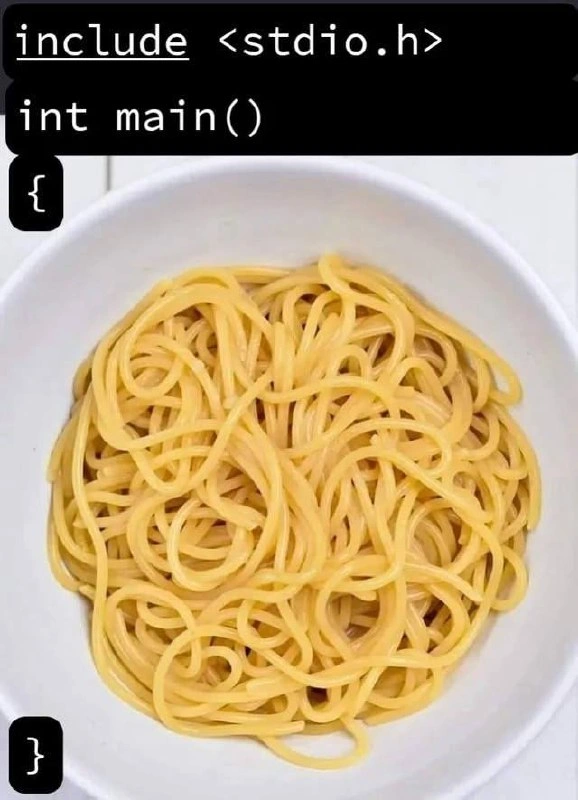
Level 1: Untangling the Headphones
You know how headphones go into your pocket as a straight cable and come out as an impossible knot? Now imagine a recipe book where step one is "preheat oven," step two is "see the knot in your pocket," and the knot is the rest of the recipe. That's the joke: the program starts out looking neat and official, and then the actual instructions are just a big tangle of noodles. It's funny because everyone who writes programs has, at some point, opened one and found exactly this — and usually they tangled it themselves.
Level 2: Parsing the Boilerplate
Every element in the black code blocks is real C, and worth knowing:
#include <stdio.h>pulls in the standard input/output library — the header that gives youprintf. (The meme drops the#, which would make the preprocessor — the tool that pastes headers into your file before compilation — reject it.)int main()is the entry point: the function the operating system calls when your program starts. Itsintreturn value is the exit status —0means success.{ ... }braces delimit the function body, where the actual logic lives.
Spaghetti code is what we call a body like this bowl: logic so entangled that you can't follow one path without pulling on five others. You'll meet it early in your career — usually in the file everyone is afraid to touch, where fixing one bug breaks two features. Symptoms: functions that scroll for pages, variables named temp2, deeply nested conditionals, and control flow that loops back on itself like, well, a noodle. The cure is refactoring — gently separating strands into small, named functions — and the prevention is doing that before the bowl fills up.
Level 3: Al Dente Control Flow
The meme is a perfect single-frame compiler joke: include <stdio.h>, int main(), an opening { — and then, where the function body should be, a photograph of a bowl of tangled spaghetti, dutifully closed by } at the bottom. The framing matters. By giving us the canonical C boilerplate — the ceremonial header include and the sacred entry point — and only the boilerplate, it asserts that everything between the braces of every real program is, structurally, noodles. The careful eye will notice the # is missing from include <stdio.h>, which is either an authoring slip or the most honest detail in the image: spaghetti codebases always have exactly one thing that shouldn't compile and yet somehow ships.
"Spaghetti code" earned its name in the era this image deliberately evokes. C inherited goto from assembly, and pre-structured-programming codebases were literal control-flow tangles — execution jumping mid-bowl from strand to strand, with no way to trace where any noodle begins or ends. Dijkstra's famous complaint about goto was, essentially, a complaint about this bowl: when control flow has no shape, reading the program requires simulating it. Structured programming, functions, and later OOP were supposed to plate the noodles neatly. What practitioners learned is that spaghetti is a conserved quantity — banish goto and it reappears as 800-line functions, boolean flag parameters, mutable globals threaded through twelve modules, and if pyramids deep enough to have weather. The modern microservices variant even has its own dish name: ravioli code in theory, distributed spaghetti with extra latency in practice.
The choice of C specifically sharpens the joke. main() returning int promises the OS a tidy exit code, a contract of order — and the body delivers carbohydrate chaos. And because the spaghetti is plain, no sauce, the metaphor extends: no comments, no documentation, no seasoning of intent. Just strands. Everyone who has inherited a legacy main.c that begins with 40 includes and ends 6,000 lines later knows that the bowl in this image is not exaggeration; it is a build artifact.

Compiles on the first try, too - spaghetti code's only reliable property is that it works until the one person who understands the sauce leaves
The dependencies are circular, but at least they are al dente.
Instant segmentation fault
That code lacks bolognesse sauce
refactor this, make no mistakes
Don't hallucinate
lgtm
It tried but failed
int main() { return "🍕"[0]; }
#include <stdio.h> #define 🚀 main #define 📢 printf #define 🧱 int #define 🎁 { #define 📦 } #define 🎈 ( #define 🎊 ) #define 🏁 return #define ✅ 0 #define 💎 ; 🧱 🚀 🎈 🎊 🎁 📢 🎈 "Hello World! 🌍🔥✨" 🎊 💎 🏁 ✅ 💎 📦 /* gcc -finput-charset=UTF-8 hello.c -o hello */ For your enjoyment
Wait, is this real spaghetti code with bolognaise? #include <stdio.h> #define 🍝 printf("Hello World! 🌍🍝\n"); return 0; int main() { 🍝 }
Yes, compilers typically support only one encoding, but that encoding doesn't need to be ASCII
F in the chat