
AI Memory Efficiency Stock Crash Meme Explained
The meme claims Google's AI algorithm cut memory use 6x and tanked Micron's stock while promising cheaper RAM. The dive explains market demand narratives, Jevons paradox, and why efficiency gains rarely shrink hardware consumption.
Level 1: The Lemonade Stand Panic
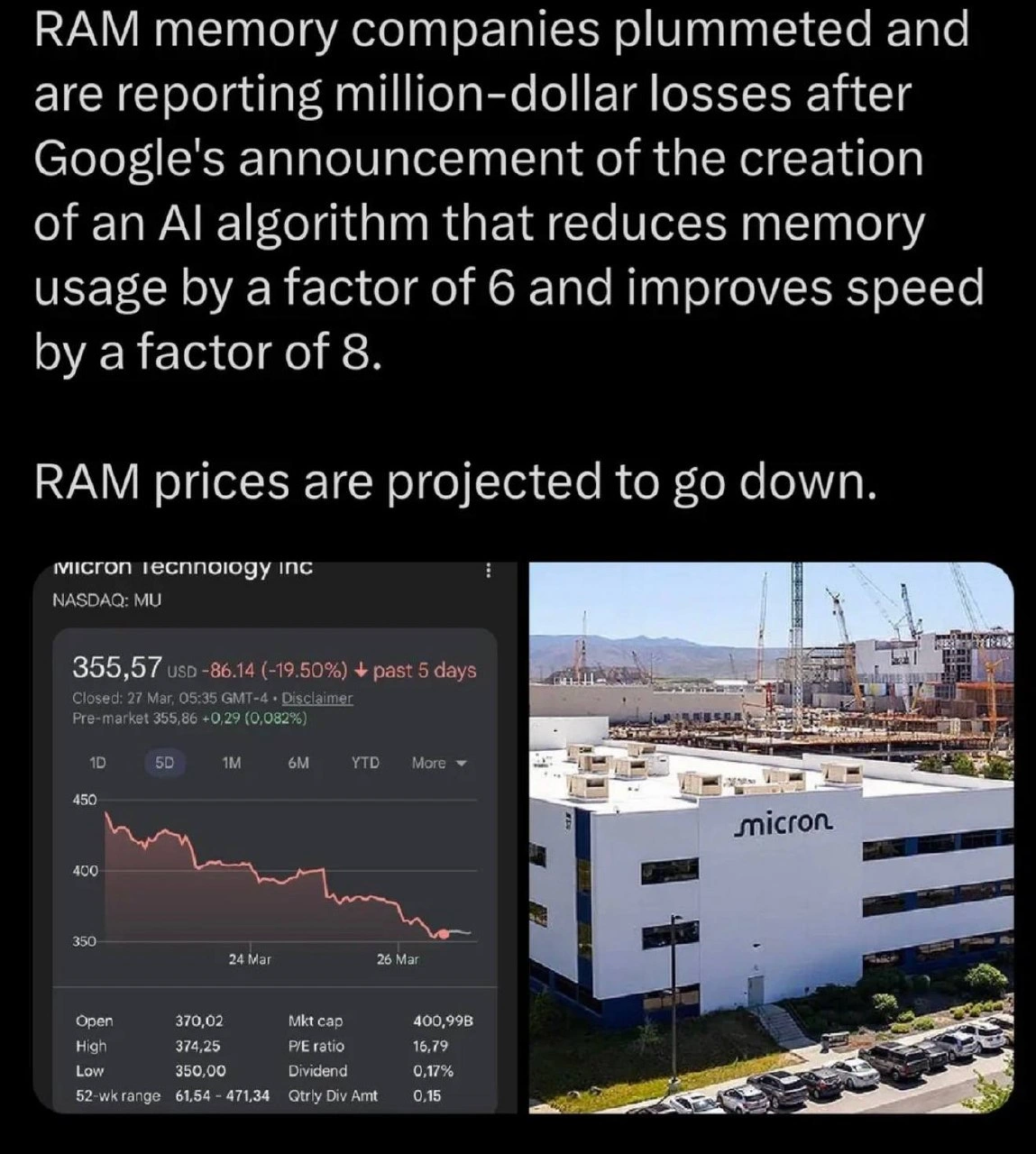
Imagine a town where everyone believes people will drink ten cups of lemonade a day forever, so the cup factory builds three new buildings to make more cups — you can see the construction cranes right in the picture. Then someone announces they invented a magic cup you can refill six times. Instantly, everybody who invested in the cup factory panics and sells, the factory's value falls off a cliff, and the chart turns into a red ski slope. The joke is that ordinary folks watching all this aren't worried about the factory at all — they're just quietly hoping that, finally, cups will get cheap enough that they can afford one.
Level 2: Reading the Scoreboard
A few terms decoded:
- RAM (Random Access Memory) — the fast, temporary memory your programs live in while running. Companies like Micron manufacture the actual chips (DRAM), so their fortunes track how much memory the world thinks it will need.
- NASDAQ: MU — Micron's stock ticker. The screenshot shows a stock app: price (355.57), the 5-day change (-19.50%),
Open,High,Low, and Mkt cap (total company value, ~401 billion USD). The red downward chart between 24 Mar and 26 Mar is the market reacting to news in near-real time. - P/E ratio (16.79) — price divided by earnings; a rough gauge of how much future growth is baked into the price. When expectations crack, the price corrects fast.
- AI memory optimization — recent AI workloads (training and serving large models) consume staggering amounts of memory, which drove a genuine memory shortage and rising RAM prices. An algorithm cutting memory use 6x would, in theory, mean fewer chips needed — hence the panic.
The career lesson hiding here: hardware demand, stock prices, and AI hype form a tightly coupled system. As a developer you feel it directly — when AI datacenters buy up DRAM supply, the 64 GB upgrade for your dev machine suddenly costs double. That's why the line "RAM prices are projected to go down" reads less like analysis and more like a prayer.
Level 3: Jevons Has Entered the Chat
The post claims, in plain dark-mode text above a brutal stock screenshot, that "RAM memory companies plummeted and are reporting million-dollar losses after Google's announcement of the creation of an AI algorithm that reduces memory usage by a factor of 6 and improves speed by a factor of 8," punctuated by the hopeful kicker: "RAM prices are projected to go down." The receipts: Micron Technology (NASDAQ: MU) at 355.57 USD, -86.14 (-19.50%) past 5 days, with a red chart sliding from ~450 toward 350, next to a photo of a gleaming Micron building still surrounded by construction cranes — a fab being built for demand that the market just decided might evaporate.
Experienced engineers immediately recognize two intertwined patterns. First, the "DeepSeek moment" template: an AI efficiency claim drops, and the market — which had priced semiconductor companies as if compute demand were a law of physics — panics and repriced overnight. The same script ran when efficient training claims briefly vaporized hundreds of billions in GPU market cap. The asset crashing isn't the technology; it's a narrative about future demand.
Second, and this is where the seniors smirk: Jevons paradox. When a resource becomes more efficient to use, total consumption historically goes up, not down. Make memory 6x cheaper to consume per task, and the industry will find 12x more tasks. We watched this exact movie with every hardware generation — RAM got a thousand times cheaper per gigabyte, and yet a chat application now idles at 1.5 GB because it ships an entire browser engine. The notion that an optimization algorithm would lead to less RAM being bought is the part of the meme that's actually funny: efficiency gains are absorbed by software bloat and new workloads within roughly one product cycle.
The original poster's caption sharpens the irony further: "And OpenAI canceling RAM orders? Cisco moment? 🤔" — invoking the dot-com era, when Cisco was the picks-and-shovels darling priced for infinite internet buildout, then lost ~80% when demand projections collapsed. The cranes behind the Micron building are the punchline within the punchline: capex committed years in advance against demand forecasts that one press release can delete. Also worth noting the deadpan absurdity of "million-dollar losses" next to a 400.99B market cap — losing millions would be a good day for a company that just shed tens of billions in valuation.


An algorithm that cuts memory usage 6x won't lower RAM prices - Electron apps will simply discover they can now open six windows
The market heard `free()` once and garbage-collected the entire memory sector.
Yay we can finally order ram again then
YESSSSS
Context
Good news
JUST AFTER I GOT A KILLER DEAL ON DDR4 FUCK YEAH
Yay faster inference
pivoting away from the consumer market, how's that working out for ya, are ya winning son?
I'm not opening a browser on my fuckass A04e
They just need to reduce production to increase prices
Lol they'll just keep the high prices and pocket the difference.
What's up with protogens and RAMs?
Do they eat RAM?
Can someone enlighten me on the "Cisco moment" moment?
Remember. Don't forgive micron for betraying the consumers.
But if compare to older prices will it be losses?
Cisco