
EU Startup Regulation Meme Explained
A Gru meme shows the EU plan to regulate tech and tax SMBs, only for startups to move to the US. The dive covers compliance overhead, venture-capital friction, stock-option complexity, and why founders practice geographic arbitrage.
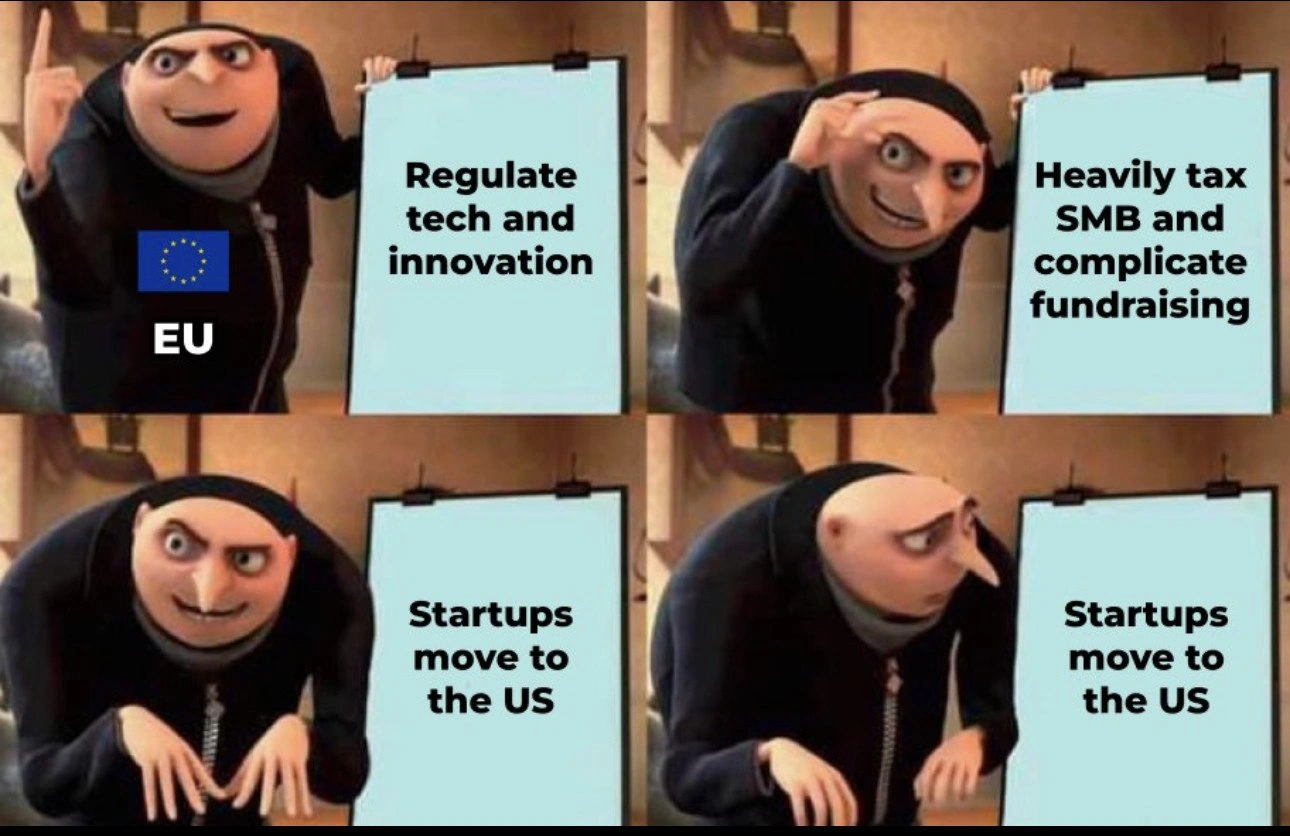
Level 1: Strict Teacher, Empty Class
Imagine a teacher who makes a lot of strict rules for the classroom. They say, “No talking at all, difficult homework every night, and heavy fines (or extra chores) for any small mistake.” The teacher thinks these rules will create a perfect class. But what happens? All the kids decide, “We don’t want to be in this class anymore,” and they transfer to another teacher’s class where the rules are kinder and they can actually have some fun while learning. Suddenly, that first teacher looks up and the classroom is empty — all the students moved next door! This meme is just like that story. The EU is the strict teacher making tough rules and high “taxes” (like giving a lot of homework or fines). The startups are the students who decide to leave because it’s easier to learn and play in the other class (the US class with a friendlier teacher). It’s funny in a way because the teacher’s big plan completely backfired — they wanted a well-behaved class, but ended up with no class at all. The feeling behind the joke is a mix of “Oh no, that didn’t go as planned!” and a laugh at how sometimes making things too strict just makes everyone run away.
Level 2: Startup Exodus
At its core, this meme contrasts two different environments for startups: Europe (EU) versus the United States (US). In the first two panels, the European Union is making big rules. “Regulate tech and innovation” means the EU creates laws about how tech companies must behave — for example, laws about user privacy, data handling, or how companies can use AI. These rules are often strict to protect people’s rights. Next, “Heavily tax SMB and complicate fundraising” refers to how small and medium-sized businesses (SMBs) in Europe face high taxes and complex processes when they try to get money from investors. Fundraising is how startups get cash to grow (often from venture capital funding or angel investors). In some parts of Europe, if a startup wants to raise money or give shares to new investors, there are lots of forms, regulations, and sometimes limitations on how it can be done. It can be complicated, especially compared to the US, where the process is generally more straightforward and there’s a larger pool of venture capital willing to invest in risky new ideas.
Because of these challenges, the next panels show the result: “Startups move to the US.” This means many European startup founders decide to relocate their company to the United States. Why the US? The US is famous for Silicon Valley (in California) and other tech-friendly regions where investment money is plentiful, regulations for new businesses are lighter, and taxes (especially in certain states) can be lower. The term startup exodus is often used to describe this phenomenon of companies leaving one place for another en masse (exodus means a mass departure). In real life, it’s common to see a promising startup from, say, France or Germany incorporate as a US company or attend an American accelerator program to more easily access funding and partnerships. This is sometimes jokingly called “geographic arbitrage” — basically, choosing the location that gives your business the best advantages.
The meme uses the Gru board presentation format, which is a popular meme template from the movie Despicable Me. In that scene, a character named Gru shows a series of slides. Meme creators use it to set up a plan that goes horribly wrong by the last slide. Here, the EU (represented by Gru with an EU flag pasted on him) proudly presents their plan on the flip chart. But by the third panel, when the policy leads to “Startups move to the US,” Gru is slouching, and by the fourth panel he’s completely defeated realizing he’s just repeated the unwanted outcome. It’s a visual way to say, “the plan backfired.” For a junior developer or someone new to the tech industry, the message is that rules and taxes can shape where companies choose to build their dreams. A place with too many rules (even if meant to do good) might scare away the very innovators you want to keep. This is a frequent talking point in StartupCulture and among entrepreneurs: Where should we base our startup for the best chance of success? The meme humorously sums up one answer to that — if Europe makes it too hard, startups pack their bags for America.
To put it in simpler terms: imagine the EU is trying to guide and control the tech space carefully, but doing so without realizing it might be pushing the brilliant new companies right out the door. The humor comes from that irony and from recognizing a real-world trend portrayed in a silly cartoon format that tech folks share for a laugh (and a bit of a sigh).
Level 3: The Regulatory Boomerang
Europe’s well-intentioned tech regulations and tax policies can sometimes act like a boomerang — they come right back around with unintended consequences. The meme nails this irony: the EU (portrayed by Gru) proudly unveils a plan to “Regulate tech and innovation” and “Heavily tax SMB and complicate fundraising,” expecting to shape a fair, controlled tech industry. However, in the very next panel, the plan backfires spectacularly: startups flee to the US in search of a friendlier ecosystem. This Gru presentation format (a classic Despicable Me meme framework) often highlights plans that self-sabotage, and here it perfectly captures a recurring pattern in the startup world.
Seasoned founders and venture capital veterans recognize this scenario as a commentary on regulatory burden. Europe’s strict laws — from comprehensive data protection rules like GDPR to strong labor regulations — are meant to protect citizens, but they also increase compliance overhead for young companies. A fledgling startup with 5 employees might suddenly need a legal team to navigate EU directives or devote precious time to paperwork instead of coding their product. Likewise, “Heavily tax SMB” refers to high taxes and limited incentives for small-to-medium businesses. Many European countries impose robust corporate taxes and stringent rules even at low revenue, which cut into the runway of a startup. When early-stage companies are burning cash to find product-market fit, every extra expense or delay counts.
Fundraising complications add more fuel to this fire. European startups often report that raising capital can be more complex due to fragmented markets and conservative investment climates. For example, granting employee stock options — a key tool to attract top tech talent — can be tax inefficient or legally convoluted under some EU jurisdictions. And many EU-based venture funds prefer startups to incorporate abroad for simpler exit strategies. As a result, ambitious entrepreneurs practice geographic arbitrage: they register their companies in places like Delaware (a US state famous for business-friendly laws) or physically move to Silicon Valley or other US tech hubs. This transatlantic migration is essentially a startup exodus, a direct consequence of the very policies meant to rein in tech power.
The humor here is that the EU’s “master plan” slideshow ends up advertising the opposite of its intent — it’s as if an attempt to tame innovation ends with “Go West, young startup!” written on the board. Experienced folks in startup culture chuckle (perhaps a bit ruefully) because they’ve seen this movie before: stricter rules often spur the most driven innovators to seek freedom elsewhere. It’s a classic tale of policy impact gone awry. Gru’s stunned, defeated posture in the final panel is basically the EU realizing, “Oops, we just nudged our brightest innovators across the ocean.” In the world of TechIndustryHumor, this meme hits home: the path to StartupLife is already hard, and piling on red tape can inadvertently create a one-way ticket to America. The emotional subtext is both funny and frustrating — funny as a comic exaggeration of bureaucrats outsmarting themselves, and frustrating because it reflects a real hurdle for international entrepreneurs.


Every time Brussels drops another 200-page directive, our founders treat Delaware like we treat us-east-1: not ideal, but all the docs assume you’re there
The EU's tech strategy is like implementing strict typing in production without a migration plan - sure, it catches errors, but your entire engineering team just migrated to a company that still lets them ship fast and break things
The EU's master plan: regulate innovation so thoroughly that startups optimize their jurisdiction selection algorithm and discover O(1) relocation to the US beats O(n²) compliance overhead. Turns out the real 'exit strategy' wasn't an IPO - it was literally exiting the regulatory jurisdiction. Who knew that when you make the cost function of doing business asymptotically approach infinity, rational actors would simply change their deployment region?
EU regs: the compliance layer that balloons your tech debt faster than any monolith migration
EU keeps adding middleware (GDPR, DSA/DMA, AI Act) and wonders why the workload gets migrated to us-east-1 - just regulatory latency optimization via a Delaware C-corp
Schrems II made data transfers hard; turns out the only export the EU streamlined is our cap table - straight to Delaware via a SAFE and one DocuSign
This also happened before regulations
EU would give money for researchers. Researchers would come up with stuff. US companies would buy researched stuff
To be fair, regulations are not always bad. Hello USB-C on iPhone
I'd bet that of the startups that move to the US many are either dating apps or other "service as a product" style businesses who rely on data acquisition.
Mood although I have no idea what is SMB in this context https://github.com/liberapay/liberapay.org/issues/30
This new law only benefits non-Apple customers: any Apple customer now needs to buy a new cable because I won't be able to use the one I have from my device
And probably a new charger because it might not be the same
The EU might be good for some things but if they want to rule private companies then they should guarantee utilities don't get overpriced, or broadband providers don't suck customers blood
Mate, this is as simple as “use the right tool for the job”. If USB-C was not even considered for years, then there must be a reason that neither regulators nor customers understand because none of them know the tech requirements their devices have. Only because someone says “I have an Android and when I go to visit my friend I find myself unable to use their charger” - Wake-up! That's the same than petrol and diesel! Or when someone has a food allergy and they can't eat something (like additives) but it's everywhere because someone decided it must be. I experienced this crap first hand!
It’s not applicable for USB connection for example, HDMI and Ethernet works fine
Want a standard? Manufacturers must provide the necessary cables. Don't force them to use “your” design. That's not an open market if someone imposes rules!
Or even worse - author of usb and typec standard
Then use an adapter - Apple provided it but not Android. So fuck Apple? That's not a standard, it's a way to force Apple to operate against their own product
Options are there - imposition is the problem.