
Database Normalization Meme Explained
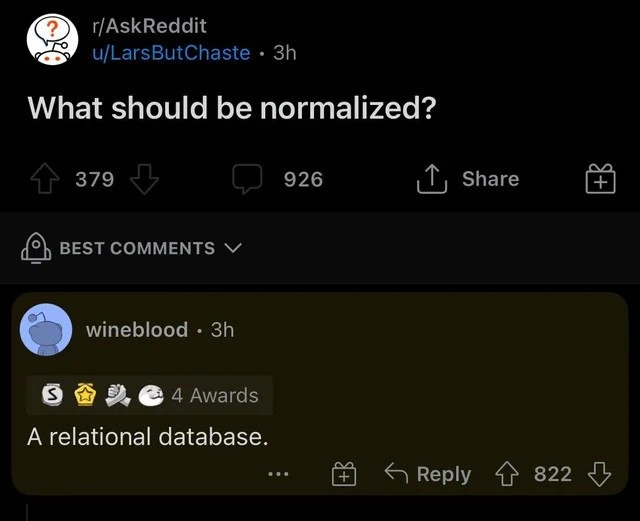
A Reddit screenshot shows “What should be normalized?” met with the deadpan answer “A relational database.” The dive explains database normalization, normal forms, and how the social vs SQL double meaning fuels the joke.
Level 1: Normalization Means Two Things
Imagine you’re in a classroom and the teacher asks, “What’s something we should make normal for everyone?” Most students are thinking of answers like “saying thank you” or “helping others”. But one kid – let’s call him Danny the data geek – hears the word “normal” and thinks about making things tidy and organized. So he raises his hand and confidently says, “We should make sure our library’s books are properly organized on the shelves, with no duplicates in wrong places!” Everyone giggles because that’s not what the teacher meant. The teacher was talking about social normals, but Danny answered with a literal organizing-the-library idea. The humor comes from this mix-up: the same word “normalized” can mean two different things. In the Reddit meme, someone did exactly that. The question was asking what behavior or idea should become normal, and this person answered as if the question was about cleaning up and organizing — specifically, organizing data in a relational database. It’s funny in the same way as if someone asked, “What’s something we need more of in society?” and a jokester answered, “RAM for my computer!” The answer fits the words of the question but comes from a totally different world. The joke makes people laugh because the person took a geeky meaning of “normalized” (make a database neat and orderly) and pretended that was the obvious answer to the original question. It’s a playful misunderstanding on purpose – basically saying, “You said normalized, so of course I thought of databases!” Even if you don’t know what a relational database is, you can sense the silliness: it’s the classic nerdy friend who hears a common phrase and can’t help but turn it into a tech joke. The laughter is in that leap from a regular everyday context to a super specific computer context, all with one word playfully misinterpreted.
Level 2: Normalization 101
Let’s break down the tech jargon behind this joke. Relational databases (like MySQL, PostgreSQL, or Oracle) are a way to store information in structured tables. Think of a bunch of Excel sheets (tables) where each sheet has rows (records) and columns (fields), and those tables can be linked together by common identifiers. SQL (Structured Query Language) is the language used to query and manage these databases. Now, when database designers talk about “database normalization,” they mean organizing those tables according to certain rules so everything is stored cleanly and efficiently. The goal of normalization is to reduce duplication and ensure data integrity. In simple terms, you don’t want the same piece of data (say, a customer’s address or a product price) copied in multiple places, because if it changes, you’d have to find all the places it’s stored and update each one (and you might miss some!). Instead, you structure the data so that each fact lives in one table, one time, and other tables just refer to it. This is a core idea in relational database design – it’s one of the first things you learn in DatabaseDesignPrinciples class.
Normalization is typically taught in stages called “normal forms.” First Normal Form (1NF) is the baseline: it says each column should hold a single value (no lists or comma-separated junk in one field) and each row should be unique. For example, if we have a field for phone numbers, 1NF means each phone number should be in a separate row or a separate table, not jammed together in one cell. Second Normal Form (2NF) and Third Normal Form (3NF) add more rules about how data depends on other data. By the time you reach 3NF, your tables are structured so that each column depends on the primary key, the whole key, and nothing but the key (so help you Codd!). In plain English: every piece of info in a record is only about that record’s main subject. If we have any detail that describes something else, we pull that out to its own table.
Here’s a concrete example. Imagine an Employees table for a company database:
In an unnormalized design, the table might look like:
Employees(id, name, department_name, department_location).
If 50 employees work in the “Engineering” department located in “New York,” the words “Engineering” and “New York” would be repeated in 50 rows. That’s a lot of redundancy. If the department moves or gets renamed, you have to update all those rows!In a normalized design (let’s say 3NF), you’d split this into two tables:
Departments(dept_id, department_name, department_location) – listing each department once,
and Employees(id, name, dept_id) – each employee refers to their department by an ID.
Now “Engineering, New York” lives only once in the Departments table. If it changes to “Engineering, NYC,” you update one row in one table, and all employees linked to that department see the updated info through the relationship.
That’s normalization in action: organize data into tables so that each fact is stored once and references are used everywhere else. The result is a database that’s easier to maintain and less prone to inconsistencies (like one employee still tagged in “New York” while everyone else is updated to “NYC”).
So, coming back to the meme: The Reddit post asks a broad question, “What should be normalized?” — usually people answer with things like “napping during the day” or “telling someone you need mental health time,” basically social behaviors or ideas they think should become more normal. But the commenter answered, “A relational database.” Why is that funny? Because they’re using the technical meaning of “normalized” instead of the social meaning. In database terms, normalizing means applying those design rules we just discussed. Essentially, the commenter is joking that the thing in dire need of proper normalization is a relational database (implying perhaps databases out there are a mess and need this fix!). It’s a bit of DatabaseHumor that plays on the double meaning. If you know about SQL and databases, you immediately picture someone earnestly normalizing database tables and it clicks why that answer is clever. If you don’t, it might fly over your head as a non-sequitur. This is why the comment got such a huge response on a tech-savvy platform — a lot of people reading that thread likely have written an ALTER TABLE statement or two, and the term “normalized” instantly reminded them of database design. It’s an inside joke, turning an everyday question into a cheeky reference to RelationalDatabaseDesign guidelines. Basically, the Redditor treated an open-ended question as if it were asking, “What (in the world of data) should be normalized?” and gave the textbook answer. And honestly, for anyone who’s struggled with chaotic data, the idea of a nicely normalized database does sound pretty wonderful to normalize!
Level 3: Not That Kind of Normalization
On the surface, this meme is a screenshot of an AskReddit thread, but the humor is pure programmer insider wit. The original Reddit question in big bold font asks, “What should be normalized?” — in a general, society-and-culture sense. The top comment (highlighted in the screenshot with 379 upvotes on the post and a staggering 926 comments total under the question) comes from user wineblood, who quips: “A relational database.” In context, it’s a one-line joke twisting the meaning of “normalized.” Everyone else is thinking about social norms, but leave it to a developer to give a straight-faced SQL answer. It’s the kind of TechHumor where one word has dual meanings and the nerdy meaning hijacks the conversation. The result? Over 800 replies to that comment and 4 Reddit awards plastered on it, indicating how much it resonated. You can almost hear the groans and laughter echoing through the thread as thousands of readers, especially those with a tech background, clicked the upvote arrow for that perfectly normal play on words.
For experienced developers and database geeks, this joke lands immediately. The phrase “should be normalized” was practically baiting a database answer. In the world of DatabaseHumor, it’s the obvious punchline. There’s an unwritten rule that whenever someone says “normalize” in a general forum, some cheeky coder will pipe up with a database remark. Here, wineblood beat everyone to it, and Reddit’s reaction (“Best Comment” status and awards) shows how relatable this humor was to the crowd. It’s funny because it’s literal and context-swapped: they answered a broad life question with a super-narrow technical solution. It’s like someone asked, “What’s a fundamental change we need in society?” and an engineer replied, “Version control for everyone!” – wrong context, yet somehow making a clever kind of sense only techies appreciate. In this case, the idea that “a relational database” needs to be normalized is 100% true in the technical realm – database normalization is a best practice taught in every introductory database course. So the commenter is jokingly treating that serious database design principle as if it’s the pressing answer to a casual question. The dual meaning of “normalized” creates a perfect nerdy pun.
Beyond the wordplay, there’s a layer of shared experience here. Any developer who has dealt with the fallout of an unnormalized database (duplicates everywhere, inconsistent data, nightmare maintenance) will smirk at this answer. It’s too real. We’ve all seen that one user table with the address fields repeated in every row, or product entries copied-and-pasted across records, and thought, “Ugh, this really should have been normalized.” When you know the pain of redundant data, the idea that the first thing to normalize is “a relational database” feels like a cheeky bit of truth. It’s as if the commenter is subtly saying, “Hey world, you want to know what needs fixing? Our database schemas! Let’s get those to Third Normal Form before anything else.” Seasoned engineers have had debates over normalization – for instance, arguing if a design is in 3NF or if it’s worth pushing to BCNF, or conversely whether strict normalization is hurting performance and if they should denormalize for practicality. That’s a classic tug-of-war in RelationalDatabaseDesign: the purity of perfectly normalized data versus the reality of query performance and simpler code. This redditor’s joke firmly (and facetiously) takes the side of purity: normalize everything!
The Reddit comment thread itself became a celebration of this nerdy reply. With 822 replies under wineblood’s comment, you can imagine people riffing on it – perhaps further SQL puns, or jokey discussions like “I see what you did there” and “Ah yes, 3NF – truly the most important thing to normalize.” The screenshot’s dark-mode reddit_screenshot_ui highlights the momentum: multiple award icons (someone even spent real money to give this joke gold, silver, and other medals), and “BEST COMMENTS” clearly showing this one on top. In programmer circles, a punny response like this often blows up because it’s a bit of RelatableHumor – it validates the reader for knowing the reference. If you’ve spent time designing databases or studying DatabaseDesignPrinciples, you’re in on the joke. You feel a tiny rush of pride chuckling, “Ha, I get it – normalization, like in databases!” It’s humor that rewards you for your niche knowledge. And for those who didn’t get it, well, the thread’s popularity might even prompt them to google “relational database normalization” – effectively turning an AskReddit comment section into an impromptu computer science lesson. Normalization – not just for databases, but now for comedy, too. 😉
Level 4: Normalization Nirvana
From a pure CS_Fundamentals perspective, the term normalization has a very specific, almost sacred meaning in relational database theory. It refers to the process of organizing a relational database into well-structured tables so that data redundancies and anomalies are minimized. This concept originates from the pioneering work of E. F. Codd (the father of the relational model) and has been formalized into a series of normal forms. In classic DatabaseDesignPrinciples, you start with First Normal Form (1NF), then Second Normal Form (2NF), and typically aim for Third Normal Form (3NF) or even the stricter Boyce-Codd Normal Form (BCNF). Each normal form adds rules: 1NF says “each column value should be atomic (indivisible) and there are no repeating groups,” 2NF and 3NF build on that by eliminating various kinds of functional dependencies that can cause duplication or inconsistency.
Why go through all that? Because a fully normalized schema eliminates pesky data anomalies. An update anomaly (where you update data in one place but not another), an insertion anomaly, or a deletion anomaly can all occur if the same fact is stored in multiple places. For instance, if a customer’s address appears in 5 different records and the customer moves, an un-normalized design might require 5 separate updates — miss one and your database has conflicting truths. In a normalized design (say, satisfying 3NF), that address would be stored once in an Addresses table and referenced everywhere else by a key, so one update does the job. Data integrity is preserved by design. In essence, achieving higher normal forms (like 3NF or BCNF) is like reaching a state of data nirvana where every piece of information lives in exactly one perfect spot.
Now, this meme’s punchline taps directly into that idealism. The Reddit question asks, “What should be normalized?” expecting answers about social conventions, but a tech-savvy commenter gave the deadpan response “A relational database.” This answer evangelizes the gospel of RelationalDatabaseDesign in a completely unrelated context. It’s as if they’re proclaiming: “The one thing in this world that truly needs normalizing is our databases!” To a database theorist or a developer who knows the beauty of a well-normalized schema, there’s comedic satisfaction in that statement. It humorously elevates a dry technical best practice to the status of the only answer to a broad philosophical question. In other words, the commenter playfully treats database_normalization as the highest virtue—implying that, academically speaking, normalizing your tables (to 3NF and beyond) is obviously the most urgent kind of normalization there is. This over-the-top literal interpretation, grounded in decades-old database theory, is what makes the joke land for the initiated. It’s a nerdy normalization pun celebrating the perfection of a properly designed SQL schema in a place no one expected it.


A junior developer writes code that a computer can understand. A senior developer writes code that a junior developer can understand
Normalize the schema to 3NF all you want - one “we’ll just drop it in a JSONB column for flexibility” request and the entire data model goes back to the primordial spreadsheet soup it crawled out of
The real question is whether this joke is in 3NF or if we need to decompose it further to eliminate the transitive dependency between 'humor' and 'upvotes' through the determinant 'database knowledge'
The beauty of this joke is that it works on multiple levels - just like a properly normalized database. While society debates what behaviors to normalize, database architects have been normalizing relations since Codd's 1970 paper. Though let's be honest, by the time you reach BCNF, you're probably denormalizing for performance anyway. The real question is: should we normalize the debate about normalization? That's a recursive relationship I'm not sure even a well-designed schema could handle
Normalize to BCNF in design reviews, denormalize to 0NF in prod for those sub-second queries
Normalize the relational DB; denormalize the reporting; slap “CQRS” on it so the architecture diagram looks intentional
Normalize the OLTP schema to 3NF; denormalize analytics - p95 latency doesn’t care about BCNF
Css styles without nomalize.css
yeah. google is more random
I'm rus
For personal reasons, I do not browse the web from my computer. (I also have not net connection much of the time.) To look at page I send mail to a demon which runs wget and mails the page back to me. It is very efficient use of my time, but it is slow in real time.
...and a set of orthogonal vectors