
Data Pronunciation Debate Meme Explained
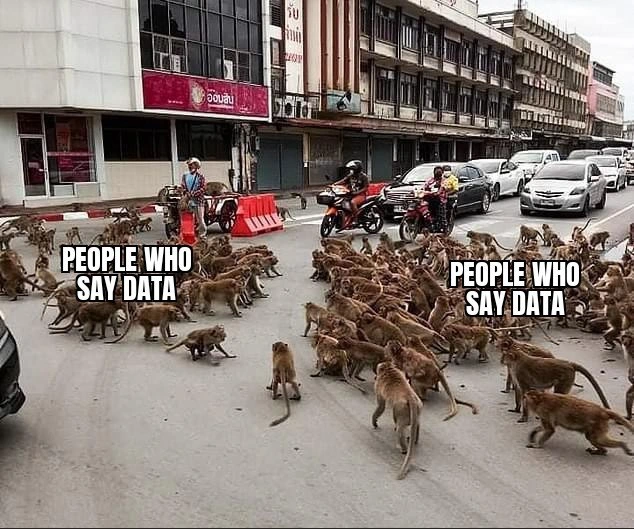
Two identical captions—People who say data—label rival monkey swarms blocking a street. The dive ties the gag to the day-ta versus dah-ta war, Parkinson's Law of Triviality (bikeshedding), and how minor linguistic fights freeze real work.
Level 1: Traffic Jam Over a Word
Imagine two groups of people arguing about how to say a simple word. For example, one group insists on saying "to-MAY-to" and the other insists on "to-MAH-to" for the word "tomato." Now picture that argument getting so out of hand that both groups run into the street and block traffic! This meme is funny because that's basically what's happening: a bunch of monkeys (pretending to be people) have stopped cars and bikes on the road just to fight over how to say "data." In real life, "data" just means information, and no matter how you say the word, the meaning stays the same. But in the joke, the two sides act like it's a huge deal – kind of like kids arguing that their way of saying a word is the only correct way, while everything around them gets held up.
The humor comes from how silly and over-the-top the scene is. It takes a small, unimportant disagreement – just a little difference in how a word sounds – and blows it up into a big monkey gang traffic jam. We laugh because it shows people (or in this case, monkeys behaving like people) being so stubborn about something so tiny that they're actually getting in the way of everything else. It's like if your friends refused to budge during recess because they were busy arguing whose way of saying "potato" is right. It's ridiculous and relatable at the same time. The meme is basically saying: "Look how crazy it is to hold up the whole world (or at least the road) over such a silly argument." You don’t need to know anything about programming or tech to get the joke – it's a playful reminder not to let small disagreements turn into big roadblocks for everyone else.
Level 2: Pronunciation Pileup
Simply put, this meme shows how developers and data scientists can get into surprisingly heated arguments over a tiny detail: how to pronounce the word "data." You may have heard some people say it like "DAY-tuh" (rhymes with "beta") and others say "DAH-tuh" (with a broad 'a', like "father"). The image uses two groups of monkeys coming from opposite sides of a street to represent these two camps of people. Both swarms are labeled "People who say data" – which looks odd, because the text is identical. That's actually part of the joke: in writing, there's zero difference between the two groups (they both literally use the word data), but in speech each group insists their way of saying it is right.
This scene is funny to developers because it's a spot-on exaggeration of what we sometimes experience in our communities. It's like an inside joke about our tendency to argue over trivial things. In many dev teams or online forums, a minor debate like this can erupt and cause a big fuss. We jokingly call these little battles language wars (even though here it's about spoken language rather than programming languages). It’s similar to two rival factions arguing in a super serious way about something that isn't actually a big deal. Here it's not about a critical technical issue at all, just a pronunciation preference. Yet it's portrayed as if two monkey gangs have taken over the road, completely stopping traffic – symbolizing real work or communication getting stuck.
For a junior developer, it’s helpful to know there's even a term for this kind of situation: bikeshedding. This term comes from a story where a committee spent so much time arguing about the color to paint a bike shed that they ran out of time to discuss the important stuff (like building a nuclear reactor!). In our case, the "bike shed" is how to say "data," and the important work (the "nuclear reactor") is whatever project or discussion got sidelined. Essentially, people focus on the easy, petty question because everyone can voice an opinion on it, whereas the harder issues are left unaddressed. It’s a common pitfall in team discussions and a classic example of spending energy on the trivial instead of the critical.
The communication gap highlighted by this meme isn’t that people don't understand each other’s words – everyone knows "data" means information – but rather a silly disconnect in preferences. It shows how even skilled developers or scientists who work with massive datasets can get hung up on something as small as a vowel sound. In a data science team, you might actually hear a light-hearted debate about "DAY-ta" vs "DAH-ta" during a coffee break. It doesn’t affect the work at all, but it can become a running joke or a friendly teasing point. It’s similar to how programmers might playfully argue about naming conventions in code (like whether to use snake_case or camelCase for variable names) – here the 'naming convention' debate is about how to say an existing word out loud.
The key idea at this level is: tech folks sometimes argue about seemingly unimportant things like pronunciation (or tabs vs spaces, or what to name a variable), and it can momentarily feel like a big standoff – just like those monkeys bringing everything to a halt. But most of us recognize it's a bit of a silly argument. The meme is basically laughing at how we can be our own obstacle, turning a tiny difference into a traffic jam. It's relatable humor for anyone in tech: we've all seen or maybe even taken part in debates that got way out of hand compared to their actual importance.
Level 3: The Bikeshedding Blockade
This meme humorously dramatizes a classic developer holy war over nothing more than pronunciation. On the surface, it shows two rival gangs of monkeys blocking a road. To an experienced developer, those monkey mobs labeled "People who say data" vs "People who say data" (identical labels for two ostensibly different factions) immediately evoke the infamous "day-ta" vs "dah-ta" pronunciation debate. It's a prime example of Parkinson's Law of Triviality, often known in tech circles as bikeshedding: teams getting bogged down in trivial details while real tasks stall out. Here, actual traffic is at a standstill — a perfect metaphor for how a minor linguistic squabble can grind a project or discussion to a halt.
Despite the absurdity, this scenario is painfully relatable in dev communities. Whether it's arguing over the pronunciation of data, the correct way to say "SQL" (is it "S-Q-L" or "sequel"?) or the perennial GIF vs JIF showdown, these battles become an almost tribal identity fight. Developers and data scientists often form camps (call them phonetic factions) around such preferences. The meme labels both crowds identically to highlight the irony: from an outsider's perspective, both groups are literally saying the same word data — the only difference is the vowel sound. Yet inside each camp, members might passionately insist their way is the one true pronunciation. It's like two swarms of primates hooting at each other over a subtle vowel, as if it were a life-and-death matter.
The image caption "Image with sound" further adds to the humor. You can practically hear the chaotic chorus of monkeys screeching "DAY-ta!" from the left and "DAH-ta!" from the right, drowning out the honking of cars. This is a tongue-in-cheek representation of loud developer debates in meetings or DevCommunities online. Everyone has witnessed a stand-up or code review where progress got derailed by a side discussion on something minor — say, whether to pronounce a term one way or another, or some nitpicking over naming conventions. In a real meeting, both sides might be well-intentioned, deeply invested in communication consistency or just enjoying some nerdy pedantry, but to onlookers it's just noise blocking the road to actual decision making.
Historically, these pronunciation debates are akin to other notorious InsideJokes and flame wars in tech culture. For instance, the battle of "to-MAY-to vs to-MAH-to" in everyday language finds its geeky counterpart in arguments like "LIN-ux" vs "LYE-nux" or how to pronounce "SQL". There's no functional difference in the code or the data itself — saying data differently doesn't change a dataset's content or how an algorithm runs. But such debates persist, partly because engineers love precision and consistency, and partly because, well, it's fun to engage in some harmless verbal sparring. It's a form of community bonding (and sometimes one-upmanship) to argue even the silliest points to exhaustion.
The result? Just like the cars and bikes stuck behind these feuding monkey gangs, real work or productive discussion gets blocked. In a software project, that might mean a team spends 30 minutes debating variable naming style or pronunciation preferences instead of fixing that bug or designing the database schema. The humor here has a bit of exasperated truth: for all our advanced DataScience algorithms and agile workflows, sometimes progress gets held up by something as mundane as a vowel sound. The meme cleverly captures that feeling of a CommunicationGap causing an epic standstill: it's ridiculously overblown, yet we've all seen it happen. Senior engineers laugh (perhaps a bit ruefully) because they've been stuck in those traffic jams of triviality before, and they know how perfectly this image sums it up.
I don't care if you say 'day-ta' or 'dah-ta', as long as you don't call it 'anecdote' and try to push it to production
Prod is gridlocked because the ‘day-ta’ and ‘daa-ta’ factions refuse to merge - apparently the hardest part of distributed systems is vowel consensus
The real chaos isn't the pronunciation debate - it's watching both camps unite to explain why your ETL pipeline pronounced 'data' as NULL for the third production deployment this week
The 'data' pronunciation debate is the perfect example of bikeshedding in tech: we'll spend 30 minutes arguing about whether it's 'day-ta' or 'dah-ta' in a meeting, then rubber-stamp a microservices architecture that'll cost us six months of refactoring. At least when the inevitable data migration fails, we'll all be united in our misery - regardless of how we pronounce the thing we just lost
Data vs. data-ta debate: the ultimate tech debt, accruing tribal interest since mainframe days - no refactor in sight
Our style guide resolved it: “day‑tuh” for reads, “dat‑uh” for writes - pronunciation is now eventually consistent
We’ve got Raft for consensus, but in standup it’s day-tuh vs dah-tuh while the dbt job backfills a petabyte because someone renamed a column in prod
how? just how?
explanation: deighta vs duhta
'data 'dəjta like this?
English speakers are trying to understand what "aye" is
It's fun)
My money is on " day ta "
with amogus
bri'ish people be like: da'a
I'm British and I voted the American way
And duh != dar
The wrong way is "darter"
I am also confused by that lol