
Data Center Water Use Meme Explained
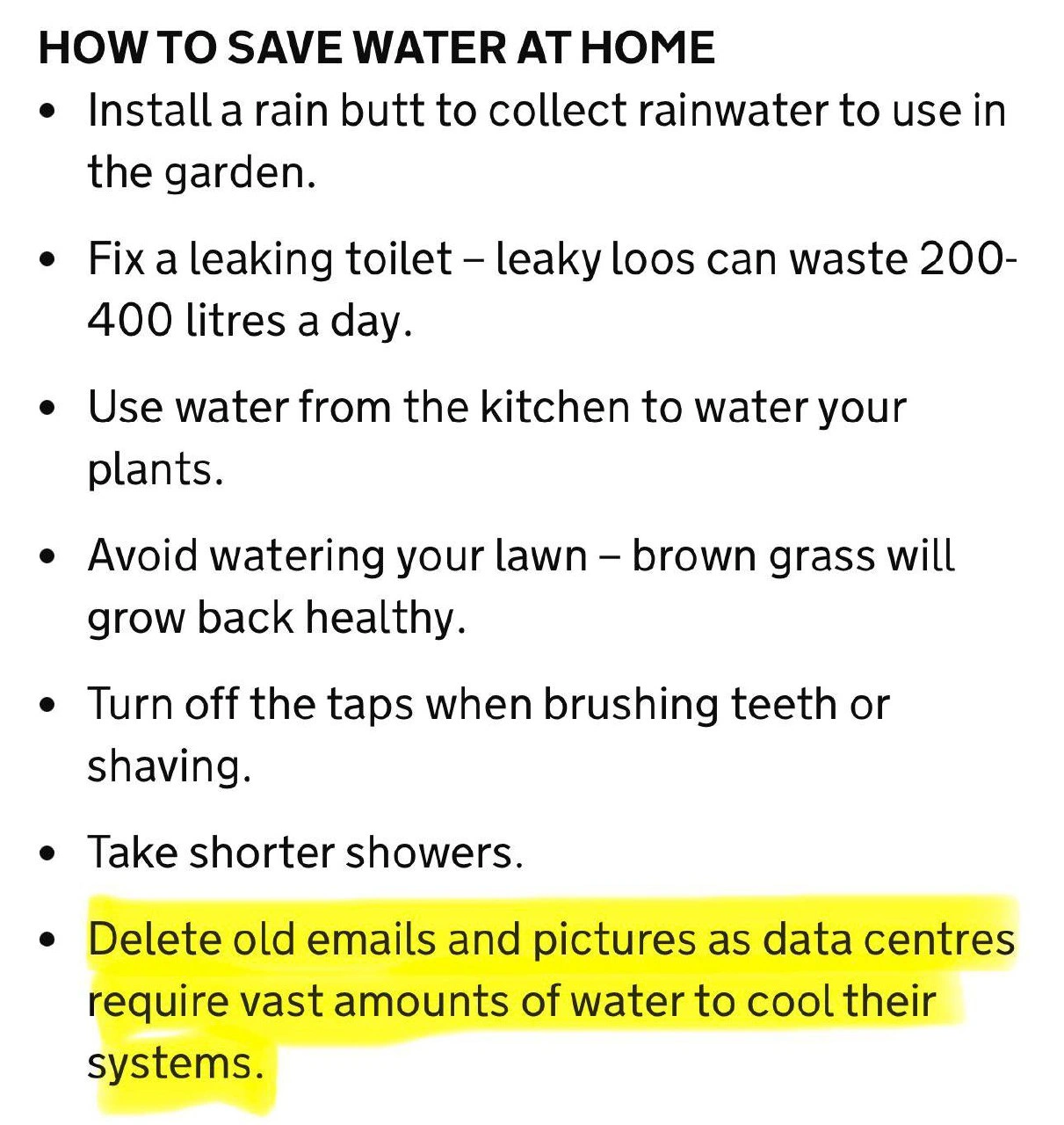
A drought flyer lists household tips, then highlights deleting old emails because data centres cool with water. The dive covers evaporative cooling, WUE, and the thin link between inbox hygiene and hyperscale water use.
Level 1: Computers Get Thirsty Too
Imagine you have a lot of toys that light up and get warm when they’re on. Now, if you left all those toys on, your room would get really hot, right? You’d maybe need a fan or even sprinkle some water to cool things down. A big computer building (a data center) is like a huge room filled with thousands of “light-up” toys (actually, servers and hard drives) that get hot when they’re working. We cool those big rooms sometimes by using water – kind of like how a car uses water in the radiator to stay cool. Now, if you have tons of old emails and pictures stored in that big computer building, those computers have to work a bit harder and stay on to keep your stuff safe, which means they get hotter and need more water to cool off. Deleting emails and pictures you don’t need is a bit like turning off a few of those toys – the computers don’t get as hot and don’t “drink” as much water to stay cool. In simple terms, cleaning up your digital stuff means the faraway computers can chill out (literally!), saving electricity and water. It’s funny to think about, because we usually save water by doing things like taking shorter showers or turning off the faucet while brushing our teeth. Who would’ve thought emptying your email trash could also help save water? It’s like finding out that eating all your peas might help save a tree – a little surprising, but kind of makes sense once you know the secret. So the meme made us laugh by basically saying “hey, want to save water? Maybe clean up your old cat photos online!” It’s a silly way to connect our everyday computer use with taking care of our planet’s water. Who knew your cute kitty pics could make a cloud thirsty? 🐱💧
Level 2: Servers Drink Water
Let’s break down why that highlighted tip isn’t as crazy as it sounds. When you hear “cloud”, you might picture something abstract, but CloudStorage and services like your email or photo backups actually live in physical buildings full of computers. These buildings are called data centers, essentially giant warehouses of servers (powerful computers) stacked in racks. Think of a server as a beefed-up version of your home PC or laptop – now imagine tens of thousands of them all working together to run Gmail, Instagram, Netflix, you name it. All those servers packed together produce a huge amount of heat (just like lots of light bulbs or ovens in one room). If that heat isn’t carried away, the servers would overheat and malfunction, just like a car engine without a radiator.
So, data centers have elaborate cooling systems as part of their infrastructure. One common method is using water as a coolant. It might sound odd – aren’t computers allergic to water? – but the water doesn’t touch the electronics directly. Instead, servers blow hot air into something like a radiator coil; water (or a special coolant liquid) flows through those coils and absorbs the heat, similar to how a car’s cooling system works. The now-warm water is then pumped away and cooled down, often via big cooling towers or chillers. In an evaporative cooling tower, the warm water is trickled over fill material while air blows through it, causing a small portion of the water to evaporate. That evaporation carries away heat (cooling the remaining water, which goes back to the servers for another round). The evaporated water leaves as a warm cloud of humidity out the top of the tower – effectively removed from the system. This is how water gets “used up” in cooling. A data center might evaporate hundreds or thousands of liters of water on a hot day to keep its servers cool, hence the focus on water_usage_effectiveness as a key metric for sustainable_computing.
Now, what does deleting emails or photos have to do with this? It’s about reducing the work those servers have to do. Imagine you have loads of old emails and pictures stored in Gmail or iCloud. They might not be actively open on your screen, but they’re sitting on some hard drives or SSDs in a data center rack. Storing data consumes electricity – the storage drives need power and produce heat, and the data center as a whole needs baseline power to keep things running (lighting, networking, etc.). The more data and active services, generally the more servers and drives are required, which means more heat overall that needs cooling. If you and millions of others delete a chunk of unnecessary data, in theory fewer drives and servers are needed or the existing ones can idle more, and that could slightly reduce the total heat generated. Less heat = less cooling water needed. It’s a bit like digital clutter cleanup translating into lowering the “temperature” of the cloud.
Think of a simple analogy: your computer’s fan. When you run a heavy game or lots of apps, the laptop gets hot and the fan spins loudly to cool it. If you close some programs, it cools down and the fan slows. Now scale that up: if everyone is storing tons of junk data, those data center “fans” (cooling systems) have to work harder. Clean out that junk, and maybe the fans/back-end cooling can take it a little easier. Inbox hygiene – deleting old emails, clearing out unneeded files – is being framed as an eco-friendly act, akin to turning off unused lights or fixing a leaky faucet. It’s a new twist on Green IT: encouraging users to be mindful of the physical resources their digital lives consume.
Let’s clarify some terms to connect the dots:
- Data centre (or data center): A large facility that companies like Amazon, Google, or Microsoft operate to provide cloud services. It’s filled with racks of servers that store your data and run computations. These buildings need robust cooling and power — they often look like massive warehouses with industrial cooling plants attached.
- Cooling towers / chillers: Equipment that removes heat from the data center. A cooling tower often uses water evaporation to dissipate heat (you can spot them by the plumes of mist on a cold day). A chiller is like a giant AC unit that can cool water or air mechanically (using compressors); some data centers use air conditioning or liquid chillers exclusively, which use electricity, while others use a mix of chillers and evaporative cooling to save energy.
- Water Usage Effectiveness (WUE): This is a metric data center operators use to track how much water they use to keep the IT equipment cool relative to how much work those computers are doing. If a facility uses, say, 1 liter of water for every 1 kWh of energy consumed by the servers, the WUE would be 1 L/kWh. Lower is better, meaning the data center is more water-efficient.
- Power Usage Effectiveness (PUE): Another common metric which tracks total power used (servers + cooling + lights + everything) divided by just the power used by the servers. An ideal PUE is 1.0 (meaning all power goes directly to computing with no overhead), but in practice anything close to 1.1 or 1.2 is considered very efficient. Sometimes reducing PUE (by using evaporative cooling instead of power-hungry chillers, for example) can increase water usage, which is where the trade-off and the need for WUE comes in.
- Digital clutter: All those files, emails, and data we keep but don’t really need. Kind of like a messy room but on your Google Drive or email server. Cleaning it up doesn’t just free storage space; at a big scale it can reduce the physical resources needed to maintain that storage. It’s like clearing out a warehouse – if you throw away unused stuff, you might be able to unplug a few extra refrigerators that were keeping that stuff from spoiling (in the digital case, “spoiling” is losing data, and the “refrigerators” are servers and hard drives).
So the meme’s last bullet point is highlighting a real link between CloudComputingServices and water consumption in an exaggerated, attention-grabbing way. For a newcomer or junior developer, it’s an introduction to the idea that the cloud is physical. Storing an email isn’t just a passive, magic act – behind the scenes there’s an ongoing cost in electricity and cooling. The meme uses humor to educate: it basically says “hey, your old selfie backups are making some machine run hotter and use water.” That’s a pretty surprising idea if you’ve never thought about where your data lives! We usually consider water conservation in terms of shorter showers or fixing leaks at home – tangible things. Extending that concept to our digital habits is novel. It also hints at the broader field of sustainable_computing, where the tech industry works on reducing the environmental impact of data centers (through better cooling tech, renewable energy, efficient code, etc.) and where users might be encouraged to be part of the solution by not treating cloud storage as an infinite dumping ground.
In essence, this list item turned meme is saying: saving water isn’t just about your lawn and taps, it’s also about your Dropbox and Gmail. That’s a pretty powerful notion for such a tiny highlighted line. And it’s true enough that engineers find it clever, but weird enough that it makes us laugh.
Level 3: From Showers to Servers
The humor hits as a classic one-of-these-things-is-not-like-the-others gag. The flyer starts with six sensible home plumbing tips – fix a leaky loo, use a rain barrel (or “rain butt” in UK parlance), take shorter showers – all advice you’d get from your local water utility during a drought. Then suddenly, bullet number seven swerves into CloudHumor territory:
Delete old emails and pictures as data centres require vast amounts of water to cool their systems.
This abrupt detour from household sinks to server farms is so absurd it’s hilarious. It reads like someone hacked an environmental_metrics PSA to slip in a sysadmin’s pet peeve about digital hoarding. For seasoned engineers, the joke lands on two levels. First, there’s the sheer cognitive whiplash: we’ve gone from talking about dripping faucets to inbox_hygiene in the same breath. It’s as if your mom, after reminding you to turn off the tap while brushing, suddenly says “and clean up your Git repositories to save the polar bears.” 😂 The surreal juxtaposition is funny on its face.
But secondly, for those of us in Cloud Infrastructure, there’s that knowing chuckle of “well, they’re not wrong.” We recognize that behind every “free” email account or endless cloud photo backup, there’s a warehouse full of Storage servers humming away 24/7. Those servers draw power, generate heat, and often rely on evaporative cooling – essentially drinking water – to stay within safe temperatures. We measure things like Power Usage Effectiveness and increasingly Water Usage Effectiveness at our data centers, so the highlighted tip isn’t just tech babble; it’s referencing real practices in DataCenterOperations. The absurdity is that a mundane action like deleting old emails is pitched as a water-saving measure comparable to fixing a toilet leak. It’s a huge scale leap: one involves your bathroom, the other involves Google or AWS’s cooling Plant #5. By highlighting that leap (literally with a yellow highlighter in the image), the meme taps into an almost dystopian modern truth: everyday digital habits now have ecological consequences. Sustainable_computing has become everyone’s business, apparently even at the level of personal inbox decluttering.
For senior folks who remember when “the cloud” was just someone else’s computer, this is both funny and a tiny bit guilt-inducing. We’ve spent years optimizing code and infrastructure to trim EnergyConsumption and improve efficiency. We championed Green IT initiatives to reduce carbon footprints, and now here we are, confronted with the notion that an overflowing email archive contributes to literal water evaporation. It’s an absurd extension of the idea of digital responsibility. The meme exaggerates it for comedy (nobody seriously expects drought remedies to include Gmail cleanup campaigns), but it’s grounded in truth. In fact, some tech companies have started nudging users about unused data and even designing storage systems to migrate cold data to more energy-efficient (and thus often less cooling-intensive) tiers. The highlighted line implies that your 5,000 unread emails are akin to a dripping faucet in the attic of the internet – an unseen waste that, in aggregate, CloudStorage providers have to deal with. Seasoned engineers will recall episodes where an explosion of “digital clutter” – say, logs left unrotated or debug backups piling up – put unexpected strain on systems. We know the digital_clutter_cleanup struggle is real. Seeing that concept transposed into an eco-friendly “tip” is both comical and oddly satisfying. It’s as if the meme is giving a nod to all the ops engineers who’ve yelled “Please, delete those useless files!” by framing it as planetary good.
There’s also a tongue-in-cheek poke at how society tackles big problems. The list implies inbox hygiene is now a civic duty: along with shorter showers, please also purge your cat memes to fight the drought. It satirizes the tendency to push sustainability habits to individuals (“you can make a difference by deleting emails!”) even when the real heavy lifting has to be done by large-scale CloudComputingServices providers optimizing their cooling systems. The senior perspective appreciates this irony. We’ve seen similar patterns: for example, telling people to unplug phone chargers to save power (a tiny impact) while industrial-scale consumers drive most of the demand. Here, deleting a few MBs of personal data might not move the needle much compared to, say, data center operators investing in water recirculation or dry cooling technology. Yet, the meme plays with the idea that every little bit helps, taken to a ridiculous extreme. The result is a punchy piece of Cloud satire that makes veteran techies smirk and maybe mutter, “Alright, time to finally clean out that 2007 email archive – for the planet!”.
Level 4: The Cloud’s Water Cycle
“Data centers operate by using water once and destroying it forever”
At hyperscale, cloud computing isn’t just about software and servers – it’s also a story of thermodynamics and resource use. In a modern data center, thousands of servers packed in racks churn out intense heat, similar to a giant oven of compute. To prevent meltdown, these facilities rely on datacenter_cooling infrastructure that often includes water. Why water? Because H2O has a remarkably high heat capacity and an even higher latent heat of evaporation. In practical terms, water can carry away heat far more effectively than air. For example, evaporating just one liter of water can dissipate ~2.26 MJ of heat – that’s like soaking up the heat from a 1000-watt server running for over half an hour! Cooling towers in many DataCenterOperations use evaporative cooling: warm water from the servers’ heat exchangers is exposed to air, some water evaporates, and that phase change carries off the heat, cooling the remaining water which recirculates to soak up more heat. It’s efficient engineering, but there’s a catch: the water that evaporates leaves the building as vapor. It’s not literally destroyed (conservation of matter still holds – it will rejoin the atmosphere’s water cycle and rain down somewhere eventually), but from the facility’s perspective, that water is gone for good, no longer available for reuse on-site. This is why data centers talk about Water Usage Effectiveness (WUE) as an environmental metric. Much like Power Usage Effectiveness (PUE), which tracks energy overhead, WUE measures how many liters of water a data center evaporates per unit of IT work (often per kilowatt-hour of computing). A lower WUE means the center is sipping water efficiently; a high WUE means it’s guzzling gallons to stay cool. Top-tier cloud providers boast ultra-efficient designs – using recycled greywater or situating near cold climates or large rivers – achieving WUE values as low as a few milliliters per kWh. Still, at the scale of hyperscale CloudInfrastructure, even a WUE of 0.2 L/kWh adds up to enormous water consumption when you’re delivering megawatts of computing day and night. If a data hall draws 10 MW for its servers, a WUE of 0.2 implies ~2,000 liters of water evaporated every hour. Multiply that by all the data centers keeping our emails, cat photos, and streaming video feeds running, and you see why commentators quip that “every cat video is part of a secret global irrigation system.” The meme’s hyperbolic claim that data centers use water once and poof, it’s “Gone”, riffs on this reality – it sure feels like the cloud is a one-way valve for local water supplies. In times of drought or water scarcity, that one-way consumption becomes a serious concern. In fact, around the date this meme was posted, public attention was on water shortages; officials and engineers alike were scrutinizing every major water consumer, including the tech industry’s green_it practices. This is the backdrop for our meme’s punchline: it takes a niche technical fact – that storing data has a WaterFootprint – and plonks it into a list of everyday water-saving tips.


Sure, I'll delete my old emails to save the planet. It's the digital equivalent of turning off a light in an office building that's already on fire
Next time the VP asks why the log-retention bucket is only 30 days, just tell them you’re protecting the company’s drought-contingency plan
After 20 years of optimizing database queries and implementing edge caching, I finally discovered the ultimate performance improvement: convincing users their 10-year-old email attachments aren't worth the water bill at our Virginia data center
Ah yes, the classic 'delete your emails to save water' advice - because clearly the 200 liters wasted by your leaking toilet pales in comparison to the nanoliters of cooling water attributable to your 47 unread newsletters sitting on a hyperscale provider's deduplicated, multi-tenant storage array. Nothing says 'I understand distributed systems at scale' quite like thinking your personal inbox has a measurable impact on a facility consuming megawatts and processing exabytes. But hey, at least it's easier than calling your data center's PUE into question or questioning why we're still using evaporative cooling in water-scarce regions
Cute idea, but my inbox won’t move WUE - try fewer 3× replicas, lifecycle to Glacier, and fewer pet clusters before asking me to delete selfies
Brown grass regrows healthy; unchecked blob storage just evaporates the local aquifer
If Legal’s seven-year retention keeps that 2013 “ok, thanks” thread, my S3 lifecycle rule isn’t cost optimization anymore - it’s water conservation
AI haters usually say something like this
Oh, those famous power hungry storages
🙀
Technically incorrect, water is rarely ever actually destroyed. But the bigger point I think is that the AI data centers use way more water in a day than you ever will
Oh that thirsty electronic My home pc consumes more water than my whole family
I believe that what they mean is that for at least for certain datacenters, water is evaporated by the cooling system. It is not release into a river sligtly hotter. (I have seen both systems) But that is even more the case about thermal power plants with big cooling towers that will produce electricity for the datacenter. However I don't know if storage of old data has such of an impact.
While it's true that water doesn't get destroyed obviously, so is true for everything else, especially showers/tap water, but still it makes sense to save up that water. Still the water used for data center and such is heated up, since it's used to cool down the infrastructure, and released into the environment (which additionally damages the environment). I'm not sure you can use the hot water released from this process for other uses immediately or after it cooled down, or how long it takes. Also like, even if it's not much imo there's no downside to sensibilize general public to the fact that data centers consumes a lot and be a bit more aware of energy costs
And yeah if it evaporates than it makes even more sense
Looks like someone just used AI to write these recommendations
Honestly I expect someone wrote this while rather pissed off about corporate consumption being so much higher than individual consumption, but given no power to actually point out how silly it is to ask individuals to solve it And hence this one is tongue-in-cheek But I dunno!
The thing is that fresh water is used for cooling data centers. When it evaporates, it's likely to turn into salt water due to the specifics of the hydrologic cycle. So, technically the amount of all water on the planet stays roughly the same, but we reduce the freshwater reserves by converting it into salt water. Running out of fresh water sucks because it takes a humongous amount of energy to turn sea water into drinkable water. Imagine Africa's water scarcity but worldwide.
This but the guy on the left is Sam Altman trying to use a modest country’s worth of water to train GPT-Safer and the guy on the right is selfish grandmas saving a whole two gigabytes of family photos.
It just goes to the cloud