
Clean Code vs Messy Desk Meme Explained
A sterile cleanroom labeled “a programmer’s code” sits above a room buried in clutter labeled “a programmer’s room.” The dive unpacks clean-code principles, maintainability versus cosmetic style, and why messy people can still ship readable systems.
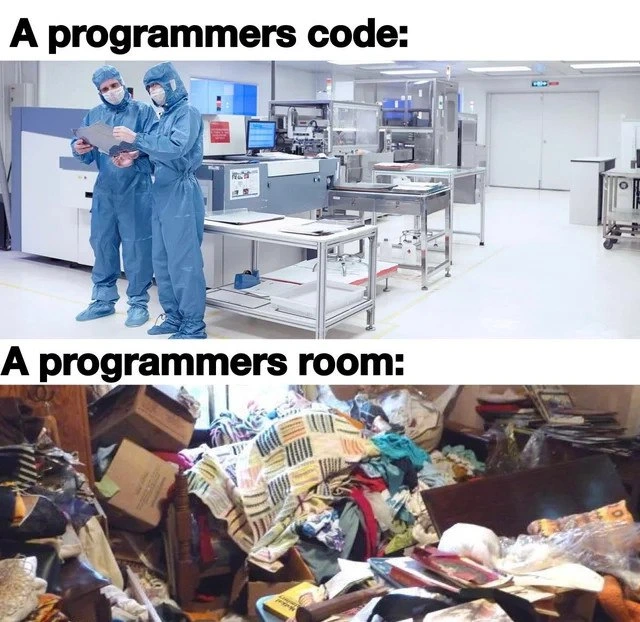
Level 1: Clean Desk, Messy Room
Imagine someone keeps their school notebook perfectly neat, with every page labeled and every answer easy to read, but their bedroom is a disaster. That is the joke: programmers may make their code beautifully organized while everything around them is chaos.
Level 2: Clean Means Understandable
Clean code means code that other people can understand, change, and trust. It usually has descriptive names, clear structure, limited duplication, and tests that explain expected behavior.
For example, this is harder to understand:
def p(x):
    return [i for i in x if i[2] > 0]
This gives the next reader more help:
def active_orders(orders):
    return [order for order in orders if order.quantity > 0]
The meme's top image represents code that is organized and carefully controlled. The messy room represents the developer's real life, where organization may not be as strict. Developers relate to this because they may spend hours aligning code style, cleaning imports, and naming variables while ignoring an actual desk full of coffee cups.
For junior developers, the useful takeaway is that clean code is not about pleasing a style guide for its own sake. It prevents bugs, makes reviews easier, and helps teammates work faster. A messy room mostly annoys you. Messy code annoys everyone who has to maintain it.
Level 3: Sterile Repository
The meme sets up its contrast with two blunt labels:
A programmers code:
A programmers room:
The top panel shows a spotless cleanroom with suited people standing near pristine equipment. The bottom panel shows a room buried under clothes, boxes, bags, papers, and miscellaneous debris. The joke is the developer fantasy that the repository is immaculate while every non-code surface has entered undefined behavior.
At the technical level, CleanCodePrinciples are about reducing cognitive load. Clear names, small functions, consistent formatting, meaningful tests, and sane module boundaries make code easier to read and change. A clean codebase is not "pretty" in the abstract; it is cheaper to maintain. Future developers can locate behavior, understand intent, and make changes without triggering a surprise tour of six unrelated subsystems.
The image is funny because code cleanliness is often more enforced than personal cleanliness. The repository has linters, formatters, pre-commit hooks, CI checks, review comments, style guides, and occasionally an architect with a red pen. The bedroom has none of those things. No pre-commit hook blocks the laundry pile. No reviewer comments, "Could we extract these cups into a dishwasher abstraction?" A shame, frankly. It might pass after two approvals.
The more serious point is that code quality is not the same as personal virtue. Messy people can write maintainable code, and tidy people can ship a ball of mud with excellent indentation. What matters in software is whether the system communicates its structure to others. Clean code is a social artifact because it serves the next reader, not just the current author.
There is also an irony in how cleanliness can become performative. A codebase can look like the top panel while hiding the bottom panel underneath:
| Looks Clean | Still Messy If |
|---|---|
| Perfect formatting | Functions have hidden side effects |
| Short methods | Logic is scattered across too many files |
| Strict naming | Domain concepts are wrong |
| High test count | Tests only preserve broken behavior |
That is the senior-developer sting. The cleanroom aesthetic is not enough. Real CodeMaintainability comes from predictable behavior, coherent boundaries, useful tests, and readable intent. Formatting is a broom. Architecture is deciding why the floor keeps filling with trash.
The repository passed linting; the bedroom is still waiting for its first formatter.
+
I think that smh programmers move the mess from their heads to the surrounding space
hey I remember your pfp from vk-io on github
this is what fame feels like
"If mess on the table means mess in the head, then what means empty table?"