
Linux Age Verification Law Meme Explained
A PC Gamer headline says California wants age verification at OS account setup—including Linux. The dive explains why Linux has no central setup funnel, how machines create accounts automatically, and why the law targets a product model that open source never had.
Level 1: Carding the Sandbox
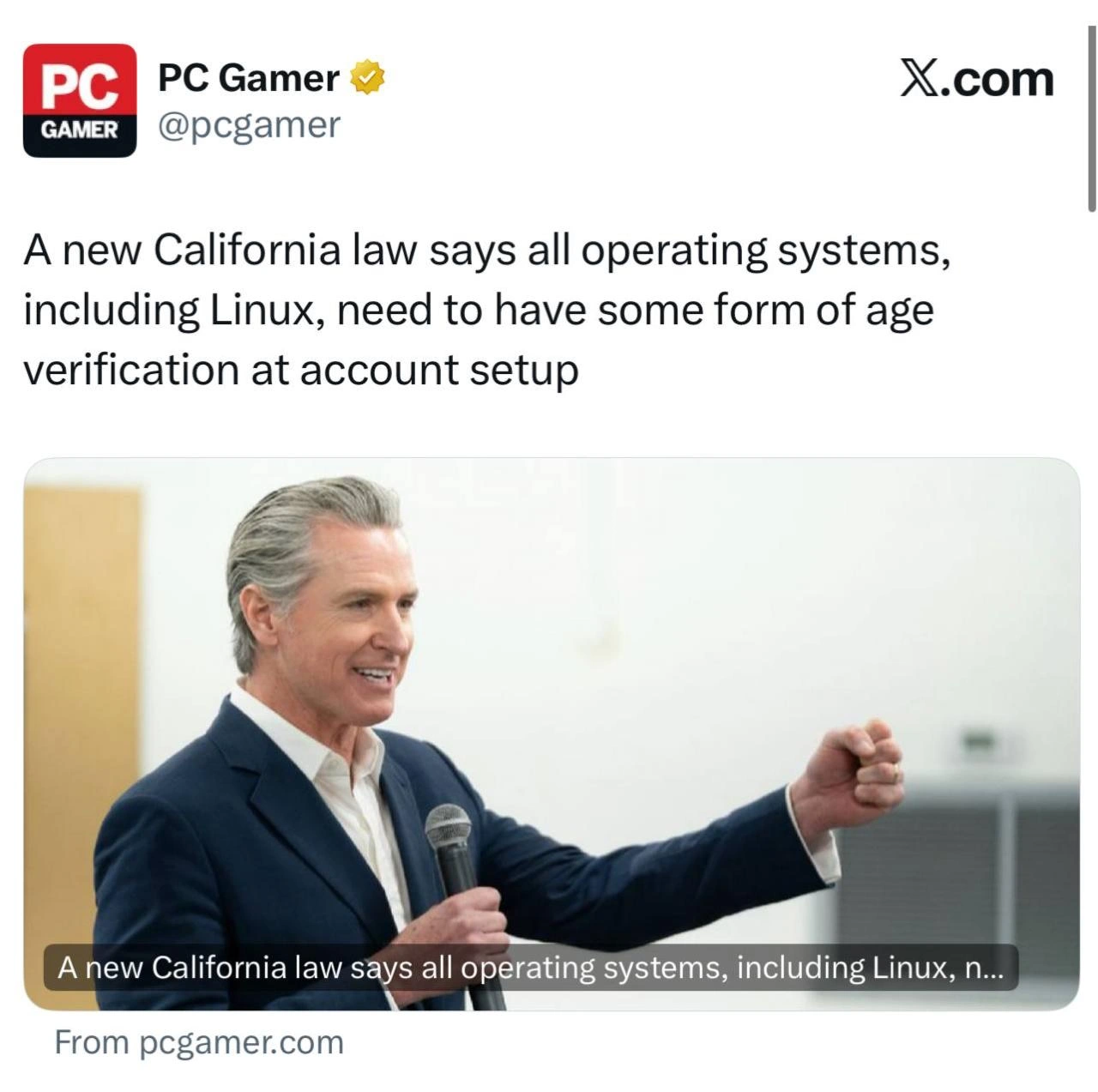
Imagine a new town rule that says every sandcastle must check the builder's ID before being built. Sandcastles made by companies with offices in town? Fine, they'll hire an ID-checker. But most sandcastles are built by anyone, anywhere, with free sand from a communal pile — some are even built by robots that make thousands of castles a minute. Who checks the robot's ID? The picture shows a politician proudly announcing this rule while everyone who's ever touched sand laughs, because the rule imagines a guard at a gate... for a beach that has no gate, no fence, and mostly no people.
Level 2: Why Devs Are Laughing
- Linux isn't one product. It's an open-source kernel that anyone can package into a distro (Ubuntu, Debian, Arch, Alpine...). Nobody "owns" it the way Microsoft owns Windows, so there's no single party a law can compel.
- Account setup on Linux is just a command (
useradd/adduser) or a config file. Servers create accounts automatically with no human present — a cloud machine (like an AWS EC2 instance) can be born, create users, do its job, and be destroyed in minutes. - Age verification mandates usually target platforms (social media, adult sites). Extending it to operating systems means verifying the age of... whoever runs an installer? The 4,000 containers your CI spins up nightly?
- Compliance burden: when laws don't match technical reality, companies implement symbolic checkboxes while actual enforcement is impossible — pure cost, zero protection.
The first time you boot a Linux server and realize there's no "sign-up" — just you, root, and a text file — is the moment this headline becomes funny forever.
Level 3: Compliance Theater Meets useradd
The screenshot is a verified PC Gamer tweet reporting, deadpan:
A new California law says all operating systems, including Linux, need to have some form of age verification at account setup
— over a link card of Governor Gavin Newsom, navy blazer, microphone in one hand, fist raised mid-gesture like he's personally about to enforce a PAM module. The comedy isn't manufactured; it's a real headline colliding with how computers actually work, and developers can hear the collision from orbit.
The core absurdity: Linux has no account setup authority. "An operating system" in legislative imagination is a product — Windows, with a Microsoft account funnel and an OOBE wizard a vendor can be ordered to modify. Linux is the opposite of that in every dimension that matters for enforcement. It's a kernel plus thousands of independently assembled distros, maintained by everyone from corporations to one Estonian volunteer, downloadable as an ISO with no vendor, no storefront, and no telemetry. "Account setup" is useradd alice — a one-line syscall wrapper any process with root can invoke, including a shell script, a Dockerfile, or cloud-init at instance boot. The channel author's caption lands the killing blow: "imagine age check for each new instance eg ec2 you spin up" — because in modern infrastructure, "accounts" are created programmatically millions of times a day by machines for machines. Is the autoscaler eighteen? Does a Kubernetes service account need a driver's license?
This is the recurring tragedy the meme taps: tech legislation written against a mental model fifteen years stale. Lawmakers regulate the artifact they can picture (a family PC at setup) and accidentally describe an unbounded set of things they can't (containers, VMs, embedded devices, your router, the seventeen Linux instances inside your car). Open source makes it worse for them: there's no legal entity to fine when the "vendor" of your OS is a Git repository and a mailing list. The realistic outcome — and every compliance engineer reading this already knows it — is not enforcement but selective theater: big commercial vendors bolt on a checkbox, the law is technically unenforceable against everyone else, and a thousand-comment orange-website thread argues about whether FROM ubuntu:24.04 now constitutes child endangerment.
The deeper irony: the gaming press covering it signals who actually feels the splash zone — age-verification laws aimed at content keep ricocheting into infrastructure, because legislators keep mistaking layers for products.

Can't wait for `sudo useradd --verify-age` - enforcement handled by an unmaintained PAM module compiled from an AUR package
Linux is 34; unfortunately, `www-data` left its ID at home.
It just requires either the birthdate or age to be set for an account along with an API to access the age range (not the age/birthdate)
Wouldn't be difficult to add support even on headless systems, though I doubt it even applies there
Another instance of a politician, that doesn't know what he is talking about
I'm sure root comes preverified
Can't wait to see Persona being integrated into Linux kernel
Why parents and government can classify people into four age groups to impose restrictions on access to information and communication, why is this fine at all?
it implies telling them what to avoid exactly
Well parents may actually just not notice
Is this sarcasm?
Ah, but in this last message I talked about IRL experiences too
The parents do not necessary have this know-how themselves
Suddenly all people in California stopped using electronics
Me (seeing age verification): January 1st, 1900 looks like a good year... Default age, here I come!
Go back to Windows 3.1, without accounts...