
JS Supply Chain Risk Meme Explained
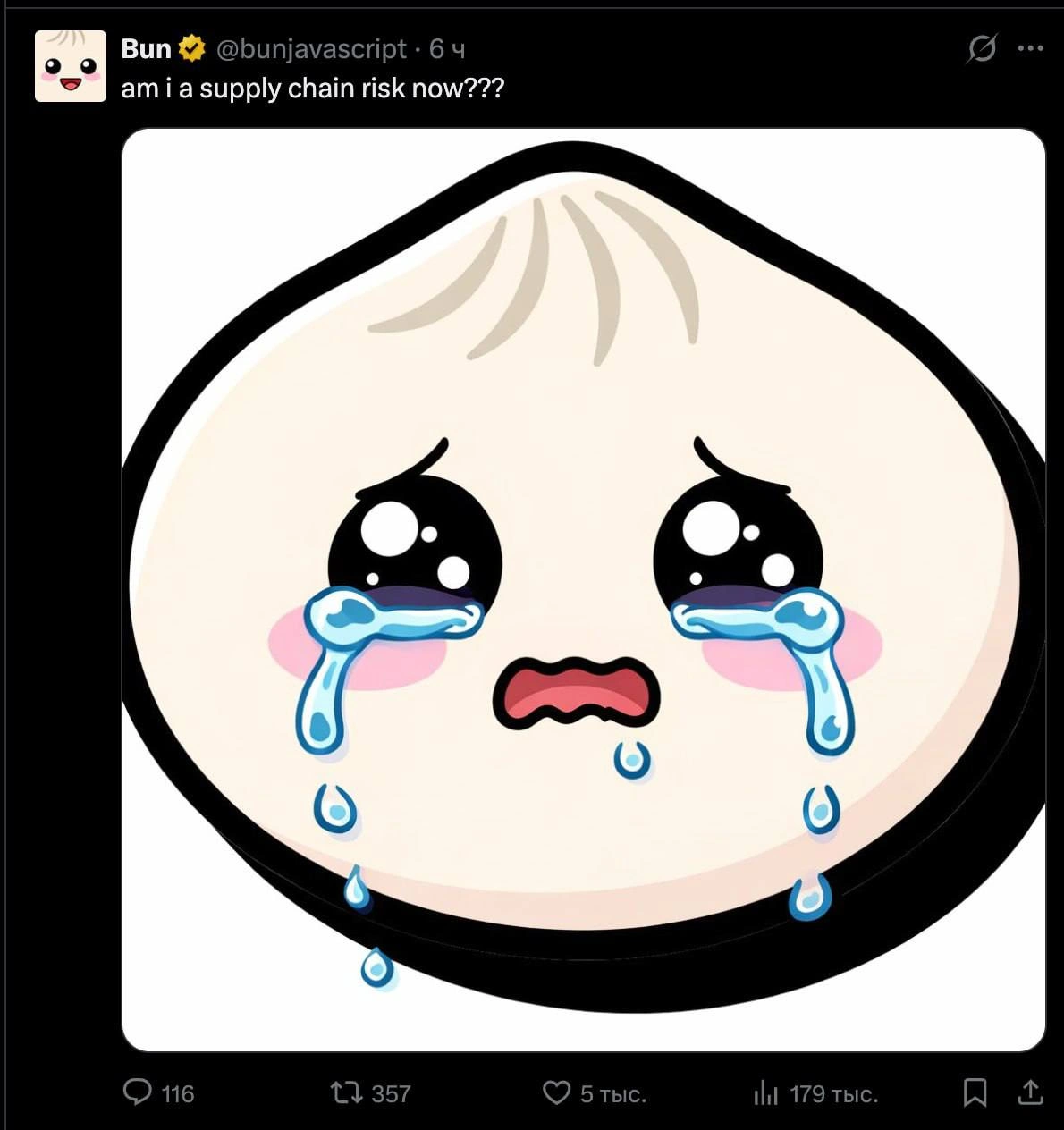
The official Bun account posts a sobbing dumpling mascot asking if it is a supply chain risk now. The dive explains npm attack panics, why runtimes sit deepest in the trust graph, and the tradeoff of consolidating Node’s toolchain into one binary.
Level 1: The Lunchbox Problem
Imagine the whole class shares snacks every day, and one kid's cookies turn out to have something yucky hidden inside. Suddenly everyone starts side-eyeing all the snacks — even the sweet little dumpling who never did anything wrong. This picture is that dumpling, big teary eyes, asking "wait... do you think MY snacks are bad too???" It's funny because the dumpling is so dramatically heartbroken about merely being suspected — and because being suspected, fairly or not, is just what happens to everyone in the lunchroom after cookie-gate.
Level 2: The Terms Behind the Tears
- A supply chain attack in software means compromising something you depend on rather than attacking you directly — like poisoning an ingredient instead of breaking into the restaurant. In JavaScript, this usually means a malicious version of an npm package that thousands of projects auto-install.
- npm is the JavaScript package registry; a typical app pulls in hundreds of transitive dependencies nobody has read. Each is a potential entry point, which is why these incidents recur and why the panic is communal.
- Bun is a JavaScript runtime (the program that executes your JS, like Node.js) plus package manager and bundler, famous for speed and for its cute bun mascot. Being a runtime means it's the most trusted layer in your stack — it runs before and beneath everything else.
- The tweet format — a brand account responding to discourse with a distressed mascot — is standard mascot-marketing, but here it doubles as commentary on how quickly the community's suspicion can rotate onto anyone.
If you've ever run npm install and watched 900 packages appear, you've already participated in the trust exercise this meme is crying about.
Level 3: Trust Falls in the Dependency Graph
The screenshot shows the verified Bun account (@bunjavascript) posting, six hours earlier, a single anxious line — "am i a supply chain risk now???" — above an illustration of its kawaii steamed-bun mascot in full anime meltdown: enormous glossy black eyes welling with cartoonishly glassy blue tears, pink blush cheeks, a wobbling distressed mouth, droplets actively falling off its face. The engagement counters (5K likes, 179K views, rendered in a Russian-locale client as "тыс.") confirm the bit landed.
The comedy mechanism is a vendor doing preemptive self-deprecation during one of the JavaScript ecosystem's recurring supply chain attack panic cycles. Every time a popular npm package gets hijacked — a maintainer's token phished, a postinstall script weaponized, a typosquat slipping into transitive dependencies — the community goes through the same grief ritual: audits, hot takes, calls to vendor everything, and a sudden suspicion of anything that sits in the path between source code and production. A JavaScript runtime sits at the deepest point of that path. If your runtime is compromised, no lockfile saves you; it executes everything. So Bun's mock-tearful question has a real edge: the moment "supply chain risk" becomes the discourse, scrutiny climbs the stack from leaf packages to the platform itself.
There's a sharper subtext for those tracking the runtime wars. Bun's whole pitch is being the fast, batteries-included alternative to Node.js — bundler, test runner, package manager, all in one binary. That consolidation is precisely what makes the question funny-but-not-joking: concentrating the toolchain into one vendor's binary is a supply-chain consideration, trading npm's thousand-points-of-failure for a single, much fatter point of trust. The crying mascot performs innocence while the replies section, you can be sure, contains at least a hundred people earnestly explaining SBOMs to a cartoon dumpling.
And that's the meta-joke about modern DevRel: in an ecosystem where trust incidents are weekly weather, the winning corporate move isn't a security whitepaper — it's posting your mascot sobbing. Vulnerability (the emotional kind) as a response to vulnerability (the CVE kind). The bit works because everyone's alert fatigue is real; laughing at the dumpling is cheaper than re-auditing node_modules.


Don't cry, Bun - you're not a supply chain risk until you're in package-lock.json of something that matters
Geopolitical risk is now a transitive dependency, and the lockfile has no override.
I missed it. Can someone fill me in on the context?
Same…