
Brave Silent VPN Install Meme Explained
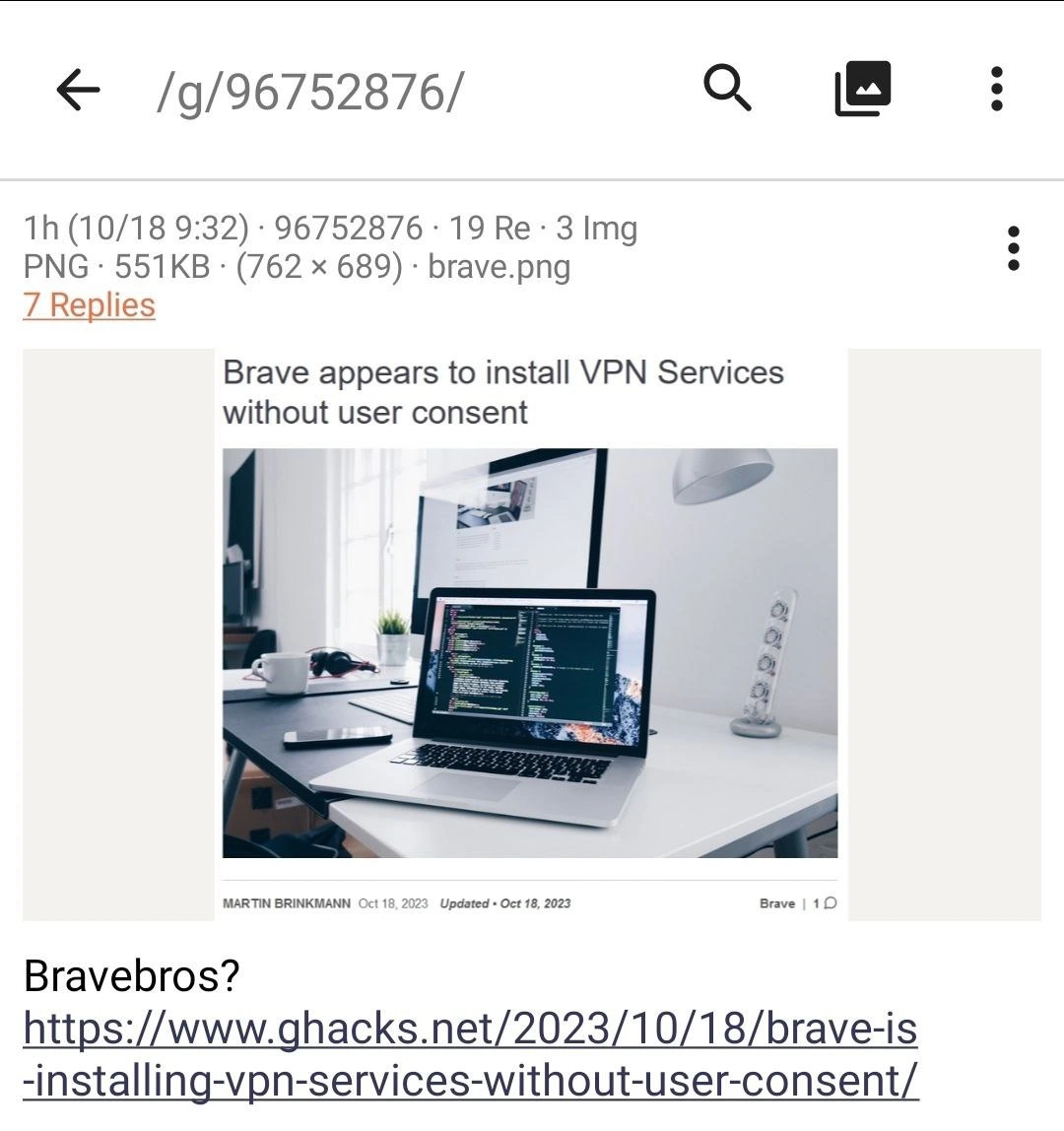
A /g/ post shares news that Brave appeared to install VPN services without user consent, with the sarcastic tagline “Bravebros?” The dive unpacks consent, attack surface, supply-chain transparency, and why privacy browsers get no free pass for sneaky updates.
Level 1: Trust Betrayed, in Plain Terms
Imagine you have a trusted friend who always talks about keeping secrets safe. You give them your diary because they promise, “I’ll guard it and never peek.” But one day you find out they secretly made a copy of your key and opened your diary without asking. You’d feel pretty upset and tricked, right?
That’s what happened here with Brave browser and its users. Brave was like the friend who promised to protect your privacy (your secrets). People chose Brave because it said, “I won’t do sneaky things with your data.” But then Brave went and added a new secret tool (a VPN) on people’s computers without telling them first – kind of like that friend sneaking a look at your diary.
For the people using Brave, this was both upsetting and a bit ironically funny in a “seriously? you too?” way. It’s like the safety-first toy company that suddenly includes a surprise gadget in the box that nobody asked for. Even if that gadget is meant to be helpful, doing it behind everyone’s back makes it feel wrong.
So the heart of the joke is: a browser that was supposed to be super honest about privacy did something privately, without permission. It’s a mix of disappointment and “I can’t believe they did that,” which is why folks are talking about it and sharing this meme. Everyone’s basically shaking their heads and saying, “Even the ‘good guy’ browser pulled a sneaky move!”
Level 2: But Did You Ask?
For those newer to this arena, let’s break down the scenario. Brave is a web browser, much like Chrome or Firefox, but it brands itself as privacy-focused. It automatically blocks ads and trackers, and many privacy-conscious users install Brave to feel safer online. Now, a VPN (Virtual Private Network) is a tool that routes your internet traffic through an encrypted tunnel to a server, hiding your IP address and encrypting data so your ISP or others can’t easily snoop on your browsing. VPNs can be great for privacy if you choose to use them. The key phrase there is “if you choose.”
What happened, according to the meme’s screenshot (from a tech forum), is that Brave appeared to install a VPN service without asking the user. A “service” here likely means a program running in the background of your computer (for example on Windows, something listed in the Services panel, or a daemon on macOS/Linux). Normally, if you want a VPN, you’d install it yourself or explicitly enable a VPN feature. But Brave seemingly did this on its own, during an update, quietly. The user didn’t click “Yes, install Brave VPN” – it just showed up.
This is causing an uproar in communities focused on Security and Data Privacy (two key categories mentioned). Why? Because user consent is a cornerstone of trust. When software that promises to protect you does something without asking, it feels like a breach of trust.
Imagine you downloaded Brave precisely because you were wary of big companies sneaking in unwanted things. You’re enjoying your tracker-free browsing… then one day you see a news headline (like the one in the image: “Brave appears to install VPN Services without user consent”). It’s jarring: the browser that was supposed to respect your choices made a pretty big choice on your behalf.
Let’s clarify a few terms and context tags in simpler words:
- PrivacyConcerns / Privacy Marketing vs Practice: Brave’s marketing says “we care about your privacy.” The concern is that their practice (installing something silently) doesn’t match the promise. It’s like a restaurant that advertises healthy, organic food but then you find out they add secret sugar syrup to everything.
- BrowserSecurityFeatures: Modern browsers often have extra features like password managers, ad-blockers, or even VPNs. Brave’s VPN in this case might be one of those features – possibly meant to give users more privacy by letting them tunnel traffic. Opera (another browser) for example offers a built-in VPN but it’s clearly a selectable feature. The outcry here is Brave included its VPN component without the clear “Click to install” step.
- Silent_vpn_install / User_consent_violation: “Silent install” means installing in the background, without popping up a dialog or asking the user. User consent violation means the user wasn’t given a choice or didn’t approve this action. In software terms, it’s like not respecting an opt-in model.
- Browser_trust_issues: People now have “trust issues” with their browser. A browser is an application you use constantly and often grant a lot of freedom (it can update itself, it handles all your web data). If it misbehaves, you feel betrayed. This tag signals the meme is about the trust relationship between users and the Brave browser being damaged.
The image itself shows a forum post on 4chan’s technology board (known as /g/). The user posted the news article and wrote “Bravebros?” which is a tongue-in-cheek way to get the attention of Brave enthusiasts (“Brave, bros, care to explain?”). It’s a quick way to stir discussion among developers and techies: “Look, your favorite privacy browser might be doing something shady.” In forums like these, it’s common to challenge fans of a technology when bad news drops – a bit of tech community ribbing.
So in summary at this level: Brave Browser, champion of privacy, reportedly installed a VPN component on users’ machines without asking them. This has raised eyebrows and hackles in the developer and privacy communities. It’s a clear clash between Brave’s privacy-first reputation and an action that feels more like something a sneaky adware-laden app might do. New developers witnessing this learn an important lesson: always be transparent with users. If even a well-regarded app gets flak for skipping consent, it’s because trust is hard to earn and easy to lose in software.
Level 3: Brave’s Hidden Service Betrayal
At the most technical level, this meme spotlights a browser trust model failure. Seasoned engineers see the irony: Brave – a browser celebrated for privacy by default – apparently slipped a VPN service onto user systems without explicit consent. Under the hood, Brave likely pushed an update bundling a background VPN component (maybe a system service or daemon) that runs outside the usual browser sandbox. This is a big deal because installing system-level services silently edges into malware territory. It breaks the implicit social contract of software updates: we trust that security features are opt-in or at least well-communicated, not covertly injected.
Why do seniors find this both horrifying and darkly humorous? Because we’ve seen this movie before. Privacy tools gone rogue form a classic trope in tech. It’s the “encrypted wolf in sheep’s clothing” scenario. The meme shows a 4chan /g/ thread referencing a ghacks.net article, complete with a laptop displaying code (a nod to developer scrutiny). The poster quips “Bravebros?” – calling out Brave’s loyal fans. It’s a sarcastic way of asking: “Well, what do you say now, Brave advocates?”
From a Senior DevOps/Security engineer perspective, a browser surreptitiously adding components triggers multiple alarms:
- Security Surface Expansion: Every additional service is another point of potential failure or exploit. If Brave’s VPN module has a bug, it could become a new attack vector on your machine.
- User Consent Violation: In security culture, unconsented changes are an absolute no-go. It’s akin to finding an SSH backdoor left by a trusted sysadmin – technically functional, but a profound betrayal of trust.
- Supply-Chain Transparency: Developers preach reproducible builds and open-source scrutiny. If an update silently adds something, how do we know it’s intentional and vetted? Could it have been a supply-chain attack? (e.g., malicious code injected into Brave’s build process). Even if it wasn’t malicious, opacity here sets a dangerous precedent.
- Privacy Hypocrisy: Brave markets itself against “big brother” browsers (like Chrome’s data collection). So doing something sneaky in the background – even if well-intentioned (say, prepping a feature) – reads as hypocritical. It’s an architectural and ethical misstep.
Consider the technical mechanics: to install a VPN service, Brave might have bundled a TUN/TAP driver or configured a system-level network adapter. On Windows, that could mean a new service in services.msc or a background process always listening. This isn’t trivial – it may require admin rights (perhaps granted during update installation). The very act reminds battle-scarred engineers of past incidents where software overstepped: antivirus suites installing root certificates without asking, or updaters bundling unexpected “features” that looked like spyware.
In essence, this meme’s humor is a bitter, knowing laugh. Brave’s hidden VPN is the punchline to an unsaid joke: “Of course the ‘privacy-first’ browser is doing something without telling us – why am I not surprised?” It resonates with veteran devs because it validates a cynical worldview: no piece of software, no matter how noble its mission, is above slipping up or succumbing to business pressures. The situation is absurd yet predictable, making it ripe for gallows humor on forums.


Brave's new feature is zero-click VPN installation. It's so private, even *you* don't know it's running. They've finally achieved statelessness by removing the user's state of consent
Brave silently bundling a VPN is the browser edition of the ops team kubectl-injecting a sidecar into every prod pod on Friday afternoon and labeling the commit “zero-trust”
The irony of a privacy-focused browser silently installing services without consent is like a security consultant leaving their laptop unlocked at DefCon - it's not the vulnerability that hurts, it's the betrayal of fundamental principles you literally built your reputation on
When your 'privacy-focused' browser decides to practice security through obscurity by installing VPN services without asking - because nothing says 'we respect your privacy' quite like making unilateral decisions about your network stack. The real brave move here is trusting any browser that thinks informed consent is just a suggestion, not a requirement
Brave: npm install vpn --silent --no-audit --ignore-consent
Nothing screams privacy like silently shipping a privileged VPN daemon; it’s opt‑in the same way surprise cronjobs are “scheduled features.”
Privacy-first browser quietly dropping a VPN daemon is the version of Zero Trust where the vendor trusts the user zero - check your services list before the marketing page
Read the primary sources.
What is so terrible with installing some module without using it, aside from occupying extra drive space? Majority of people do not use most of a program's functions anyway.
i like how every time that brave is once again is found out to be malicuous, brave users are screeching so hard my nigger, no fucking shit
Linux users of Brave suffer much more. It spawns a daemon!
Remember when Brave hijacked URLs?
it's yet another way of tracking the user via fingerprinting
thorium ftw
why not just use TOR ?