
Tuesday Boy Probability Meme Explained
Limmy-style panels pit 66.6% against 51.8% on Mary’s two children when one is a boy born on Tuesday. The dive walks the sample space math and why selection assumptions decide the answer.
Level 1: The Detail That Shouldn't Matter
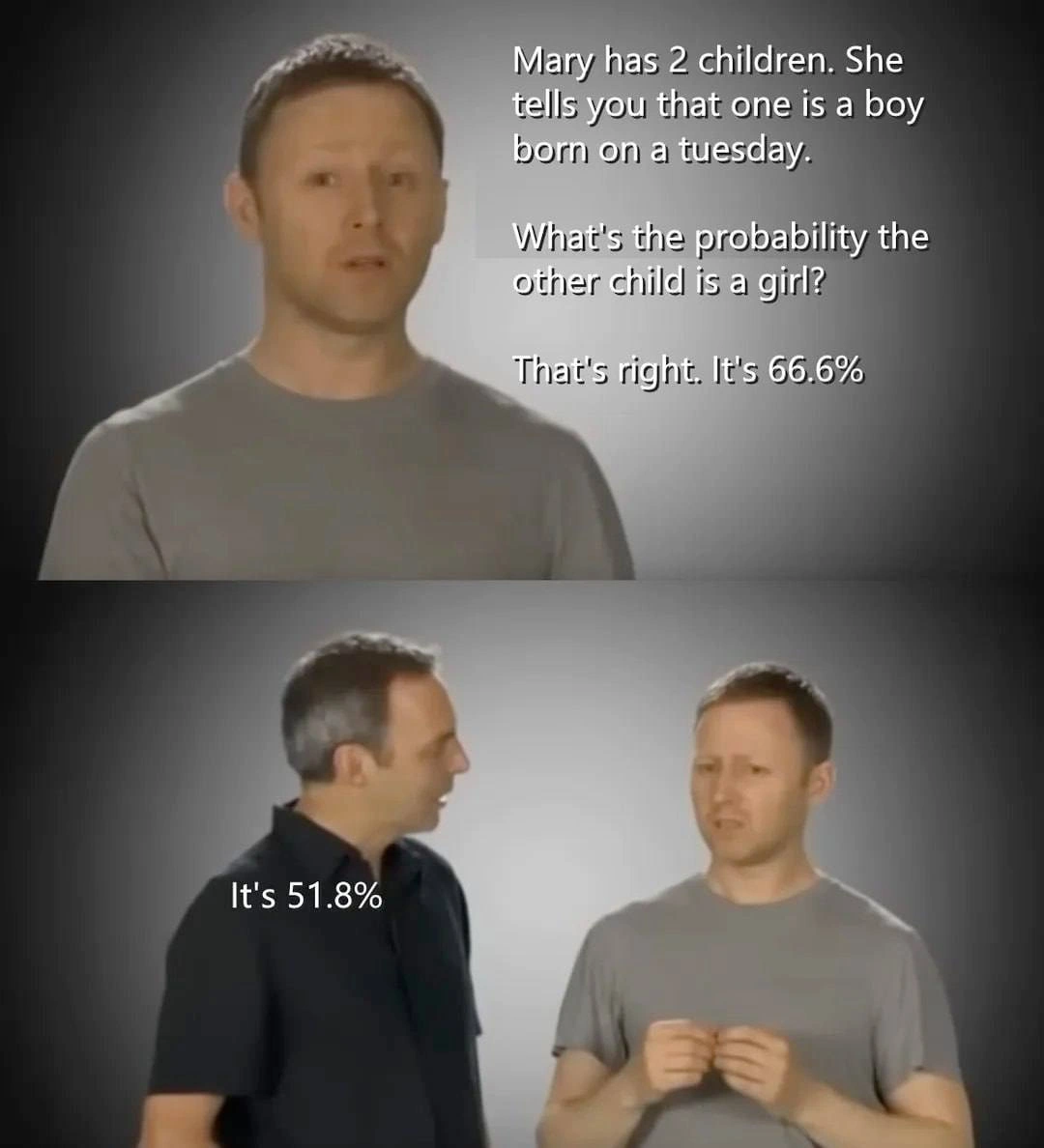
One man proudly answers a riddle about whether a kid is a boy or a girl, and another man calmly tells him a slightly different number — all because the riddle mentioned the boy was born on a Tuesday. The first man's face melts, because how could a Tuesday change anything? It's like saying a coin flip changes odds because the coin is wearing a tiny hat. The funny part is that the tiny hat really does change the math — and watching a confident know-it-all discover that is one of life's purest joys.
Level 2: Why a Tuesday Changes Anything
The key concept is conditional probability: the chance of something given what you already know. Learning information shrinks the set of possible worlds, and you recompute odds inside the smaller set.
- With "one child is a boy," the possible families are boy-boy, boy-girl, and girl-boy (girl-girl is ruled out). Two of three have a girl → 66.6%.
- With "one child is a boy born on a Tuesday," you list families by gender and birth weekday. Doing the bookkeeping leaves 27 possible family configurations, and 14 of them include a girl → 14/27 ≈ 51.8%.
The unintuitive part is that the weekday feels irrelevant — and for any single child it is — but as a filter on which families qualify, it reshapes the candidate pool. It's the same trap as debugging with logs: the events you get to see are not a neutral sample of the events that happened. If you've ever been burned by a dashboard that only counted requests that completed, you've met this paradox in production clothing.
Level 3: Weaponized Trivia, Reversed
The format is the beloved Limmy's Show "steel is heavier than feathers" sketch, and the casting is the joke. In the original, Limmy (gray shirt, facing camera) is the confidently wrong one. Here the meme flips the energy: gray-shirt delivers the 66.6% answer with the smugness of someone who has read one probability blog post — the guy who corrects others at parties — and the black-shirted man lands the 51.8% like a counter-sniper, leaving Limmy with the sketch's signature thousand-yard stare of a man whose mental model just segfaulted.
That's the social dynamic this meme skewers, and it's painfully familiar in tech circles: the mid-curve correction. The 50% answer is the naive take; 66.6% is the "actually 🤓" take; 51.8% is the "actually-actually" take that punishes the first corrector. It's the probability version of replying "well, technically HTTP/2 multiplexes over one TCP connection" to someone who just finished correcting someone else about keep-alive. Interviewers have abused the two-child family of puzzles for decades precisely because every level of sophistication is wrong from the next level up — the question selects less for statistical skill than for whether the candidate has seen this specific landmine before. Data scientists recognize the deeper lesson: conditioning on information correctly is genuinely hard, the answer depends on how the data reached you (selection bias, in the wild), and a single innocuous-looking field added to the dataset — a weekday column, of all things — can silently shift every downstream estimate.
Level 4: Counting to 14/27
Both numbers in this meme are defensible, which is exactly why it's a fight. The setup is the Tuesday boy problem, a sharpened variant of Martin Gardner's classic two-child paradox, and the whole thing lives or dies on how you construct the sample space.
Naive version first. Two children, four equally likely gender orderings: BB, BG, GB, GG. "One is a boy" eliminates GG, leaving three equally likely worlds, in two of which the other child is a girl — hence the gray-shirt confidence:
That's right. It's 66.6%
Now the man in black. Take each child as a (gender, weekday) pair: $2 \times 7 = 14$ equally likely types per child, $14^2 = 196$ ordered pairs per family. Condition on "at least one child is a boy born on a Tuesday." Count those worlds: first child is a Tuesday-boy ($14$ options for the second) plus second child is a Tuesday-boy ($14$ for the first), minus the double-counted both-Tuesday-boys case:
$$ 14 + 14 - 1 = 27 $$
In how many of those 27 is the other child a girl? Tuesday-boy first with any girl (7 days) plus any girl first with Tuesday-boy second (7 days): $14$. So
$$ P(\text{other is a girl}) = \frac{14}{27} \approx 51.85% $$
The apparently useless weekday detail changes the answer because it acts as a near-identifier: the more specific the description of the boy, the closer you get to having pointed at a particular child, and "the other child" then collapses toward an independent 50/50. Push the specificity further ("a boy born at 3:07:42 AM on a Tuesday") and the probability marches asymptotically to 1/2. The remaining war — fought in every comment section this meme has ever appeared in — is about the selection procedure: 66.6% and 51.8% both assume Mary was filtered from the population of qualifying families. If she just volunteered a fact about a randomly chosen child, the answer is a boring 50%. The paradox is less about probability than about the unstated likelihood model behind a sentence — pure Bayesian ambiguity wearing a puzzle costume.
Like every estimate in engineering, the answer changes the moment someone adds one irrelevant-sounding detail to the ticket
Nothing turns a family into a Cartesian product faster than conditional probability.
Never understood combinatorics
But biologically it's 50%
When thinking on probability you can arrange the event results in a table G : girl b : Boy Plotting this out: B B B G G B G G
ah, apparently I can't count. thanks
The first set on the left shows 7 sets in one row, then 6
B⁰ meaning Boy born on Sunday B¹ meaning boy born on Monday This table is showing all results in which have at least B² meaning at least one boy born on Tuesday You can't show the same result twice that's why there is one result 'missing' Meaning 14/27 Instead of 14/28 (50%)
The correct answer should be even less than 50%, because on average, there are more newborn boys than girls (in human race)
Canon event
#whalegang 🐳
Fascinating thread. Brightest example of how bureaucracy is solving a made up problem with math without applying common sense
@victorbratov @purplesyringa conditional probability is meaningless until the selection rule is specified. You are only allowed to study probability if you have two kids and at least one son born on Tuesday. You are selected at random from all eligible contestants. What is the probability that your other child is a girl? and you get 14/27 if it's a real life talk about your kids, then Tuesday condition doesnt bring anything meaningful to the context - it's just noise. Therefore you can guess the gender of the other child with 50% possibility - no info whatsoever, 2 variants