
Jacobian Conjecture Counterexample Meme Explained
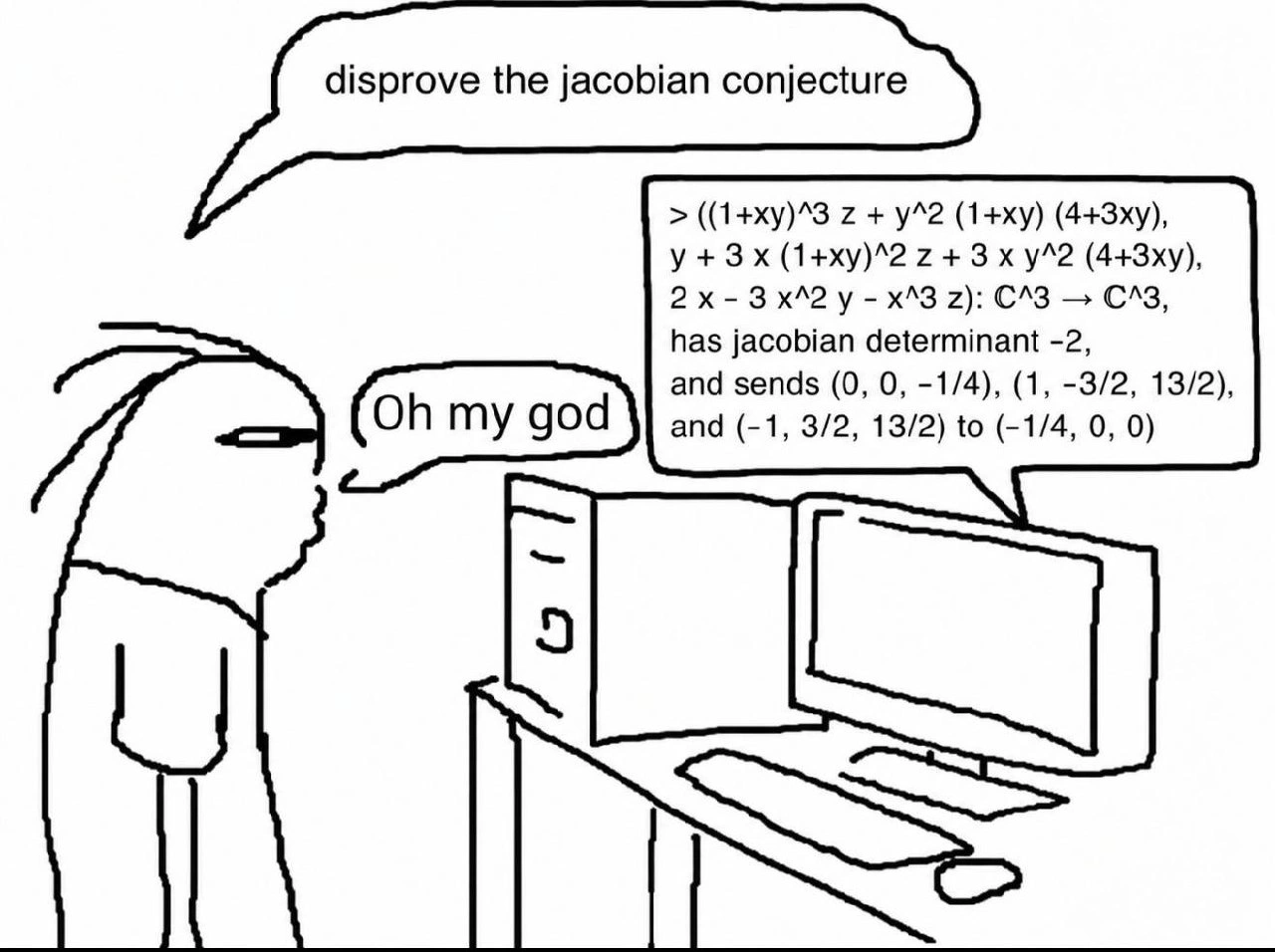
A stick figure asks an AI to disprove the Jacobian conjecture and gets a dense polynomial counterexample. The dive explains local versus global invertibility, the checkable certificate, and AI-assisted math verification.
Level 1: One Lock, Three Keys
Imagine everyone believed that a special kind of lock could have only one matching key. The computer instantly draws a lock that passes every special-lock test, then places three different keys on the table and shows that all of them open it. The person says “Oh my god” because one small, checkable example has overturned a belief older than almost everyone alive.
Level 2: Three Inputs Walk In
A conjecture is a mathematical statement believed to be true but not yet proved. To prove it, one must show it works in every case covered by the statement. To disprove it, one valid counterexample is enough.
The map in the computer bubble takes three numbers (x, y, z) and returns three new numbers. Its Jacobian determinant summarizes how tiny changes in the inputs affect tiny changes in the outputs. A nonzero value means the transformation is locally reversible: near a particular input, nearby outputs come from one nearby input.
“Locally” is the trap. Imagine three different neighborhoods printed on transparent sheets. Each sheet can be perfectly undistorted on its own while all three are placed over the same location. The formula does something analogous:
(0, 0, -1/4)goes to(-1/4, 0, 0).(1, -3/2, 13/2)goes to(-1/4, 0, 0).(-1, 3/2, 13/2)goes to(-1/4, 0, 0).
Because three inputs collide, an inverse could not know which one to return. The conjecture predicted that a polynomial map with a constant nonzero Jacobian would prevent such a collision. The displayed map says otherwise.
The AI angle does not eliminate the mathematician’s job; it changes where the work sits. A model can search for or suggest a strange formula, while people must define the problem correctly, preserve the exact expression, test it symbolically, assess its relation to the established conjecture, and communicate the scope. The stick figure’s stunned face is funny because the verification is far shorter than anyone expected the discovery to be.
Level 3: The Shortest Peer Review
disprove the jacobian conjecture
Oh my god
The visual joke is the mismatch between interface and consequence. A rough stick figure types a five-word lowercase request into an ordinary desktop computer. The answer is a dense wall of algebra. The user does not offer a scholarly critique; “Oh my god” is the only proportionate reaction when a chat box appears to dispatch a problem open since 1939.
The image compresses the real workflow into one miraculous exchange. The public story surrounding the formula credited mathematician Levent Alpöge with prompting and announcing the result, after Akhil Mathew suggested the problem, and credited Anthropic’s Fable model with producing the candidate. That happened immediately before this meme was posted, so the crude drawing is effectively a breaking-news diagram. It satirizes the suddenly unstable division of labor between mathematician, machine, and verifier.
The post message adds an even better layer: it says Fable’s own reasoning kept trying to reject the formula as a working counterexample. That apparent self-skepticism is funny because the model had already produced the decisive object but behaved like a researcher trained by decades of failed Jacobian-conjecture proofs: surely the embarrassing mistake will appear on the next line. In this case, attempts to falsify the candidate are exactly the right scientific instinct. The comedy comes from the candidate surviving them.
This episode is unusually favorable to AI-assisted mathematics because a counterexample can carry a short, independently checkable certificate. A long proof may hide a subtle invalid inference across many pages. Here, no one has to trust an opaque chain of thought, a benchmark score, or the reputation of the model vendor. The formula either expands to a constant determinant and has the stated collision, or it does not.
That distinction matters for reproducibility in science. “An LLM said so” is not a mathematical argument. Neither is “a famous mathematician reposted it.” The responsible pipeline is closer to software verification:
generate candidate
      ↓
state exact acceptance conditions
      ↓
check with independent methods
      ↓
publish the small certificate
The meme’s computer conveniently outputs the acceptance conditions alongside the candidate. It is less like an oracle handing down truth and more like a fuzz tester finding a tiny input that crashes an 87-year-old specification. The conjecture had exceptional uptime; then three rational test cases reached production.
The deeper AI-industry irony is that the most important output is not persuasive prose but a falsifiable object. Language models are often criticized for producing confident explanations whose details are difficult to audit. Here the prose could be deleted entirely. A handful of polynomials and rational points are enough. The strongest claim the image makes about machine problem-solving is therefore also the safest one: machines can be valuable when humans can specify, inspect, and mechanically verify what success means.
Level 4: Local Truth, Global Failure
The speech bubble contains a complete candidate counterexample, not merely an AI claiming victory:
((1+xy)^3 z + y^2 (1+xy) (4+3xy),
y + 3 x (1+xy)^2 z + 3 x y^2 (4+3xy),
2 x - 3 x^2 y - x^3 z): C^3 → C^3,
has jacobian determinant -2,
and sends (0, 0, -1/4), (1, -3/2, 13/2),
and (-1, 3/2, 13/2) to (-1/4, 0, 0)
For a polynomial map $F=(F_1,F_2,F_3)$, its Jacobian matrix is
$$ JF= \begin{pmatrix} \partial F_1/\partial x & \partial F_1/\partial y & \partial F_1/\partial z\ \partial F_2/\partial x & \partial F_2/\partial y & \partial F_2/\partial z\ \partial F_3/\partial x & \partial F_3/\partial y & \partial F_3/\partial z \end{pmatrix}. $$
The determinant measures whether the map’s first-order action is invertible. Here the claimed identity $\det JF=-2$ means the determinant is nonzero at every finite point. By the inverse function theorem, each point has a neighborhood on which $F$ has a well-behaved local inverse. There is no ordinary critical point where the map pinches space flat.
The Jacobian conjecture, associated with Keller’s 1939 work, asserted a remarkable local-to-global rigidity over $\mathbb C$: if a polynomial self-map of $\mathbb C^n$ has a nonzero constant Jacobian determinant, then it must have a global polynomial inverse. The displayed formula breaks precisely that implication. Its three listed inputs are distinct, yet exact substitution gives the same output $(-1/4,0,0)$. Therefore $F$ is not injective, so it cannot possess any global inverse, polynomial or otherwise.
The value -2 rather than 1 is no escape hatch. A nonzero constant factor can be normalized by composing with an invertible linear scaling of one output coordinate. What matters is that the determinant never vanishes while global injectivity still fails.
Geometrically, the example separates local invertibility from global topology at infinity. A map can behave like a one-to-one coordinate change in every sufficiently small neighborhood while different distant regions land on the same target region. Polynomial maps were conjectured to be too rigid for this over complex affine space. The counterexample’s escape route is nonproper behavior: points can run arbitrarily far away while their images remain bounded, allowing separate local “sheets” to overlap globally without a finite critical point announcing the collision.
This is why the visible certificate is so devastatingly compact. A universal theorem must cover infinitely many polynomial maps, but a disproof needs one witness satisfying two finite conditions:
- Expand $\det JF$ and verify that every variable-dependent term cancels, leaving
-2. - Substitute the three rational input triples and verify that all three outputs equal
(-1/4, 0, 0).
Both checks use exact algebra, with no numerical tolerance and no appeal to the model’s confidence. They can be reproduced by hand, a computer algebra system, or a formal proof assistant. In research terms, the AI output proposes the artifact; the identities are the evidence.
The result is dimension-sensitive. This one formula refutes the conjecture in dimension three, and adding untouched coordinates extends it to every higher dimension. It does not by itself settle the distinct two-variable case. Eighty-seven years of a conjecture can end while still leaving a rather substantial sequel for the next sprint mathematical community.
The conjecture had 87 years in production and failed on three test inputs.