
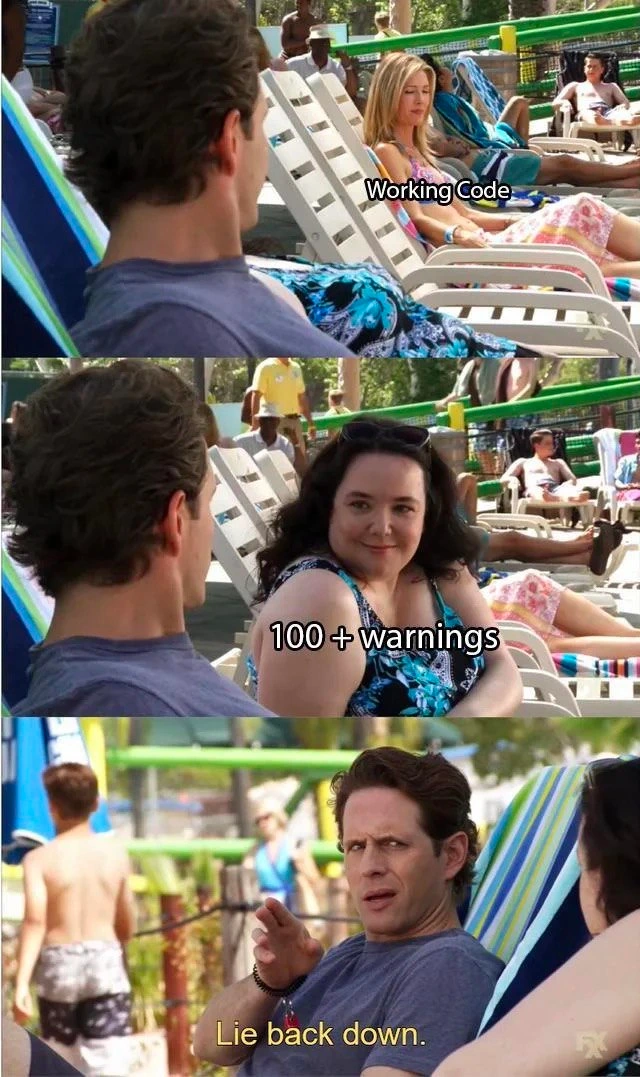
Ignoring Compiler Warnings for a Moment of Peace
Description
A three-panel meme using the 'Lie Back Down' format from the TV show 'It's Always Sunny in Philadelphia'. In the first panel, the character Dennis Reynolds is looking admiringly at an attractive woman lounging by a pool, who is labeled 'Working Code'. In the second panel, another woman, depicted as less conventionally attractive, sits up to get his attention, and she is labeled '100+ warnings'. In the final panel, Dennis looks irritated and dismissively gestures with his hand, with the caption 'Lie back down.'. The meme humorously illustrates a common developer behavior: prioritizing functional code over code quality by deliberately ignoring a large number of compiler or linter warnings. For an experienced developer, this is a relatable, albeit risky, trade-off. While warnings don't stop execution, they often indicate underlying issues, potential bugs, or poor practices that accumulate as technical debt. The joke lies in personifying the warnings as an unwelcome distraction from the satisfaction of having a program that, at least on the surface, works perfectly
Comments
8Comment deleted
Treating warnings as errors is a sign of a good junior. Knowing which 100+ warnings you can safely ignore until the next sprint is the sign of a senior who's seen too much
Our CI cheerfully calls 167 compiler warnings “informational” - that’s Enterprise-speak for “future archaeologists, bring shovels.”
Those warnings are just the compiler's way of saying "I've seen your architectural decisions and I'm concerned" - but we both know that's tomorrow's problem when the junior who inherits this codebase files their first therapy claim
Warnings are just errors with imposter syndrome - and like all unaddressed issues, they're saving themselves for the production incident
Every senior engineer knows that '100+ warnings' is just the compiler's way of saying 'I have opinions about your life choices.' Sure, the code compiles and passes tests, but those warnings are like the Greek chorus foreshadowing your 3 AM production incident six months from now. The real tragedy is that we all know we should fix them now, but deadline pressure and the siren song of 'it works on my machine' make us rationalize that future-us will definitely have time to address this technical debt. Spoiler: future-us will be too busy dealing with the consequences of present-us's decisions while generating 100+ new warnings of their own
If your pipeline isn’t warnings-as-errors, you’re just refinancing tech debt at variable interest
If your CI doesn’t enforce -Werror or quality gates, “working code” will keep telling 100+ warnings to lie back down - until one of them pages you at 3am
100+ warnings? That's not debt, it's job security for the maintainer after you