
The Perceived Complexity of Code vs. Its Actual Function
Description
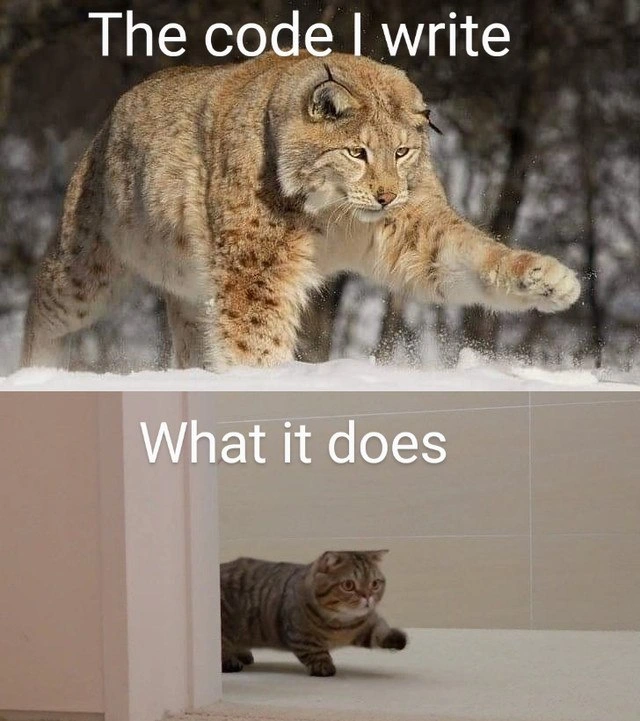
A two-panel vertical meme that contrasts a developer's perception of their work with its actual outcome. The top panel is labeled 'The code I write' and features a majestic, powerful lynx confidently striding through a snowy, wild environment. The image evokes a sense of strength, elegance, and complexity. The bottom panel, in stark contrast, is labeled 'What it does' and shows a small, timid-looking domestic tabby cat with folded ears cautiously peeking from behind a wall in a plain indoor setting. This meme humorously captures the common developer feeling of building what seems like a complex, robust, and sophisticated piece of software (the lynx), only for its actual function to be something very simple, mundane, or underwhelming (the house cat). It's a commentary on over-engineering, imposter syndrome, and the gap between effort and perceived impact


Comments
11Comment deleted
My code has six layers of abstraction, a dedicated message queue, and is deployed across three regions for high availability. It solves FizzBuzz
Design doc: “Blazing-fast, lock-free, horizontally scalable lynx of a service.” Prod flame graph: 93 % of CPU time curled up on a single synchronized block - turns out the lynx is just a housecat napping on a mutex
My code in the design doc: event-driven microservices with CQRS. My code in production: distributed monolith where every service calls every other service and we pray the circuit breakers hold
Every senior engineer knows this feeling intimately: you architect an elegant solution with clean abstractions, optimal time complexity, and beautiful separation of concerns - then watch it lumber into production like a house cat trying to catch a laser pointer, somehow consuming 4GB of RAM to process a CSV file
Design doc: lock-free, event-driven lynx; production: housecat tiptoeing past feature flags, N+1 ORM queries, and the "temporary" global mutex we added in 2017
On the whiteboard it’s O(1) and horizontally scalable; in production it’s O('it depends') behind a feature flag, waiting on a network call and a mutex
Architected for exascale distributed glory; debugs as a single-node SELECT * FROM disappointment;
The code I write: 💩 What it does: Comment deleted
✍✍ true Comment deleted
I just try to write Comment deleted
True Story Comment deleted