
Bugs Post #3460 · source on Telegram
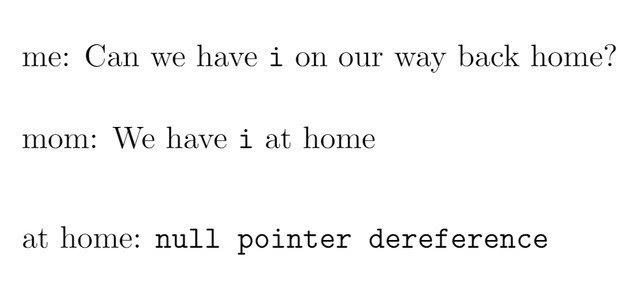
Asking for variable i but mom serves a null pointer dereference
Description
Plain white background with monospaced black text mimicking the classic “Mom, can we have X? - We have X at home” meme template. The lines read exactly: “me: Can we have i on our way back home?”, “mom: We have i at home”, and finally “at home: null pointer dereference” where the last phrase is bold-like due to a thicker font weight. The joke riffs on low-level C-style programming: instead of getting a simple loop counter variable i, the unlucky developer ends up with a fatal null pointer dereference, evoking runtime crashes and segmentation faults. It humorously highlights memory-safety bugs, debugging nightmares, and the pain of pointer misuse that seasoned engineers recognize all too well
More like this
More like this in Bugs →


Use J and K for navigation
Comments
7Comment deleted
Asked the codebase for a nice clean loop variable called “i”; turns out someone #defined i as (*((int*)0)) - because in this shop even counting to ten is undefined behavior
After 20 years in the industry, I've learned that 'i' at home is always either uninitialized, pointing to freed memory, or somehow both simultaneously in that one legacy module nobody wants to touch but is critical to production
The real tragedy isn't the null pointer dereference - it's that after 40 years of C/C++, we're still debugging the same 'i' that our predecessors fought with in the 1980s. At least Rust's borrow checker would've caught this at compile time, but then we'd just be arguing about lifetimes instead of segfaults. Progress, I suppose
Because someone 'optimized' an int into an int* in 2009, 'i at home' is nullptr - and your SLA is SIGSEGV
Mom's 'i' at home: the imaginary unit that derefs to a real segfault - every C dev's childhood trauma
Asked for i, got *i; turns out “i at home” was nullptr - our for-loop implements fail‑fast the C way: segfault at iteration zero
not me, that's for sure Comment deleted