
The Legend of the Load-Bearing Tomato
Description
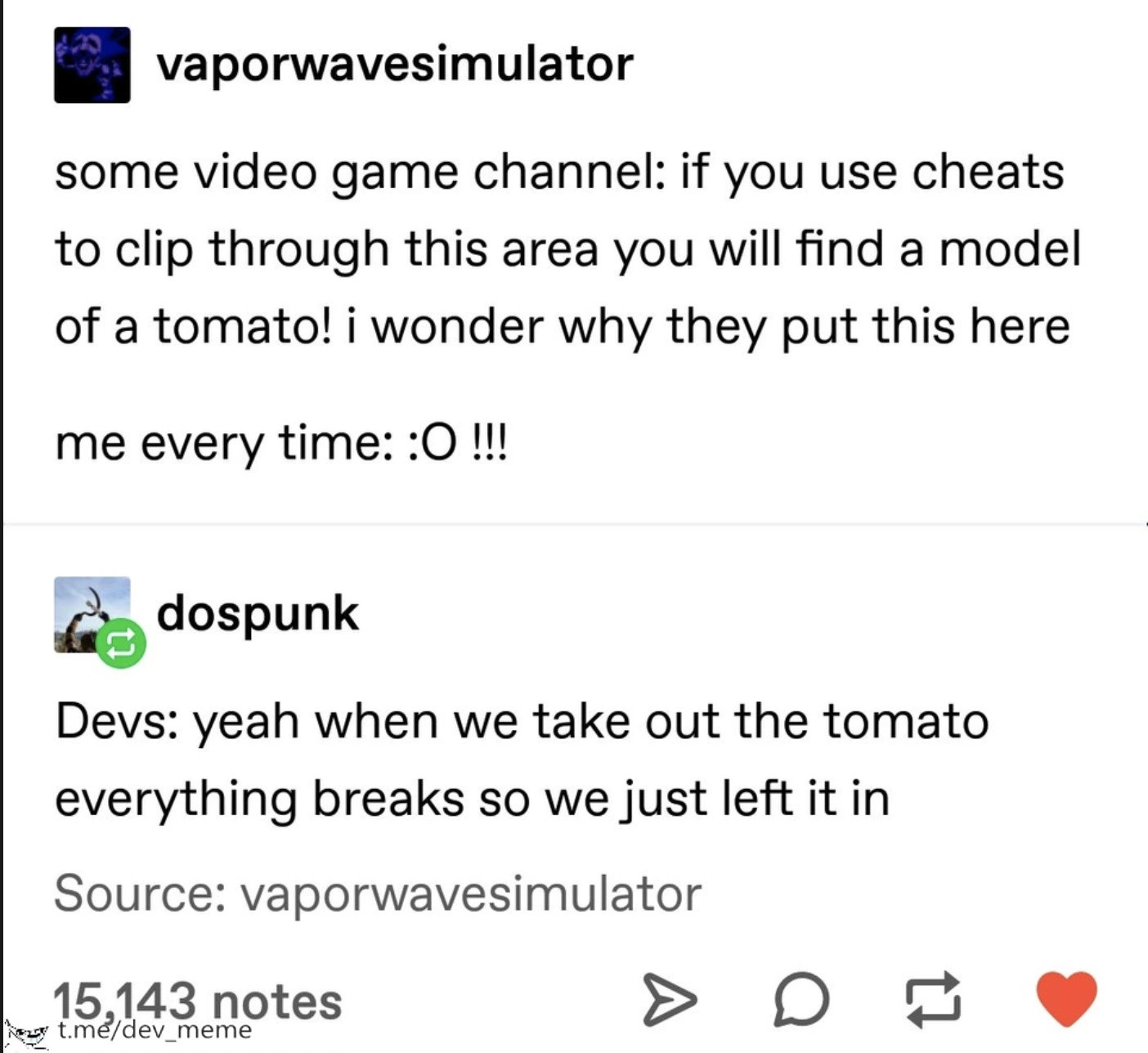
A screenshot of a Tumblr thread humorously contrasts the perspective of a gamer with that of a developer. The first post, by user 'vaporwavesimulator,' describes a video game channel finding a hidden tomato model by clipping through the game area, expressing wonder about its purpose. The reply, from 'dospunk,' gives the developer's grim reality: 'Devs: yeah when we take out the tomato everything breaks so we just left it in.' The image also shows '15,143 notes' and a small watermark for 't.me/dev_meme'. This meme perfectly encapsulates the concept of a 'load-bearing' component in software - an seemingly random piece of code, asset, or configuration that cannot be removed without causing catastrophic, inexplicable failures. It's a deeply relatable scenario for senior engineers who have worked on complex legacy systems where bizarre dependencies and technical debt are a fact of life


Comments
7Comment deleted
We have a production issue where a random, forgotten feature flag from 2012 can't be removed because it's somehow become the primary source of entropy for our encryption key generation. It's not tech debt; it's 'emergent architectural stability.'
The tomato.fbx isn’t an Easter egg; it’s the accidental service locator gluing together three coordinate systems, the save-game schema, and a decade of globals - touch it and the build pipeline becomes interpretive dance
That tomato is now a critical microservice handling authentication, payment processing, and somehow the entire WebSocket layer. The junior who added it left three years ago
Ah yes, the classic 'load-bearing tomato' problem - when your game's entire physics engine is mysteriously coupled to a vegetable model hidden outside the playable area. It's the architectural equivalent of discovering your microservices can't start without a deprecated Redis key named 'potato' that nobody remembers creating. Every senior engineer has encountered this: that one seemingly innocuous asset or config value that, when removed, causes a cascade failure through tightly-coupled systems. The real question isn't why the tomato is there - it's how many production systems are currently held together by the digital equivalent of duct tape and a prayer to a hidden tomato god
Not an Easter egg; it’s a load-bearing tomato - the sentinel asset that primes the render pipeline and keeps the occlusion culler from crashing. Remove it and you discover our “loose coupling” was just READMEware
Every big game has a load‑bearing tomato - a dummy FBX whose GUID is hard‑coded into the navmesh bake, loot tables, and a “temporary” analytics event; delete it and six subsystems and your burndown chart collapse in unison
The load-bearing tomato: that one asset no refactors touch because the whole engine's secretly depending on it