
Corporate Checkmate: The COVID Leave Gambit
Description
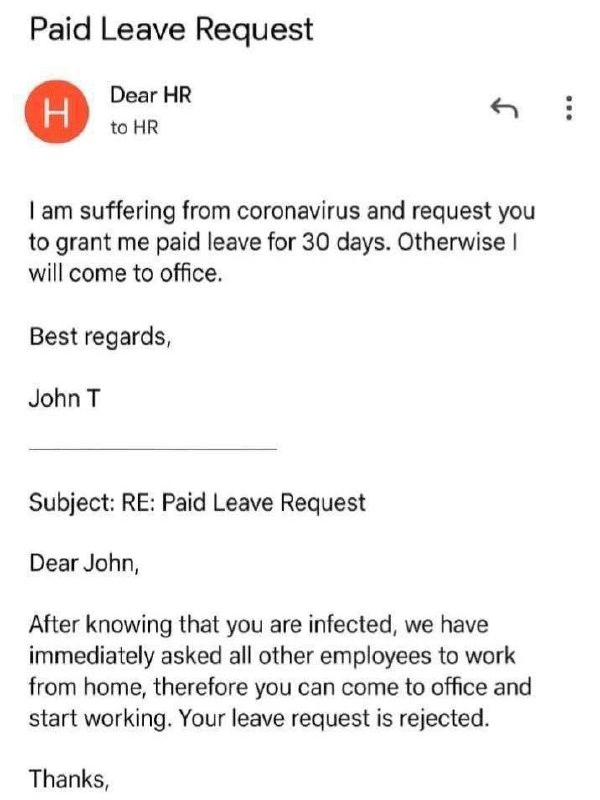
The image is a screenshot of a two-part email exchange. The first email, titled 'Paid Leave Request' and sent from a user 'John T' to 'HR', reads: 'I am suffering from coronavirus and request you to grant me paid leave for 30 days. Otherwise I will come to office. Best regards, John T'. This is a clear attempt to leverage a health risk to secure paid leave. The second email is a reply from HR with the subject 'RE: Paid Leave Request'. It reads: 'Dear John, After knowing that you are infected, we have immediately asked all other employees to work from home, therefore you can come to office and start working. Your leave request is rejected. Thanks,'. The humor stems from the corporate judo performed by the HR department. They call the employee's bluff by completely neutralizing his threat. Instead of giving in, they use the company's remote work policy to isolate the employee, forcing him to either work alone in an empty office or drop the request. It's a cynical but witty take on corporate power dynamics and the sometimes-adversarial relationship between employees and management, particularly highlighted by the workplace changes during the COVID-19 pandemic


Comments
10Comment deleted
The employee tried to use a social engineering attack to get root access to the payroll system, but HR just sandboxed him in an empty office VLAN
Nothing like HR discovering the ‘isolate the node, not the bug’ strategy - and declaring the infected dev a dedicated on-prem microservice
This is what happens when HR's incident response playbook was written by the same team that handles production rollbacks - 'If one service is infected, isolate all the healthy ones and keep the compromised one running in the main cluster.'
This HR response perfectly encapsulates the enterprise approach to incident response: when you detect a critical vulnerability (infected employee), immediately isolate all healthy nodes (send everyone home) while forcing the compromised system to remain in production. It's like running `git push --force` on a branch you know is broken, then wondering why the deployment pipeline fails. The real kicker? HR just implemented a distributed denial-of-health-service attack on their own employee while claiming it's a security measure. At least in our on-call rotations, we have the decency to rotate the misery - this is just assigning permanent pager duty to patient zero
HR's genius ops: Quarantine healthy nodes remotely, run the infected singleton bare-metal in-office for 'fault isolation'
Enterprise logic in a nutshell: quarantine the cluster, keep the compromised primary serving traffic - because the bus factor is 1 and failover is named ‘John T’.
HR implemented Kubernetes scheduling: taint office=node.infected, evict healthy pods to WFH, schedule the only tolerant pod (John) on‑prem - SLA passed, ethics segfaulted
this reminds me of this discussion https://t.me/devs_chat/146994 Comment deleted
https://t.me/devs_chat/146995 Comment deleted
hey, that was me :D Comment deleted