
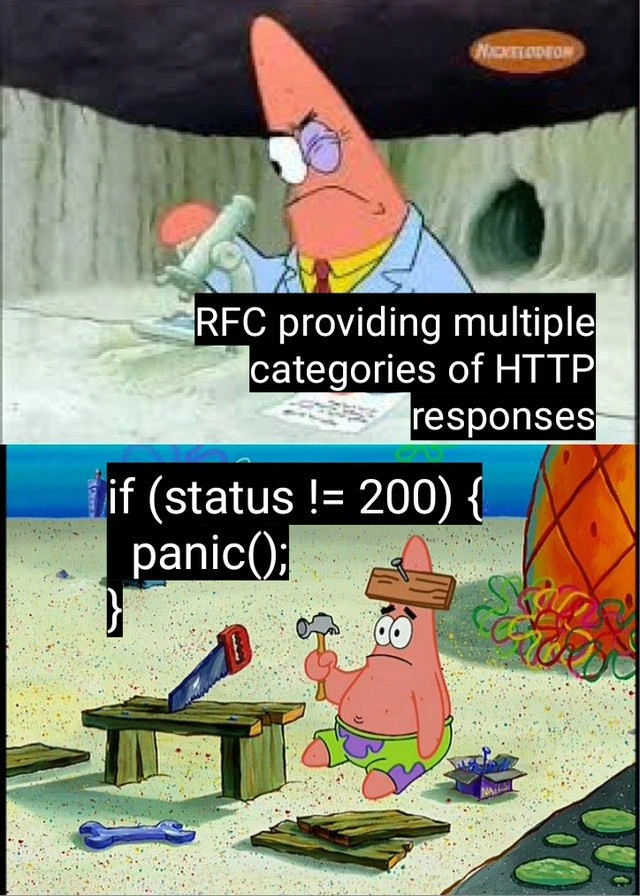
The Duality of HTTP Error Handling
Description
A two-panel meme format featuring the character Patrick Star from Spongebob Squarepants to contrast specification with implementation. In the top panel, a sophisticated-looking Patrick, wearing a lab coat and glasses, is studiously examining a document. The overlay text reads, 'RFC providing multiple categories of HTTP responses', representing the detailed and nuanced standards for web communication (e.g., 2xx for success, 3xx for redirection, 4xx for client errors, 5xx for server errors). The bottom panel shows the classic image of a confused-looking Patrick with a wooden plank nailed to his forehead, holding a hammer. The text overlay here is a code snippet: 'if (status != 200) { panic(); }'. This illustrates a common but lazy programming practice where developers ignore the rich information provided by different HTTP status codes, treating any response other than '200 OK' as a single, catastrophic failure. The humor lies in the stark contrast between the well-designed system and its crude, real-world implementation, a scenario all too familiar to experienced engineers


Comments
7Comment deleted
Why implement nuanced error handling when you can just treat every HTTP status code other than 200 as a request to reboot the entire internet?
Ship a client that panic()s on every non-200 and you’ve basically turned HTTP into a binary protocol - congrats, you just reinvented TCP with extra incident reports
After 20 years in the industry, I've learned that the difference between junior and senior developers is knowing that HTTP 418 'I'm a teapot' is the only status code that truly matters in production
This perfectly captures the eternal struggle between HTTP RFC authors who meticulously designed semantic status codes for every conceivable scenario (201 Created, 204 No Content, 304 Not Modified, 409 Conflict, 429 Too Many Requests) and the average backend developer who treats HTTP like a boolean: 200 means 'it worked' and literally anything else triggers an existential crisis. Bonus points if your error handling strategy is just wrapping everything in try-catch and returning 500 with a generic 'something went wrong' message, completely defeating the purpose of having 63 standardized status codes
HTTP gives you five classes and dozens of codes; our client implemented a boolean and wakes up on-call because a 204 dared to be empty
RFCs hand us a taxonomy for every failure mode; we reply with if(status !== 200) { summonSREs(); }
Our API wrapper: if (status != 200) panic(); - because why bother with idempotency, 201/202/204/304 semantics, or retries when you can compress the entire HTTP RFC into a boolean