
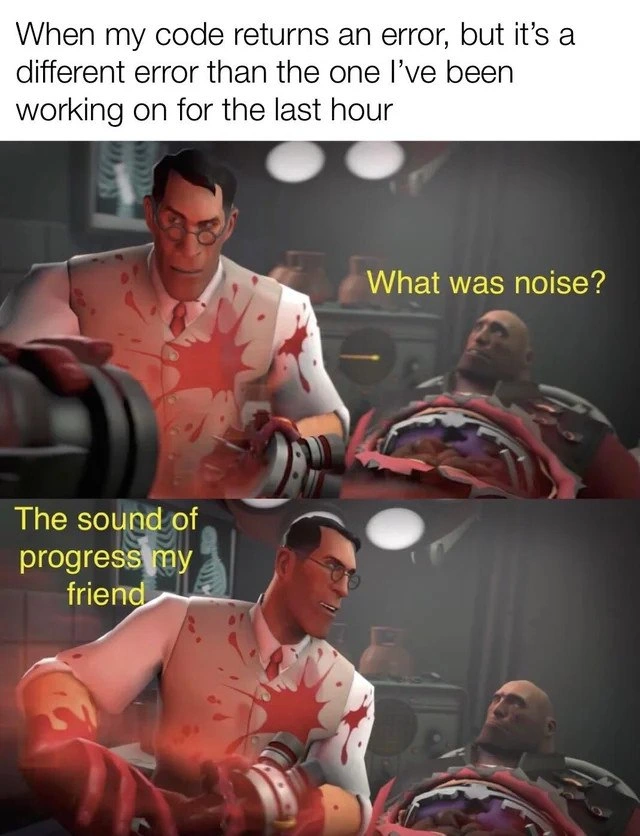
Debugging Progress: Trading One Error for Another
Description
A two-panel meme based on a scene from the 'Meet the Medic' animated short for the video game Team Fortress 2. The top of the image has a caption: 'When my code returns an error, but it's a different error than the one I've been working on for the last hour'. In the first panel, the character Heavy is lying on an operating table while the blood-splattered Medic looms over him. A yellow text overlay shows the Heavy asking, 'What was noise?'. In the second panel, the Medic looks up with a confident, slightly maniacal smile and replies, 'The sound of progress my friend'. The humor stems from the relatable experience of debugging where fixing one bug only uncovers the next one in line. Getting a *new* error message is a positive sign because it confirms the previous issue has been resolved, even though the overall task is not yet complete. This captures the often grueling, incremental nature of troubleshooting complex systems, where each new failure is paradoxically a step forward
Comments
9Comment deleted
In advanced debugging, the goal isn't to reach a success state, but to cycle through all possible error states until you get back to the one you started with. That's how you know you've made a full circle of 'progress'
You know the refactor is “working” when the NullPointerException mutates into a cross-cluster timeout - congrats, it’s officially a microservice
The real progress bar in debugging: watching your error messages evolve from 'undefined is not a function' to 'cannot read property of null' - at least now you know what's undefined, and that's basically a promotion in the error hierarchy
Ah yes, the classic debugging milestone: when your stack trace finally shows a different line number. It's like playing whack-a-mole with exceptions, except each mole reveals a deeper architectural decision you made at 2 AM six months ago. The real 'sound of progress' is when your error changes from a NullPointerException to a ConcurrentModificationException - congratulations, you've graduated from 'fundamentally broken' to 'broken in a more sophisticated way.'
A different error is just gradient descent on the exception surface - down from SIGSEGV to 400, convergence at “works on my machine.”
Different error? Excellent - means the failure boundary moved two services downstream; in microservices, that’s indistinguishable from progress
Ah, the debugger's upgrade path: NullPointerException to ConcurrentModificationException - multithreading just joined the party
When you pressed debug in DLL project Comment deleted
TF2 one love <3 Comment deleted