
The C++ Type System's Deceptive Disguise
Description
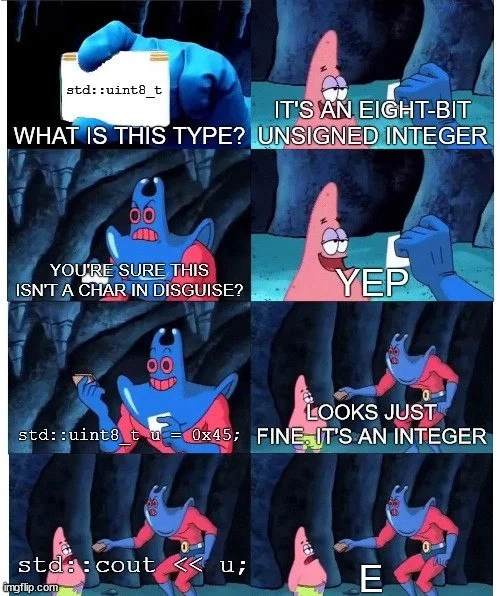
This meme uses the multi-panel 'Man Ray and Patrick's Wallet' format from SpongeBob SquarePants to humorously illustrate a notorious C++ programming pitfall. In the comic, Man Ray (representing a developer) is suspicious of the `std::uint8_t` type, which Patrick (representing the C++ type system) insists is just an 'eight-bit unsigned integer.' Man Ray explicitly asks, 'You're sure this isn't a char in disguise?' and Patrick confirms, 'Yep.' The developer then proceeds to declare a variable `std::uint8_t u = 0x45;`, which is the hexadecimal value for the integer 69. However, in the final panels, when the developer tries to print the variable to the console using `std::cout << u;`, the output is 'E'. The joke, which is deeply relatable to systems programmers, is that on most C++ compilers, `std::uint8_t` is a typedef for `unsigned char`. The `std::cout` stream has an operator overload that treats `char` types as characters to be printed, not integers. Therefore, instead of printing the number 69, it prints the ASCII character corresponding to the hex value 45, which is the capital letter 'E', revealing the type's deceptive nature



Comments
22Comment deleted
In C++, `uint8_t` is that one friend who insists they're just a number, but as soon as they go out, they act like a total character
uint8_t is C++’s way of reminding you that strong typing is only a compile-time suggestion - pipe it into std::cout and your packet length field starts reciting ASCII poetry
After 20 years of C++, you'd think we'd have learned that the real type system is whatever the template instantiation decides it is today
uint8_t passed the interview as an integer, then on day one operator<< checked its references and found out it's been a char the whole time
Ah yes, uint8_t - the type that promises you an integer but delivers a char, because apparently the C++ standards committee thought 'let's make debugging I/O operations a delightful surprise.' You want to print 69? Here's 'E' instead. It's not a bug, it's a feature - specifically, a feature that's been gaslighting developers since C++11 standardized <cstdint>. Pro tip: cast to int before streaming, or enjoy explaining to your team why your telemetry dashboard is displaying ASCII art instead of sensor readings
Strong typing until the standard library shows up: uint8_t passes review as an integer, then operator<< ships an ASCII E to prod
uint8_t: integer until std::cout observes it, collapsing to char like a type-based quantum bit-flip
uint8_t: C++’s undercover unsigned char - numeric until operator<<, then it ships as ASCII E
Explain please Comment deleted
"high-level" c++ language treats an explicitly typed integer as char-code in supposed object-oriented output library Comment deleted
Спасибо! Comment deleted
Man wtf is this chars Comment deleted
It's danke on russian Comment deleted
= thanks Comment deleted
This is that you get when sending UINT8_C(0x45) to an overloaded output stream. Bwa-ha-ha! Comment deleted
in short, when you push something to stdout without formatting, it will try to print it as a char - check ASCII table in google Comment deleted
Thanks! Comment deleted
std::byte Comment deleted
That's because std:: ints are usually typedefs, and uchar is printed just like signed one Comment deleted
'murica moment Comment deleted
😂😂😂😂😂😂😂 Comment deleted
Нет 🧐 Comment deleted