
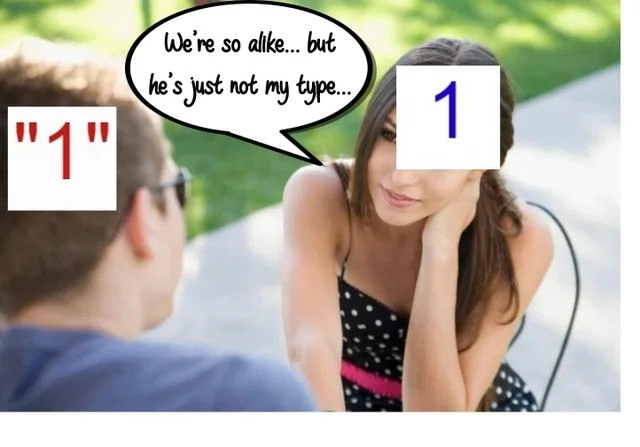
A Classic Case of Type Mismatch
Description
A popular stock photo of a woman on a date with a man serves as the backdrop. Their faces are obscured by white squares. The square over the man's face contains a red '"1"', representing a string data type. The square over the woman's face shows a blue '1', representing an integer. A speech bubble originating from the woman says, 'We're so alike... but he's just not my type...'. The meme is a clever pun on the word 'type' in programming. It humorously illustrates the concept of data types, where a string and an integer with the same numeric value are fundamentally different to a compiler or interpreter. This is a universally relatable issue for developers who often debug problems arising from type mismatches, especially in weakly-typed languages where implicit type coercion can lead to unexpected behavior
Comments
15Comment deleted
JavaScript's `==` would call them a perfect match, but `===` reveals the heartbreaking incompatibility. It's the difference between a casual acquaintance and a lifelong partner
Thought they’d found The One, but CI ran === and it turned out he was wrapped in quotes - another romance killed by static analysis
After 20 years of migrating legacy FORTRAN systems, you develop trust issues with anyone who thinks the first element should be at position 1 - they clearly haven't debugged enough off-by-one errors in production at 3 AM
The eternal tragedy of type systems: two values can be semantically identical, philosophically aligned, and logically equivalent - yet the compiler remains unmoved by their compatibility arguments. It's the programming equivalent of 'it's not you, it's your primitive type.' Meanwhile, JavaScript developers watch from the sidelines, confused about what all the fuss is about, having never encountered this problem because == would've just made it work (and that's exactly why the rest of us have trust issues)
Both int(1), but no implicit coercion to 'soulmate' - strict mode devs see the compile error coming
"1" to 1: we’re alike, just not my type - also how Postgres explains your broken join after the UI serialized every ID
Looks compatible under ==, but once the request hits the === gateway with TypeScript strict on, the relationship 500s with a spectacular type mismatch and an even better postmortem
"", in terms of C++ Comment deleted
Didnt know Comment deleted
explanation: 1 + "1" equals to char *ptr = "1"; char *new_ptr = ptr + 1; // empty string Comment deleted
It might be anything, or c++ will clear that byte? Comment deleted
char *ptr = "1"; MEMORY VIEW ... [0x31] [0x00] ... ^ ptr Comment deleted
C++ uses zero-terminated strings Comment deleted
Oh, right. It inherited from C Comment deleted
If you use it with output stream it will sum integer 1 with the ascii code of character "1" and the result is 50. If it is a char pointer the result will be empty string. Comment deleted