
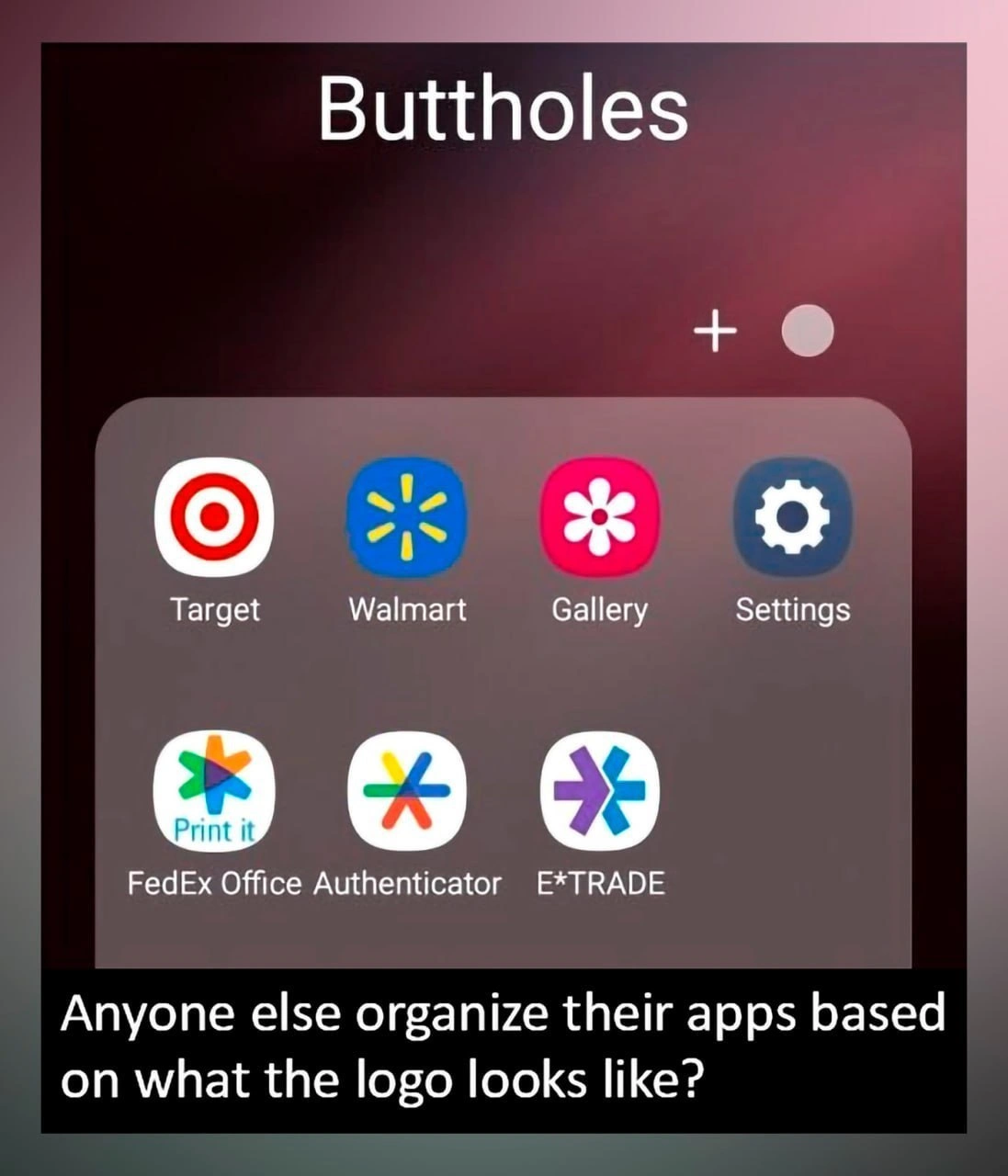
When manual icon-clustering outperforms your fancy k-means production pipeline
Description
The meme is a smartphone screenshot showing an Android home-screen folder titled "Buttholes." Inside the rounded-corner folder are seven apps whose circular or radial icons all resemble, well, cartoon sphincters: top row (left-to-right) Target, Walmart, Gallery, and Settings, bottom row FedEx Office Print It, FedEx Office Authenticator, and E*TRADE. A subtle grey '+' symbol and empty circle indicate room for more icons. Below the screenshot, a black banner reads, "Anyone else organize their apps based on what the logo looks like?" The joke riffs on human pattern-matching versus algorithmic classification - rather than semantic categories, the user has applied their own irreverent visual taxonomy, highlighting both the arbitrariness of iconography and the cognitive shortcuts developers often take when naming folders, micro-services, or code modules under deadline pressure


Comments
19Comment deleted
Proof that a senior dev with thirty seconds and low empathy can outclass your entire CV-based image classifier - welcome to the Butt-hole cluster, now serving prod
After 20 years of arguing about semantic naming conventions and domain-driven design, we've finally discovered the ultimate organizational pattern: anatomical similarity clustering. Wait until the design system team hears their carefully crafted brand guidelines resulted in the 'sphincter folder' taxonomy
When your app folder taxonomy is driven by visual hashing collisions rather than semantic clustering - a perfect example of why humans still can't be replaced by deterministic algorithms. Even our neural networks would struggle to explain why a retail app, an MFA token generator, and a brokerage platform belong in the same namespace, but here we are, organizing by logo shape like it's a valid indexing strategy
Shape-driven development: grouping apps by what the logo resembles - great for cognitive cache hits, catastrophic when marketing rebrands and your taxonomy suffers cache invalidation
When your information architecture is so weak the user invents k‑means on glyphs - unsupervised clustering of spokes and bullseyes - the mobile equivalent of naming microservices svc‑a through svc‑z
Logo-based folders: easier than partitioning Kafka topics by key hash
I have only two folds: trash and not trash. Comment deleted
I have zero folders because I know where my apps are goddamnit /j Comment deleted
No idea where my apps, whatever is app I looking for - I use search 👀 Comment deleted
Why would you keep trash on your device? Comment deleted
I need somethimes Google Auth, or my mobile provider app or gas station app, but I marking it as trash apps. Comment deleted
Understandable. Well, at leasts GAuth has multiple drop-in FOSS replacements. Comment deleted
yeah, e.g. I use Aegis Comment deleted
i have 3: -Offline apps -Online apps -Most used Comment deleted
Move over Comment deleted
Is most user app called „Your mom”? 😁 (relax it’s just a joke) Comment deleted
Target 🌚 Comment deleted
My folders are so genral that all of my different 150 games fit into a single folder Comment deleted
I only have 2 folders, 1 for tools and the other for tools that I actually use Comment deleted