
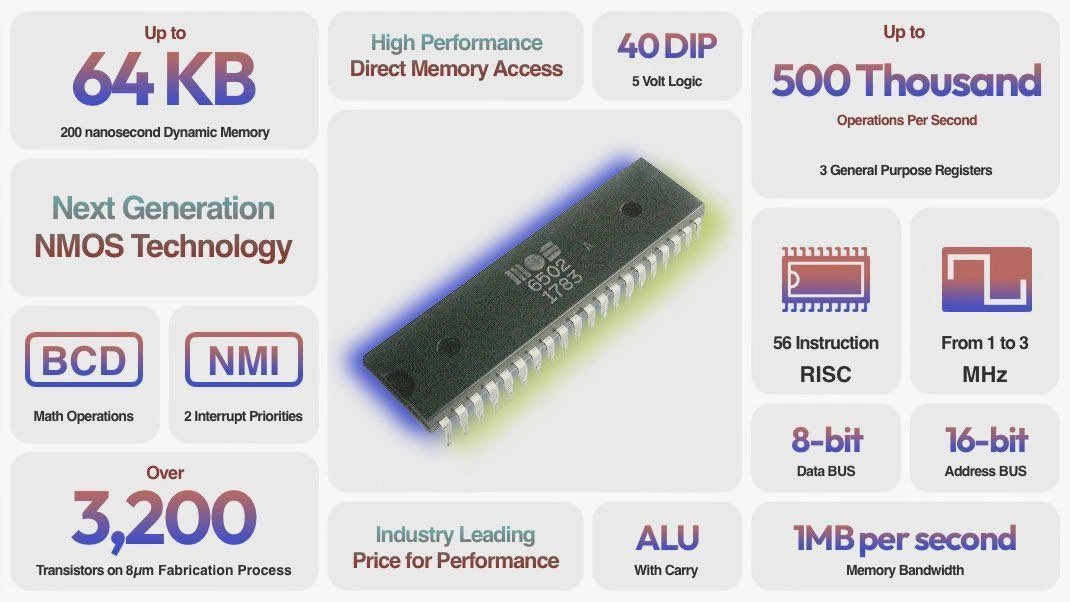
Marketing the MOS 6502 as a Next-Gen Processor
Description
This image is a satirical infographic presenting the specifications of the vintage MOS Technology 6502 microprocessor as if it were a modern, cutting-edge product. The layout is clean and contemporary, with a central image of the 40-pin DIP chip surrounded by callout boxes with smooth gradients. These boxes highlight its technical specs, including: 'Up to 64 KB' of memory, 'Up to 500 Thousand Operations Per Second', 'Next Generation NMOS Technology', 'Over 3,200 Transistors on 8µm Fabrication Process', an '8-bit Data BUS', '16-bit Address BUS', and a clock speed of 'From 1 to 3 MHz'. The humor is derived from the stark contrast between the modern, hyperbolic marketing language ('High Performance', 'Industry Leading') and the extremely modest capabilities of this 1970s-era chip. For experienced engineers, this is a nostalgic nod to a processor that powered iconic machines like the Apple II and Commodore 64, while also poking fun at how dramatically the scale of computing has changed due to Moore's Law


Comments
22Comment deleted
The 16-bit address bus was a brilliant feature, ensuring developers would never be tempted by the decadent excess of addressing more than 64KB of RAM
Remember when "high-performance DMA" meant a whole megabyte per second? These days our CI pipeline logs hit that before the coffee in Jenkins finishes brewing
Love how they're marketing 3 registers like it's a feature - modern devs complain when they only have 32. Next they'll be bragging about the revolutionary 'single accumulator architecture' and 'industry-disrupting 256-byte stack limitation'
Ah yes, the golden age when '64 KB ought to be enough for anybody' was actually aspirational, not a misquote. This chip's 500,000 operations per second would struggle to render a single frame of a modern loading spinner, yet somehow we managed to land on the moon with less. Today's developers complaining about memory constraints while their Electron app consumes 2GB of RAM should spend a day with these 3 general-purpose registers and 1MB/s memory bandwidth - suddenly that O(n²) algorithm doesn't seem so bad when your entire address space fits in a modern CPU's L2 cache
8088's 66 instructions ran the PC era; today's VMs need 66GB just to enumerate theirs
56 instructions, three registers, and 1-3 MHz, yet it still boots faster than our SPA behind a service mesh, API gateway, and six JSON parsers
56‑instruction “RISC”, 64KB, and three registers - the stack where zero page is your cache, and the end‑to‑end throughput still beats our JSON microservice once you factor serialization and egress
bot Comment deleted
No no, that chip generally changed my life for real I am now motivated enough to build a PC Comment deleted
But Julia is still a spam bot :) Comment deleted
That was supposed to be the joke since I don't really think anyone would be inspired by a 64kb processor Comment deleted
Depends on when it happened… ;) Comment deleted
True... One might need only this bit of information to invent a world changing device Comment deleted
Intel 8080 was very inspiring. Comment deleted
I followed Ben Eater's videos about the 6502, it's an incredible series, and an incredible piece of technology Comment deleted
Yeah, but can it run DOOM? Comment deleted
Cool. And it is enough for a lot of good apps Comment deleted
Z80 the best. No 64 KB limit. Comment deleted
Imagine putting 4gb in it Comment deleted
Actually there is. z80 can only address 64 kilobytes at a time. More memory is achieved by dividing memory into pages and switching between these pages in a window. this is used by both the ZX Spectrum with z80 architecture and the NES with 6502 architecture, and by many other systems too. Comment deleted
What a funky looking centipede. Comment deleted
Are those actually specs of the new iPhone? Doesn't matter I will buy it because its apple. (Dw only apple thing I have is iPhone 8 and unless its free I wont upgrade) Comment deleted