
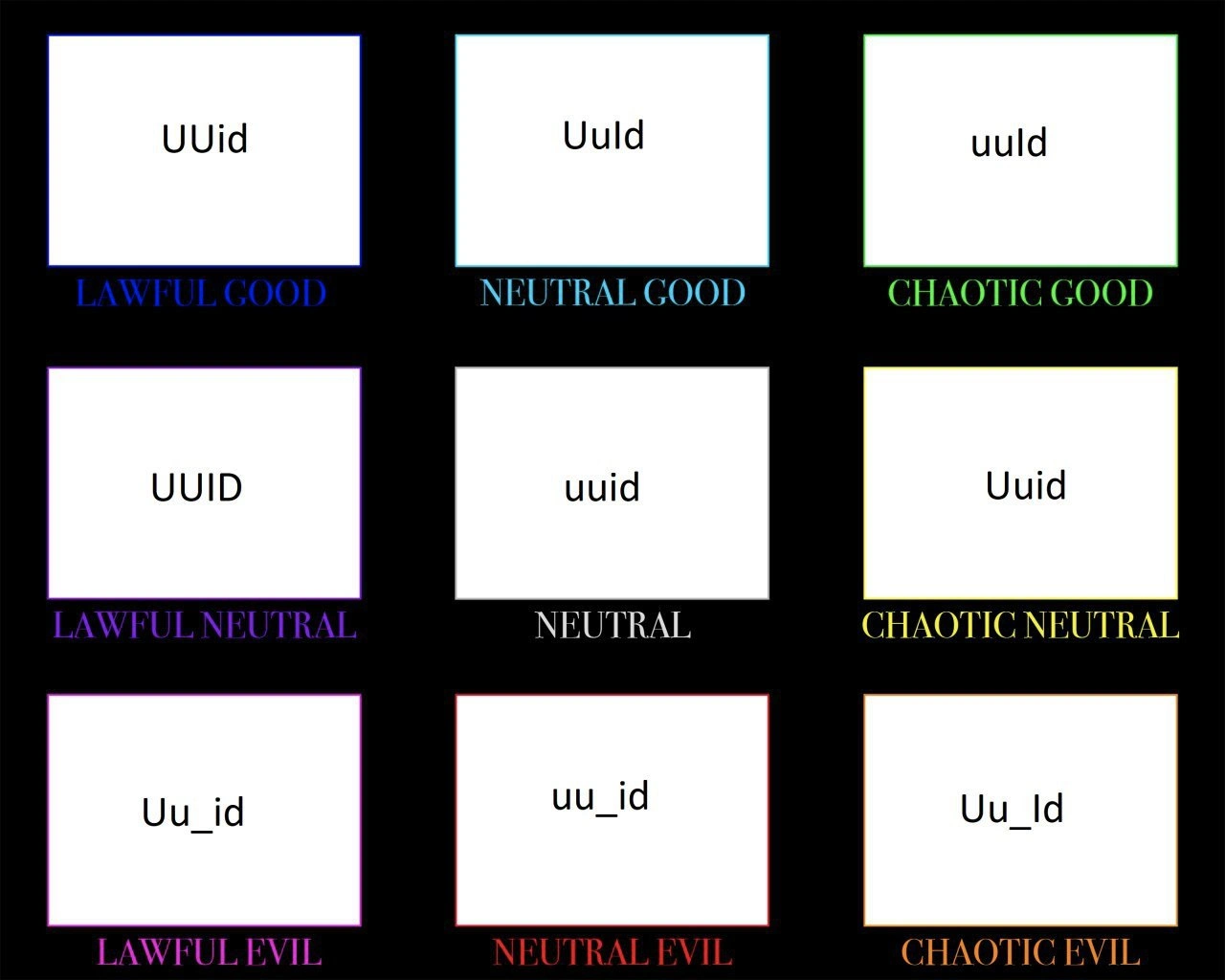
The Nine Circles of UUID Naming Conventions
Description
A meme formatted as a classic 3x3 Dungeons & Dragons alignment chart, used to satirize programming naming conventions for the acronym 'UUID'. Each square has a colored border, a white background, and text representing a different casing style, corresponding to an alignment. The alignments are: 'LAWFUL GOOD' with 'UUid', 'NEUTRAL GOOD' with 'Uuid', 'CHAOTIC GOOD' with 'uuid', 'LAWFUL NEUTRAL' with 'UUID', 'NEUTRAL' with 'uuid', 'CHAOTIC NEUTRAL' with 'Uuid', 'LAWFUL EVIL' with 'Uu_id', 'NEUTRAL EVIL' with 'uu_id', and 'CHAOTIC EVIL' with 'Uu_Id'. The joke is that while there are several reasonable ways to format 'UUID' (the 'good' and 'neutral' options), there are also truly cursed, inconsistent variations (the 'evil' options) that violate all common style guides. This resonates deeply with senior developers who have wasted countless hours in code reviews debating trivial naming standards or have suffered through maintaining codebases with 'chaotic evil' inconsistencies

Comments
7Comment deleted
The 'Chaotic Evil' `Uu_Id` isn't just a naming convention; it's a GUID, a Globally Unique Identifier for technical debt
The real alignment check is `grep -R -i "uuid" | sort -u`; if the number of unique spellings exceeds your microservice count, you’ve officially crossed into Chaotic Evil
After 20 years in the industry, I've learned that the real chaos isn't in distributed systems or microservices - it's finding 'Uu_Id' in production code and realizing it's been propagated through 47 database migrations and nobody wants to touch it because 'it works.'
After 20 years in the industry, I've learned that the real 'universally unique' part of UUID isn't the 128-bit value - it's that every team has their own uniquely terrible convention for writing it. The alignment chart is accurate though: anyone using 'Uu_Id' has definitely crossed into chaotic evil territory, probably the same architect who insists on Hungarian notation in your TypeScript codebase and names variables like 'strUu_IdValue'. Meanwhile, the 'uuid' purists and 'UUID' shouters will fight to the death in code review over a four-letter identifier while the actual bug - a race condition in your distributed transaction coordinator - ships to production
Proof that naming is the hardest problem: the D&D chart for uuid casing; pick any square and your ORM picks another - true chaotic evil is the mixed‑case Postgres column “Uu_Id” that sentences every query to double quotes for eternity
Nothing exposes a microservice architecture like deciding if it’s uuid, UUID, or Uu_Id - one bikeshed later you schedule nine migrations and rediscover the Turkish-I bug
CAP theorem for IDs: pick two - consistent, readable, or refactorable - because 'U_Id' always wins in prod