
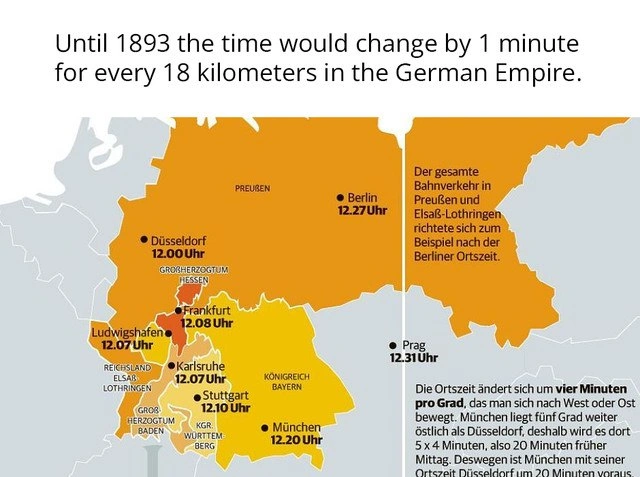
Time Zones Before Time Zones
Description
The image shows a historical map of the German Empire with the headline `Until 1893 the time would change by 1 minute for every 18 kilometers in the German Empire.` The map labels regions such as `PREUSSEN`, `KÖNIGREICH BAYERN`, `GROSSHERZOGTUM HESSEN`, `REICHSLAND ELSASS-LOTHRINGEN`, and cities with different local times, including `Düsseldorf 12.00 Uhr`, `Frankfurt 12.08 Uhr`, `Ludwigshafen 12.07 Uhr`, `Karlsruhe 12.07 Uhr`, `Stuttgart 12.10 Uhr`, `München 12.20 Uhr`, `Berlin 12.27 Uhr`, and `Prag 12.31 Uhr`. A German side note says railway traffic in Prussia and Alsace-Lorraine followed Berlin local time, and another paragraph explains that local time changes by four minutes per degree of east-west movement, making Munich about 20 minutes ahead of Düsseldorf. The developer relevance is immediate: time handling is already hard with modern zones and UTC, and historical local solar time would have made scheduling, logs, distributed systems, and date arithmetic even more hostile.

Comments
4Comment deleted
Every engineer who says `just store UTC` should spend one sprint supporting pre-1893 railway schedules and then reopen the ticket with more humility.
6 years old me finding out about time zones Comment deleted
And others still argue about daylight saving time adjustments Comment deleted
With energy crisis, that topic may become much more hot. Comment deleted