
CS Fundamentals Post #4632 · source on Telegram
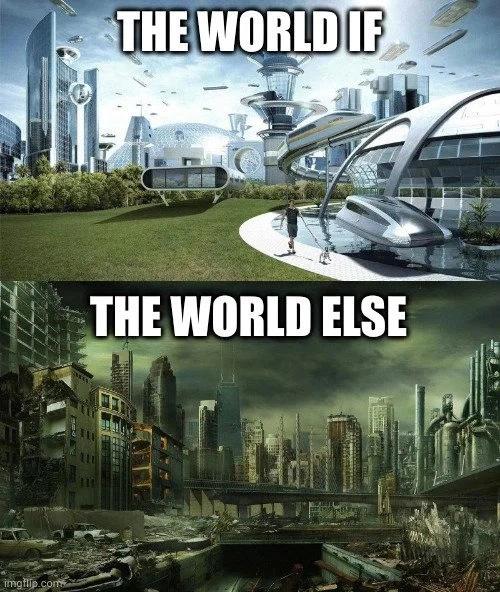
When a single else branch decides the fate of the entire world
Description
Two-panel meme. Top image: bright, ultra-modern utopian city with sleek skyscrapers, flying cars, green lawns, and people strolling; bold white text centered at the top reads "THE WORLD IF". Bottom image: dark, ruined, post-apocalyptic city with collapsed buildings, broken highways, flooded streets, and smoggy sky; bold white text centered at the top of this panel reads "THE WORLD ELSE". The joke riffs on programming control flow - an idyllic outcome for the true branch versus catastrophic results for the else branch - highlighting how a single conditional statement can radically change execution paths, a relatable exaggeration for developers debugging if/else logic
More like this
More like this in CS Fundamentals →
Use J and K for navigation
Comments
23Comment deleted
Legacy law: between utopia and a 3 AM Sev-0 lies one untested else branch that nobody’s owned since the original architect became a keynote speaker
This is what happens when your error handling consists entirely of '// TODO: handle this properly later' - the ELSE clause becomes a post-apocalyptic wasteland of unhandled exceptions, null pointers, and that one legacy system nobody wants to touch that somehow keeps the entire infrastructure running
This meme perfectly captures the senior engineer's existential dread: we spend 80% of our time architecting the pristine 'if' path with clean abstractions and elegant patterns, only to watch production traffic inexplicably take the hastily-written 'else' branch we added at 2 AM before the deploy. The real kicker? That else clause you thought would handle 0.01% of cases? It's now your primary code path, and the utopian if-block you lovingly crafted is gathering dust in the coverage reports at 3% execution
We architect the “if” for the roadmap; the “else” gets written at 3am via kubectl exec by whoever’s on call
World IF: exhaustive match on a sealed enum; World ELSE: the catch‑all default that logs “should never happen” and pages Ops at 3am
The world if architecture diagrams matched prod vs the world else: three layers of 'temporary' hacks and a COBOL microservice
looks like there were times when second picture was better than first now Comment deleted
what? Comment deleted
maybe russian will help "на второй картинке видно, что когда-то там было лучше, чем сейчас на первой" Comment deleted
I still don't speak Russian 😅 Comment deleted
second picture before apocalypse is better than first picture Comment deleted
i don't see why city on second picture was better Comment deleted
that is just feeling without proof Comment deleted
maybe because it feels more familiar? Comment deleted
"the scene from 2nd picture was once better than on 1st picture before it decayed" @RiedleroD Comment deleted
ah, that makes a lot of sense. Yeah, again, mostly because there's a lot of things to recognize from how our cities currently look. Comment deleted
actually they both look awful without trees Comment deleted
the first one looks like some Oligarch Haven, and I'm not here for that. Comment deleted
if [[unlikely]] else [[likely]] Comment deleted
It is reversed in the world of golang Comment deleted
Idiocracy Comment deleted
The world try The world catch Comment deleted
Functional programming OOP Comment deleted