
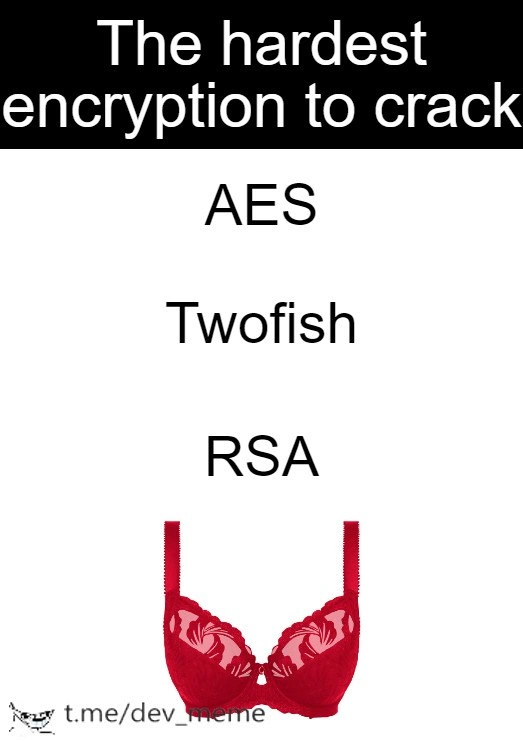
When AES, Twofish, and RSA are easier than that last clasp cipher
Description
Accessibility description: A vertically-oriented meme. At the top, white text on a black background reads, "The hardest encryption to crack". Below, on a plain white background, three lines of centered black text list well-known ciphers: "AES", then "Twofish", then "RSA". Under the word "RSA" is an isolated image of a red lace bra, implying it is an even tougher "encryption" to break. A small watermark in the lower left corner says "t.me/dev_meme". Technical context: The meme juxtaposes formidable real-world cryptographic algorithms (AES, Twofish, RSA) with the everyday challenge of unclasping a bra, poking fun at security professionals and developers who pride themselves on defeating complex encryption while struggling with mundane physical 'locks'. The humor relies on knowledge of symmetric (AES, Twofish) and asymmetric (RSA) encryption standards and the jargon "crack" meaning both breaking ciphers and undoing fasteners
Comments
6Comment deleted
I can brute-force 2048-bit RSA with enough GPUs, but the bra-clasp protocol still beats me - zero docs, non-deterministic state machine, and a single-handed handshake with catastrophic retry backoff
After 20 years of implementing AES-256, managing RSA key pairs, and arguing about post-quantum cryptography, I can confirm that the real challenge isn't breaking encryption - it's explaining to the C-suite why their 'password123' undermines our entire $2M security infrastructure
After years of implementing AES-256, RSA-4096, and Twofish in production systems, senior security engineers have concluded that the most computationally intractable problem remains understanding the clasp mechanism on women's undergarments - a challenge that no amount of side-channel analysis, differential cryptanalysis, or brute-force attacks can solve, and one that somehow gets exponentially harder after a few drinks at the company holiday party
AES, Twofish, RSA - solid, but the only truly uncrackable cipher is corporate PKI: nobody can find the root CA, nobody can rotate it, and yet every service still trusts it
AES and RSA have specs and proofs; the clasp protocol is an undocumented, non-idempotent handshake with zero observability and a one-shot rollback - still the strongest crypto in production
Shor's algorithm cracks RSA in polynomial time, but the bra clasp? Still requires exponential trial-and-error in zero visibility