
The Perfectly Secure Project
Description
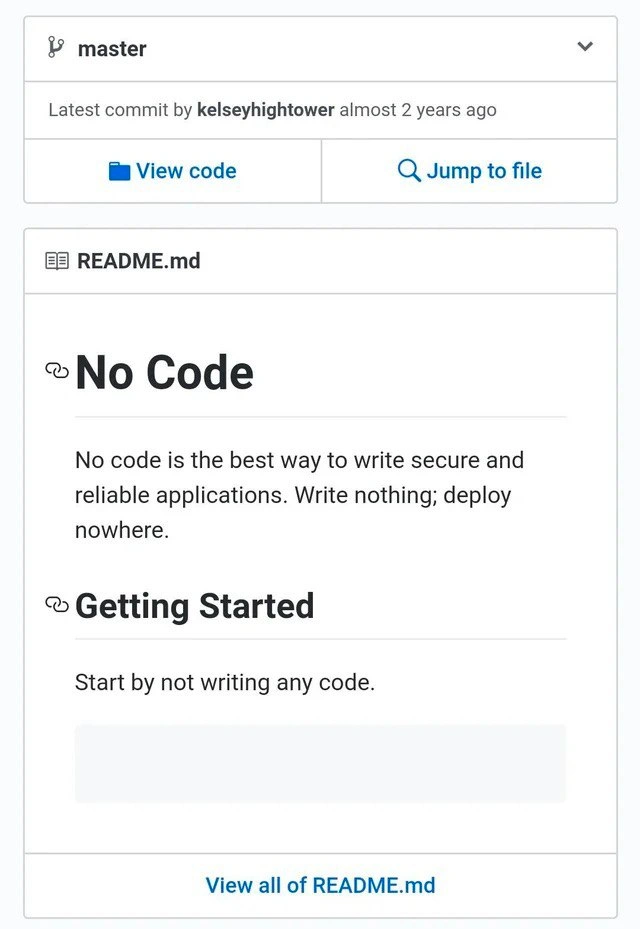
A screenshot of a GitHub repository README.md file. The top of the image shows the branch is 'master' and the 'Latest commit by kelseyhightower almost 2 years ago'. The README has two main sections. The first is titled 'No Code', with the text: 'No code is the best way to write secure and reliable applications. Write nothing; deploy nowhere.' The second section is 'Getting Started', which says: 'Start by not writing any code.' This is a satirical take on software development, created by well-known technologist Kelsey Hightower. The joke resonates deeply with senior engineers, as it humorously points to the ultimate truth that every line of code written introduces potential bugs, security vulnerabilities, and maintenance overhead. The only perfectly unhackable and unbreakable system is one that doesn't exist


Comments
7Comment deleted
This is the only project that has ever passed a security audit with zero findings. It also has the lowest maintenance cost of any system ever deployed
Finally achieved zero defect density, zero CVEs, and infinite scalability - turns out /dev/null makes a fabulous production cluster
Finally, a framework with zero breaking changes between versions and perfect backwards compatibility forever
This is Kelsey Hightower's legendary 'No Code' repository - the only framework with zero CVEs, 100% test coverage, and infinite scalability. It perfectly embodies the senior engineer's realization that the most maintainable code is the code you never write. No dependencies to update, no breaking changes, no technical debt, and it passes every security audit. The ultimate expression of YAGNI taken to its logical extreme: if you don't need it, don't build it. Deploy nowhere, break nothing
We finally hit 99.999% availability, zero CVEs, and a $0 cloud bill - turns out the most powerful feature flag is requirements := nil
SRE approved: change‑failure rate 0%, MTTR undefined, and the error budget rolls over because the entire platform is a README
Zero services means zero outages - the distributed system's holy grail of perfect availability